Poker course review
26-Day Training Plan review: is it worth $399?
GTO LAB’s 26-Day Training Plan turns tournament theory into a clear daily routine, with strong work on unequal stacks, ICM and common postflop spots. The drills are central to its value, and continued access to them requires an active subscription.
A daily plan for tournament study
Most poker courses give players more material. GTO LAB’s 26-Day Training Plan tries to solve the harder problem: deciding what to study next.
The course lays out one tournament topic per day, beginning with deep-stack preflop play and ending in 50bb three-bet pots. Between those points it covers unequal stacks, shallow-stack strategy, ICM, final tables and common postflop range interactions. Each lesson leads into a prepared GTO LAB practice scenario.
The verdict: 26-Day Training Plan
A structured daily MTT study plan with drills, for players past the basics.
The good
Serious online or live MTT players who understand basic range language and want a disciplined solver-based study routine
The bad
Tournament fundamentals are still new, or continued access to the interactive drills does not fit the budget
That order is the main reason to consider it. Open the next day and the lesson gives you a specific job to do.
The price is $399, including lifetime access to the course videos and one month of GTO LAB Pro. That Pro month renews automatically at the standard monthly price unless it is cancelled before renewal. Confirm the amount at checkout.
The best lessons earn their place by showing how stack distribution and range composition change a strategy. You then practise that same problem in the matching drill.
For a large library of real tournament hand reviews, read the Mid-Stakes Mastery review. If your main problem is organising solver work, the Simplifying Solvers review covers a course devoted to that.
Tournament Savagery is the closer comparison if unequal stacks and payout pressure are the main problem. It gives those decisions longer, more detailed treatment. The 26-Day Plan suits a different need: a study order that moves through preflop, ICM and common flop spots, with a prepared task after each lesson. Both expect tournament fundamentals. Savagery is not a required next purchase after finishing the plan.
GTO LAB 26-Day Training Plan pros and cons
What works
- The daily order removes the usual problem of deciding what to study next.
- Unequal stacks and early ICM receive more attention than they do in many tournament courses.
- Each lesson leads into a prepared practice spot instead of ending with more theory to remember.
- Four coaches bring different teaching styles without making the curriculum feel disconnected.
- The videos remain available after the included Pro month ends.
What holds it back
- The $399 price is difficult to justify if the drills are not used.
- Continued access to the practice scenarios and private Discord requires an active subscription.
- The course assumes that range notation, solver reports and tournament terminology are already familiar.
- Postflop teaching concentrates on flops and early decisions. Turns and rivers have no dedicated modules.
- The repeated coach-and-software presentation can feel monotonous during a long session.
What is inside the 26-Day Training Plan?
| Section | Days | What it covers |
|---|---|---|
| Preflop fundamentals | 1 to 7 | Deep and shallow stacks, unequal stacks, opening, calling, three-betting and squeezing |
| ICM and final tables | 8 to 11 | Bubble pressure, approaching the final table and changing payout incentives |
| Single-raised pots | 12 to 20 | C-betting and defending common position pairs at 30bb and 50bb |
| Three-bet pots | 21 to 26 | In-position and out-of-position play against BB, SB and button three-bets |
The order makes sense. Preflop establishes the ranges behind later decisions. ICM changes their value as payout pressure rises. Postflop then starts by asking what each player can actually hold.
This is much cleaner than courses that separate preflop charts, ICM and postflop theory into unrelated libraries.
Four coaches teach the course
Nick Petrangelo is the main instructor, joined by Daniel Dvoress, Ben Heath and Jonathan Jaffe.
That is a benefit. Petrangelo turns complex reports into usable questions. Dvoress excels with counterintuitive stack distributions and board classes. Heath is methodical in final-table and blind-defense lessons. Jaffe gives the button-flat chapter a different voice.
The mix works well because the course keeps one study structure while the teaching style changes from section to section.
Days 1 to 3 build usable preflop ranges
The opening lessons avoid the least useful form of solver teaching: clicking through chart after chart and reading frequencies aloud.
Petrangelo begins with range entry. Which hands should enter the pot? Which very strong hands should never call? Which playable hands need to appear in both calls and three-bets so later-street ranges are not predictable?
One example is the temptation to call comfortable suited hands every time. Doing so leaves the three-bet range without natural bluffs on many boards. The explanation shows why those hand classes need to appear in both branches, so each range can work postflop. You do not have to reproduce every mix to understand that.
Baseline strategy is separated from population adjustment. Early position demands discipline because many opponents remain. The button allows more freedom against passive blinds.
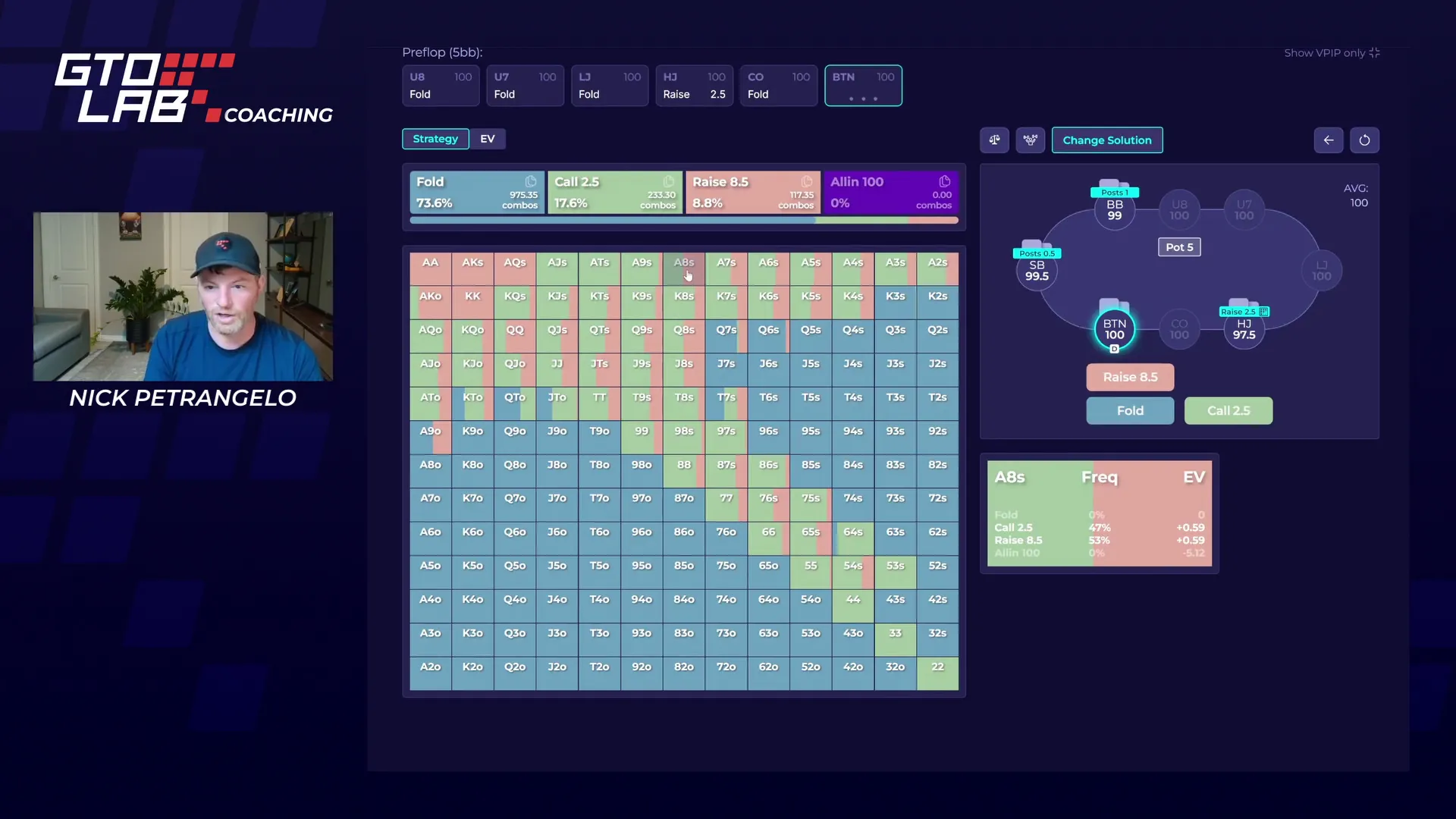
This is more memorable than a page of exact charts. You still need to know terms such as RFI, squeeze, VPIP and chip EV before starting. The explanations and prepared drills build strategic intuition from first principles, but they do not stop to teach beginner poker vocabulary.
Days 4 to 7 contain the most distinctive preflop work
The unequal-stack block is where the course separates itself from standard tournament training.
Dvoress shows why an 18bb button can sometimes min-raise wider into two stacks above 50bb than it could against equal stacks. The deeper blinds have to account for each other. Neither can attack the short opener without risking a larger confrontation with the other deep stack. The short stack can use that tension to enter more pots and rely less on open-shoving.
Add another very short stack to the table and the incentives change again. Limping can disappear because limp-folding against the shortest player is unattractive, while the remaining stacks tighten around the collision risk. Dvoress gives you a useful question to take to the table: which stacks constrain each other? That comes before choosing a limp, min-raise or shove.
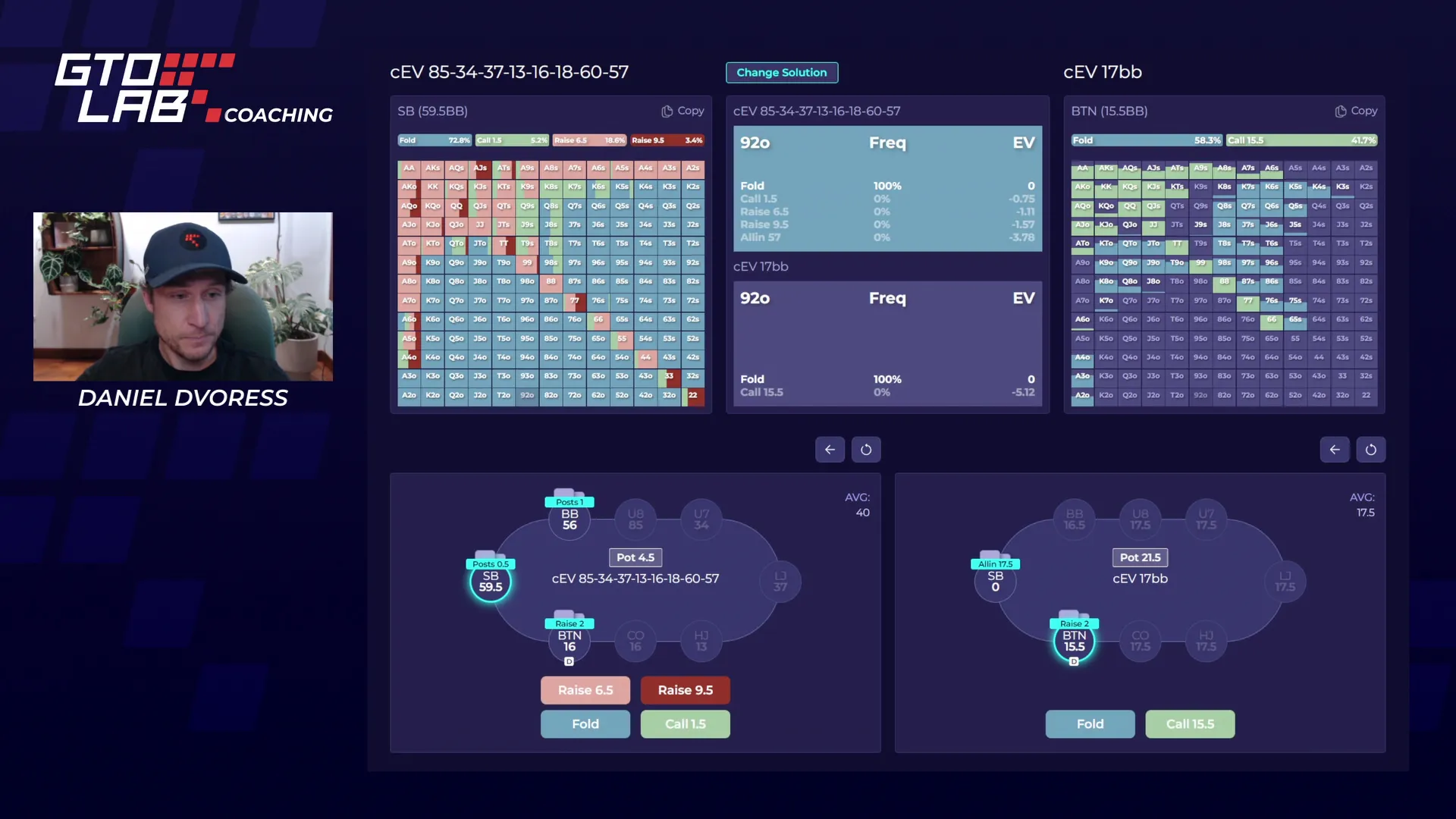
Equal-stack charts are convenient, but tournament tables are rarely equal. A sound short-stack button range can become wrong when the blinds are much deeper, or when a very short stack changes everyone’s incentives.
The selected unequal-stack simulations are there to be compared with familiar equal-stack spots. That comparison is more useful than memorizing another isolated chart.
Days 8 to 11 make ICM easier to use
The strongest ICM explanation arrives near the start of Day 8. Petrangelo reduces bubble factor, risk premium and ICM pressure to one practical question: how strong must a hand be before committing the stack?
That threshold shapes the ranges around it. Covered stacks lose freedom. Covering stacks gain pressure, but do not have to three-bet relentlessly to use it. A chip leader can flat in position and make a covered opponent play the flop under payout pressure.
The same distribution is examined with 300 players remaining and again with 177 when 150 are paid. The contrast shows that “near the money” is not a binary label.
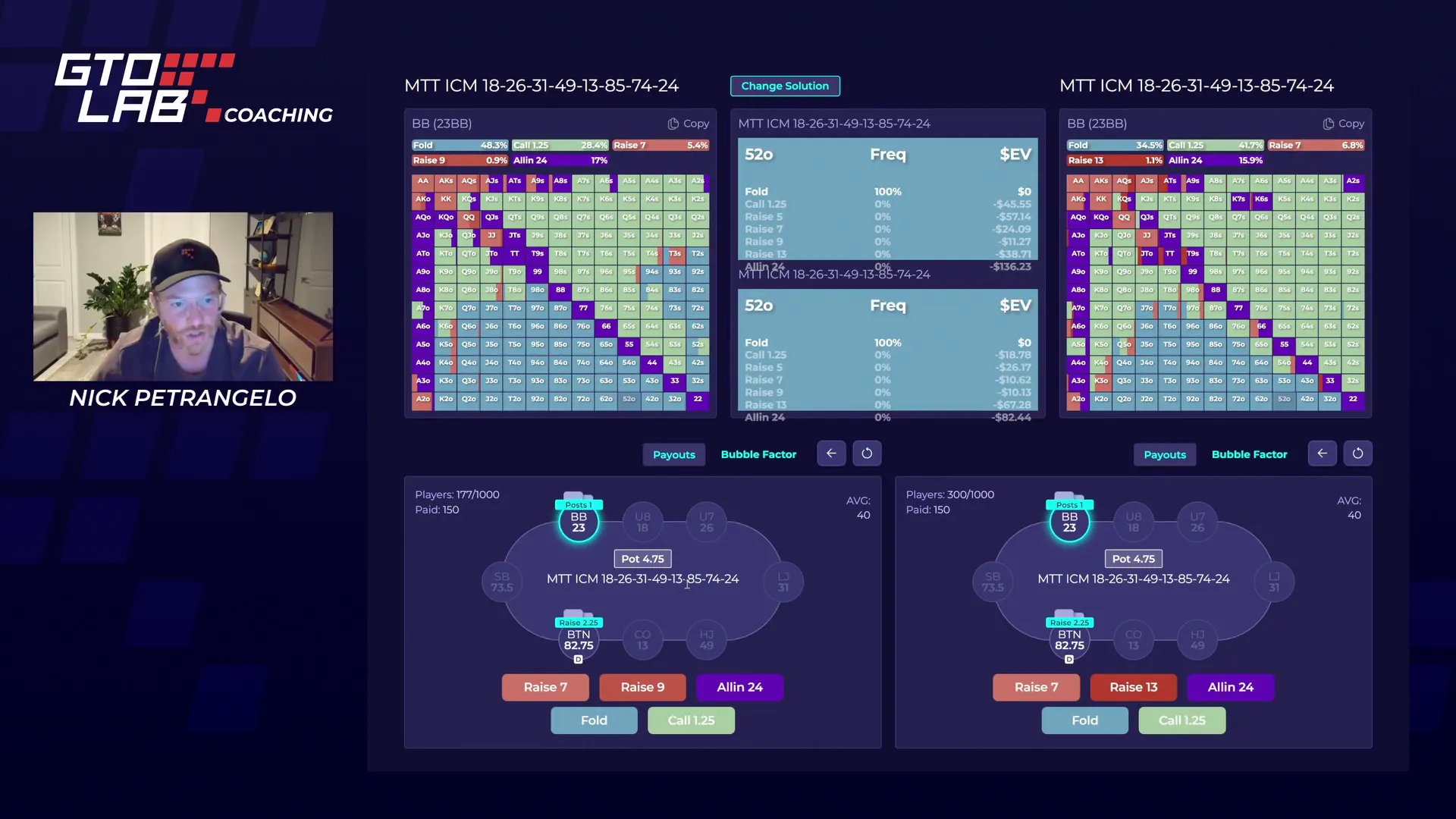
The explanation below brings those ICM terms back to the decision you actually face before the flop.
Once the hand-strength threshold is clear, the surrounding range discussion becomes much easier to follow.
Heath then carries the framework into long-handed and short-handed final tables. Using similar distributions helps isolate the payout effect. A stack that can apply pressure on the direct bubble may have a very different incentive at the final table, where every elimination creates another pay jump. He also stresses that being covered is not enough information. The size of the covering stack, effective depth and the rest of the range all change the answer.
The course also warns against becoming too tight merely because a tournament feels important. Some approaching-final-table spots stay close to chip EV until pay jumps and stack distribution create real pressure.
Days 12 to 20 connect preflop ranges to flop strategy
The postflop block begins with a rule that holds the section together: every flop strategy starts with the preflop ranges.
The lessons show why generic board rules fail. An early-position opener can hold a concentrated high-card and overpair range. A button arrives with more weak pairs and missed hands. On the same ace-high board, the early-position range may support more large betting while the button needs more checking.
Petrangelo uses aggregate reports to move from that range imbalance into board families. The reports are not treated as answers to memorize. They are maps for finding patterns, such as where the opener can use a polar large size, where a wide range needs protection from its own weak hands, and where an opponent’s capped range permits more pressure.
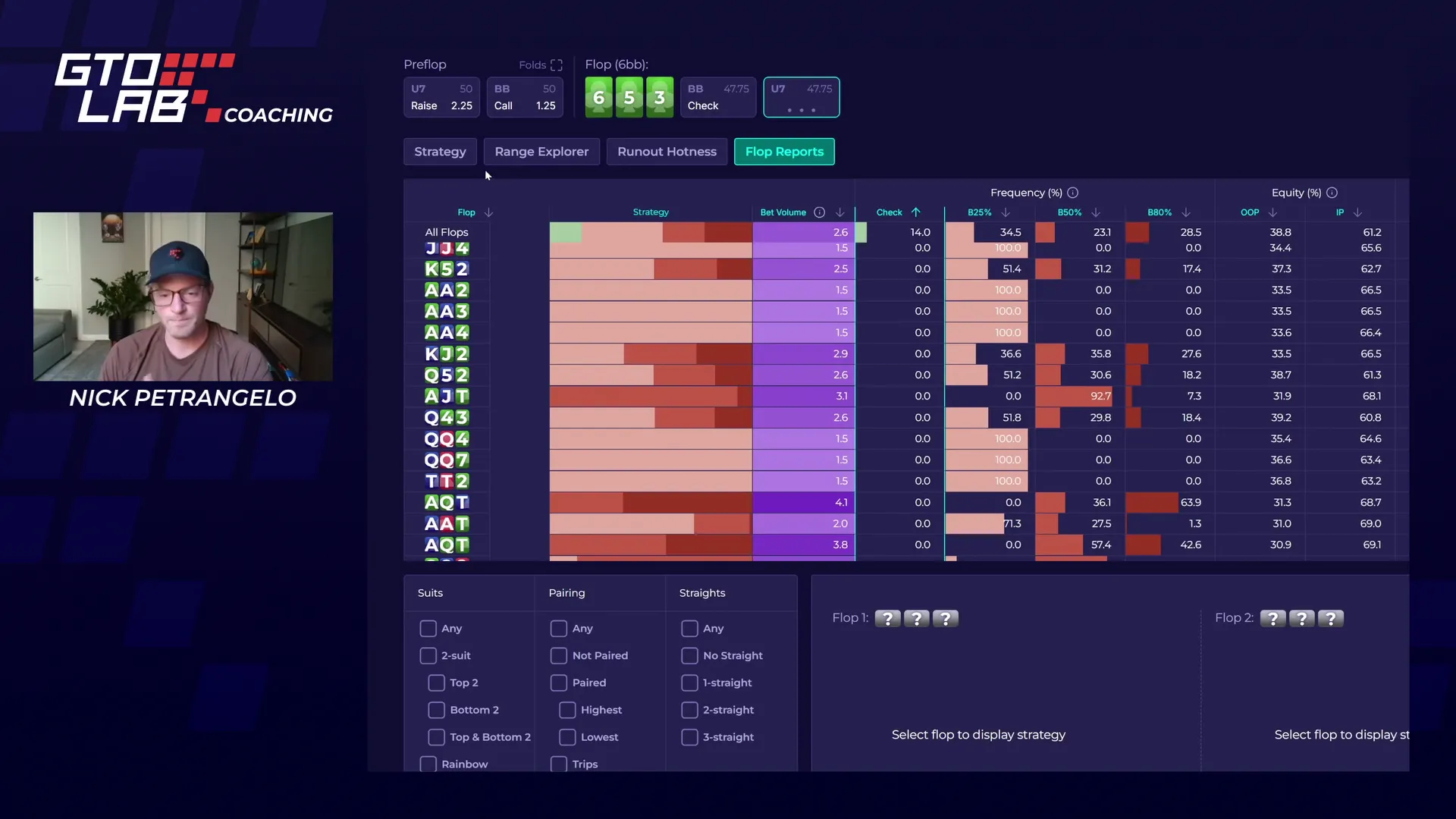
Heath shows why big-blind defense needs both check-raises and uncomfortable calls. On dry boards, weak backdoor hands may need to float because too few obvious draws can fill the continue range. At 30bb, some strong hands raise more readily because the money can go in over fewer streets.
Day 20 covers button flats against out-of-position raisers. Jaffe compares the opener’s premium pairs and offsuit broadways with the button’s small pairs and suited hands. He also stresses that understanding the strategy matters more than chasing a trainer score in the high nineties.
There is a clear limit here. Turns and rivers appear as consequences of the flop plan, with no dedicated days of their own. If you want a complete course across all streets, this does not go far enough.
Days 21 to 26 simplify three-bet pots
The final block uses the same process under lower stack-to-pot ratios: compare the preflop ranges, identify the imbalance, scan the aggregate report, then study representative boards.
Petrangelo turns population mistakes into clear responses. If a button three-bets loosely and c-bets too automatically, the out-of-position caller can answer with more flop calls and well-chosen check-raises.
Dvoress gives Days 23 and 24 a particularly effective structure. Three-bet-pot flops are grouped into heavy-check, heavy-small-bet, heavy-large-bet and complicated families. That creates a mental model before individual hands and frequencies are introduced.
One example shows why the middle of a range may raise while the top slow-plays. At a low stack-to-pot ratio, the strongest hands can get the money in later. Medium-strength hands gain more from immediate protection.
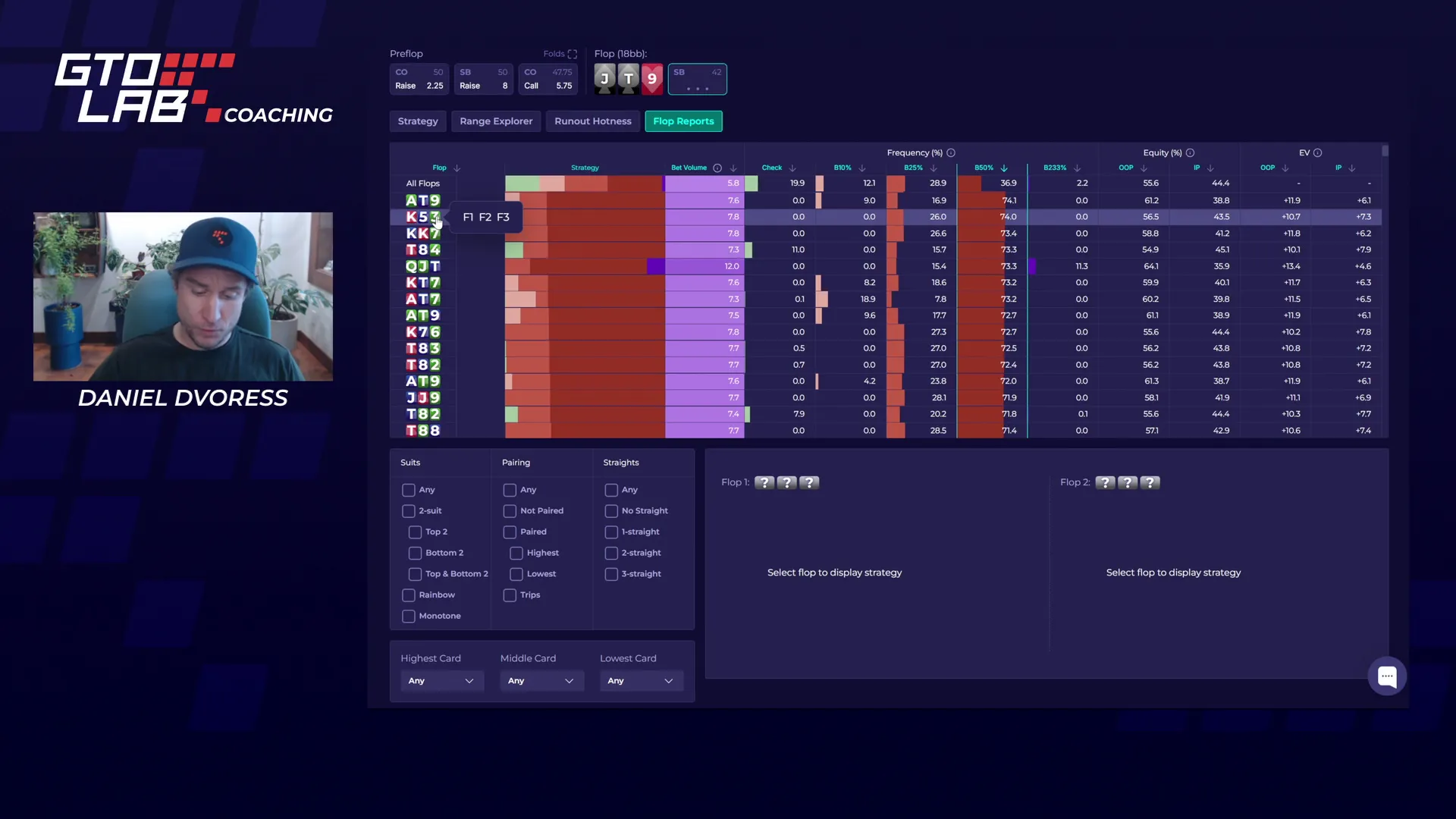
Dvoress explains the reason for those board groups below. Understand what the spot has in common with others before trying to copy its exact solver output.
That makes the individual hands and frequencies easier to place when they arrive later in Days 23 and 24.
The final lesson returns to real opponents. Calling can be aggressive when it keeps weak bluffs alive and creates a profitable later street. Raising is not the only way to pressure a range.
What should improve after the 26 days?
The strongest reason to follow the plan is the way it connects decisions that players often study separately. The later drills keep returning to questions introduced earlier:
- The preflop work explains how mixed ranges fit together. Knowing why a hand belongs in calls or three-bets gives you something to work from when the exact frequency is forgotten.
- Unequal stacks make you look at the whole table. The lesson asks which stacks constrain each other before looking at the hero’s big-blind count.
- The ICM lessons put a decision behind the terminology. Payouts, field position and covering relationships affect how strong your hand needs to be to commit the stack.
- Flop study starts with the ranges. The same board can demand a different strategy when the hands arriving at the flop change.
- Three-bet pots get a workable starting point. Board families give you a way into the spot before the coach adds individual hands and frequencies.
- An unfamiliar solver output becomes something to question. The explanations show why a size or action appears, so every strange answer need not become a new problem to memorise.
That is what the daily order does well. It keeps bringing you back to the variables that change a strategy, giving you a way to approach a new spot after the course ends.
The teaching is concise, but the presentation repeats
Most lessons run between 8 and 25 minutes. A coach opens with a strategic question, works through a small group of reports and sends you to a practice pack. There is little wasted time.
The trainer interface and range grids are readable. The presentation does its job, although looking at the same coach-and-software layout gets monotonous during a long session.
Following one day at a time helps. You spend less time staring at reports and more time working through the drill between lessons.
The different coaches and reports also help keep the software work understandable. Day 20 feels less closely tied to the rest, even though button flats deserve their place in the course.
The drills are part of the value, but not part of lifetime access
Each day gives you the same sequence to follow:
- Watch the lesson.
- Open the prepared training scenario.
- Practise the exact spot discussed in the video.
- Review mistakes and compare adjacent stack depths or position pairs.
- Discuss difficult decisions with coaches and the private community while Pro access is active.
The prepared scenario saves you the setup work. You can go straight from the coach’s explanation to making the decisions yourself.
The subscription clock matters if you study slowly. A day in the course may take several evenings to finish properly. Work out when you can use the included Pro month before buying, and check when that month starts. Lifetime videos give you time to revisit the explanations; they do not keep the paired practice available indefinitely.
But the practice links require an active Tools or Pro subscription, and the private Discord requires Pro. Lifetime access covers the videos. The included month gives you the full combination for a limited time; keeping the interactive part means continuing a qualifying subscription.
Understand the renewal and refund terms before buying
The 26-Day Training Plan purchase terms say the included Pro month renews automatically at the standard monthly price unless you cancel before renewal. Confirm the charge before paying. Cancelling leaves you with lifetime video access; drills need active Tools or Pro, and the private Discord needs Pro.
Existing members should check the change to their plan too. Pro members get another month. Tools members get a month of Pro, which continues at the standard Pro price unless they downgrade before renewal. Buying the course can therefore change the next subscription bill even if you already pay for GTO LAB.
GTO LAB lists the course purchase as non-refundable. Make the buying decision on that basis, not on the assumption that you can try the lessons and ask for the money back.
Is the GTO LAB 26-Day Training Plan worth $399?
Strong value for an active MTT player
If you play tournaments regularly and will use the paired drills during the Pro month, $399 is easier to justify. The unequal-stack work fills a common gap. The ICM explanations give payout pressure a practical meaning, and the flop lessons keep connecting boards to the ranges behind them.
Weak value for a passive viewer
Paying $399 to watch the videos in the background is much harder to defend. You lose the practice that follows each lesson. Let Pro renew unused and the bill keeps growing without adding anything to your study.
The wrong purchase for a beginner or non-MTT player
The coaches expect you to follow solver reports and mixed actions. They use stack-to-pot ratios, range composition and ICM without stopping to teach the vocabulary. If positions, pot odds or basic preflop ranges are still new, cheaper introductory material makes more sense. Cash and PLO players also have little reason to buy a course built around No Limit Hold’em tournaments.
Strong recreational players, low-to-mid-stakes regulars and aspiring professionals can get good value here if they will do the drills. Without that work, the $399 price is difficult to defend.
What to know before starting
Before starting, make sure you can already do the following:
- Read opening, calling and three-betting ranges without stopping to decode the notation.
- Follow terms such as RFI, chip EV, ICM, range advantage and stack-to-pot ratio.
- Set aside at least 45 to 60 minutes on most days for the lesson and practice.
- Save difficult hands and match them to the relevant part of the course.
- Use the included Pro month and decide about renewal before the next payment date.
You do not need every part of your routine in place. But if most of that list is unfamiliar, the plan becomes an expensive introduction to concepts you could learn more cheaply first.
A sensible way to use the 26 days
The official daily order is worth following. Give the practice its own time too:
- Reserve at least 30 minutes for the video and another 30 minutes for practice.
- Write one heuristic from each lesson in plain language.
- Complete the assigned drill before moving to the next day.
- Compare the drill with one neighbouring stack depth or position pair.
- Save difficult hands from live play and tag them to the relevant day.
- Return to Days 4 to 8 after the first pass. Unequal stacks and early ICM often affect the same decision.
- Make the Pro renewal decision before the next charge.
A perfect trainer score tells you little if you cannot explain why the answer changes. Use the practice to recognise those changes and avoid applying the right idea to the wrong kind of spot.
Who should buy it?
This is a good fit if most of these apply to you:
- You play No Limit Hold’em tournaments regularly, online or live.
- You understand standard preflop notation and basic solver output.
- You want a daily study sequence and a clear next task.
- Unequal stacks, ICM or common flop spots need work.
- You will use the prepared drills during the included Pro month.
- The course fee will not come out of money needed for poker or household expenses.
Who should skip it?
Save the money if any of these apply:
- Poker terminology and tournament fundamentals are still new to you.
- You mainly play cash, Pot Limit Omaha or sit-and-gos.
- You would watch the course without doing the paired practice.
- Your main priority is a complete turn-and-river course.
- You do not want a continuing Tools or Pro subscription.
Final verdict
GTO LAB’s 26-Day Training Plan answers a familiar problem well: you have plenty of poker material and no clear idea what to study next.
The strongest lessons justify that order. Unequal stacks affect the opening ranges, payout pressure changes the risks you can take, and those ranges carry into the flop work. The instructors make difficult solver reports useful by explaining how those decisions connect.
The continuing cost is the main reservation. You keep the videos for life, but the complete watch-and-drill experience needs a subscription after the included month.
That bill matters when you decide how much of the plan you will actually use.
For an MTT player ready to spend a focused month on the lessons and drills, this is a strong, unusually well-organised plan. As a video bundle to watch later, it is expensive.
Official course page: 26-Day Training Plan at GTO LAB (opens in a new tab)
Frequently asked questions
How much does the GTO LAB 26-Day Training Plan cost?
The course costs $399. It includes lifetime access to the videos and one month of GTO LAB Pro.
Does the free Pro month renew automatically?
Yes. The included month becomes a paid Pro subscription at the standard monthly price unless you cancel before renewal. Confirm the current amount at checkout; the course fee does not cover ongoing Pro access.
How long is the 26-Day Training Plan?
The course is designed for 26 daily sessions. Most video lessons take 8 to 25 minutes, with practice intended to follow each lesson.
Who teaches the course?
Nick Petrangelo is the main instructor. Daniel Dvoress, Ben Heath and Jonathan Jaffe also teach parts of the plan.
Is the course suitable for beginners?
Serious developing players can follow it once the fundamentals are in place. As a first poker course, it asks too much: range grids and mixed strategies appear alongside chip EV, ICM, stack-to-pot ratios and aggregate reports from the beginning.
What happens after the 26 days?
The course videos remain available for life. Access to the prepared practice scenarios requires an active Tools or Pro subscription, while the private Discord requires Pro.
Does it cover both live and online tournaments?
Yes. GTO LAB positions the course for both live and online tournament players. Most of the core lessons focus on stack distributions and range interaction that transfer between the two formats.
Does the course teach turns and rivers?
Turns and rivers are discussed as extensions of flop strategy, but the 26-day curriculum does not give them dedicated modules. The postflop section is primarily about flop c-betting, defending and building sound early-node ranges.
Can the course be refunded?
GTO LAB’s course-specific terms list the purchase as non-refundable. Do not buy on the assumption that there is a trial or a refund after watching.
Is the included GTO LAB Pro month important?
Yes. The videos can be studied on their own, but the prepared drills are a central part of the course. Pro also supplies the tools, wider coaching library and private Discord.
Disclosure
This review is independent editorial analysis. GTO LAB did not approve the conclusions. Short edited course excerpts are included for criticism and analysis. Poker carries financial risk, and training does not guarantee profit. Course fees and playing money should never come from funds needed for ordinary living expenses.