Poker course review
PLO Battle Plan review: is it worth a Crush Live Poker membership?
TerpHimself explains the decisions that trip up live PLO players, from multiway draws to playing a bigger stack. The teaching is useful, but some lessons take too long to get going.
PLO Battle Plan is a good course for the hold’em player who has moved into live Omaha and keeps getting into trouble after the flop. TerpHimself spends a lot of time on the decisions that cause it: calling with draws that won’t get paid, building a pot without a plan and treating a winning hand as proof of a good play.
His explanations are useful, particularly if your games have several callers and big differences in stack size. But he takes his time. Long introductions and repeated ideas make this harder to work through than it needs to be, and access comes through a recurring Crush Live Poker membership.
The verdict: PLO Battle Plan
Useful live PLO hand discussions, with too much talk before some lessons.
The good
Hand discussions explain multiway pots and changing stack sizes. The Kasey sessions help hold'em players understand why their usual thinking can go wrong.
The bad
Long introductions and repeated ideas slow the course down. One worked slide has an arithmetic error, and ongoing access requires a membership.
Built for the 1-2-5 game
Ryan Terpstra, better known as TerpHimself, teaches from the live cash games he plays. The course page describes him as a semi-pro with a day job, playing around the Midwest and Las Vegas.
The main setting is full-ring PLO around 1-2-5 to 5-5. Expect several people seeing the flop, straddles changing the size of the game and opponents who don’t all think alike. He assumes you know hold’em and the basic rules of Omaha before you start.
There are tougher live games later in the course, including a 25-50 stream. Those examples show how his advice changes against better players. They don’t turn Battle Plan into an advanced online PLO course, and he is upfront about that.
Four-way pots change the maths
The preflop material gives you a clear reason to stop bringing every attractive-looking hand along for the ride.
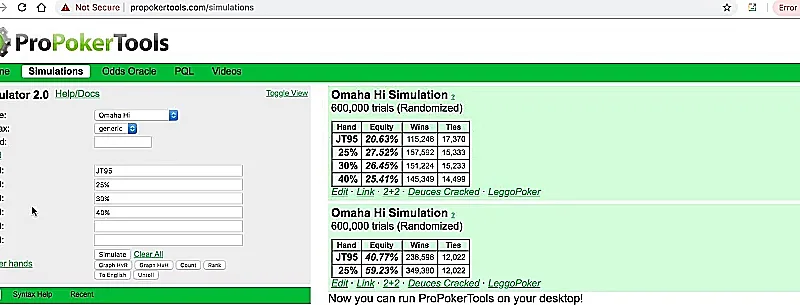
Terp compares the same connected hand heads-up and against several opponents. Its equity roughly halves in the example. He then explains why a draw can be even less useful than the percentage suggests: making a low flush doesn’t help much if the action comes from a higher one.
Aces get the same treatment. Their side cards and position matter, and getting a short stack in is a different decision from building a large pot while deep. The explanations help you see why a hand becomes awkward, which is much more useful than being told it belongs in a starting range.
There is a limit to that approach. This isn’t a chart-led course, so you won’t leave with a ready-made answer for every preflop situation. Terp asks you to judge how the hand will play in the game in front of you.
Calling now, getting stuck later
One of the strongest parts of Battle Plan is how often it follows a decision into the next street. A call can look reasonable on the turn and still leave you with no idea what to do on the river. Terp spends real time on that problem.
In Seeing Into the Future, he questions a bluff because the player won’t have enough left to put meaningful pressure on an opponent later. The player can talk about firing again, but the stack size doesn’t support the plan. Elsewhere, he asks whether a draw will get paid when it improves, and what happens if another player stays in.
These are useful explanations for someone who keeps thinking one bet at a time. He works through why the plan breaks down rather than just pointing at the losing decision. The drawback is the pace: one situation can take a long time to explain, especially when he goes back over the alternatives.
What changes after you double up?
From Short to Deep follows one of Terp’s own sessions as his stack changes. He starts short, builds it up, loses it and starts again. At different points he explains how he would play a hand with more or less money behind.
That is a good way to teach stack depth. You get to compare decisions within the same session instead of hearing a separate rule for each stack size. If you are comfortable getting a short stack in but start making expensive mistakes once you have more chips, this is a useful reason to consider the course.
It isn’t a complete mathematical guide to short stacking. Terp says that deeper treatment belongs elsewhere. The value here is hearing how he adjusts his decisions as the session changes.
The best habit here: question the pots you win
The bet-folding lesson has a particularly good example of Terp questioning his own play. He goes back over a river bet that won a pot and decides checking would have been better, because there were so few worse hands willing to call.
That makes the lesson more convincing than a string of successful bets. He is willing to question the decision even when the result gave him no reason to complain. For a player who only reviews the big losses, it gives a clear reason to look at the other hands too.
How he reads opponents
The Live Game Dynamics lesson shows why playing against a reckless opponent involves more than loosening up. Terp looks at how the other players react, including a tighter re-raising range and a deeper opponent who still has plenty to win in a side pot.
That is a familiar problem in loose live games. Everybody wants to play with the wild player, but you can still get yourself into a bad spot against somebody else. The course explains how the action around that player changes the decision.
His stronger-hand examples have some useful variety too. Although one lesson is called Please Stop Slowplaying, other hands explain why checking can keep an aggressive opponent betting. You get reasons for changing the play, rather than an instruction to bet every big hand.
The reads remain Terp’s judgments about particular opponents. Some rely on knowing the players and how they respond to pressure. That suits someone who regularly sees the same faces, but you can’t assume an unfamiliar opponent will react the same way. This is experience-led coaching, with equity calculations supporting parts of the discussion.
What studying it involves
Much of the course is Terp talking over slides or recorded hands, with ProPokerTools on screen for equity comparisons. Some lessons are podcast episodes. It has the feel of an ongoing coaching series, and the order of the modules isn’t the order in which everything was recorded.
The Kasey sessions are a helpful place to start if you know the rules but have only played a little PLO. Kasey answers questions before Terp explains his view, so you hear the hold’em habits that cause the confusion.
In one conversation, Kasey chooses what looks like a safe flop for a strong hand. Terp asks him to think about which worse hands could actually pay him. The discussion moves from being pleased with the hand to judging the action it can get. That exchange explains the idea more naturally than another slide telling you to make the nuts.
The maths lesson is also worth taking before the main preflop section. Later, a pause-and-decide lesson asks you to write down your play and reasoning before the answers are revealed. There are other study tasks, such as counting your own 3-bets across sessions, but you have to do the work yourself.
An equity calculator will help you follow up on the examples. ProPokerTools appears repeatedly, and Terp points to other teaching for learning the software. Don’t choose Battle Plan mainly because you want someone to teach you how to operate a solver.
A lot of talk
The biggest frustration is how long some lessons take to get going. Finding More Aggression opens with that week’s poker news and a home-game story before reaching the hands. Terp warns you about the detour and gives timestamps, but it is still a lot to sit through if you play the lesson from the beginning.
Other episodes open with pandemic-era news. Those discussions have little use now, and information about where games were running should be treated as history.
The strategy repeats as well. Planning the next street and taking value on the turn come back in several lessons, and one stream hand is reviewed more than once. A second explanation can help an idea sink in, particularly in the Kasey conversations. If you already understand it, though, the repetition slows things down.
The course would be easier to study with shorter introductions and less going back over the same ground. That matters with a subscription, because the amount of material is only a benefit if you have time to use it.
Check the numbers
There is a clear arithmetic problem in When Right Can Be Wrong. A slide reworks a hand with larger bets but keeps the original effective stack. The bets add up to more money than that stack contains, so the proposed line cannot be played as printed.
The discussion about missed value is still worth following, but that example needs correcting. It is a reason to check the worked figures before using them in your own study.
Moving over from hold’em
If Omaha itself is new to you, PLO Launch Pad is the easier first step. It starts with the rules and offers a one-time purchase with lifetime access. Battle Plan makes more sense once you can follow a PLO hand and want help with the situations in your live cash games.
For tournament study, look at the Crushing PLO Tournaments review. The cash-game decisions in Battle Plan don’t replace tournament-specific teaching.
What it costs
PLO Battle Plan is offered through a Crush Live Poker membership. The Premium plan is advertised at $54.99 a month for training videos and coursework. Elite is $549.99 a year and includes Premium’s material plus Top Section podcasts.
Basic costs $27.99 a month, but its description covers audio and free material. Don’t treat that as the full video-course price: the feature lists underneath the plans repeat the same items despite those different descriptions. Before subscribing, confirm that your chosen plan includes PLO Battle Plan.
At the advertised Premium rate, two months cost $109.98. That is reasonable for a live PLO player who wants to work through the hand discussions. The cost keeps rising if you leave the subscription running, though, and there is no advertised lifetime-access purchase for this course.
The published terms say to cancel at least 10 days before monthly renewal. They also say payments are non-refundable, with no credit for a partially used period, although discretionary refunds may be offered. Access continues through the period already paid for.
A monthly plan is the smaller commitment if Battle Plan is your main interest and you expect to finish it in a few months. Annual access is harder to justify in that case. It becomes more relevant if you want to study for most of the year or keep using the wider library.
Final verdict
PLO Battle Plan is worth considering if you know Omaha’s rules but struggle with the decisions in live cash games. Its best explanations follow a hand beyond the immediate bet and show how the other players or the remaining stacks change what you can do.
The Kasey sessions make it easier to see where a hold’em player’s thinking goes wrong. The short-to-deep session adds something useful for players who struggle once their stack grows, and Terp questioning his own winning hands is a good example of how to review a session.
There is too much talk before some of the teaching, and the worked arithmetic needs more care. If you prefer concise lessons and ready-made charts, this will probably frustrate you. It also isn’t the right purchase for online solver study or tournament PLO.
For the live player who enjoys working through hands with a coach, the course has plenty to offer. Allow time to pause the examples and work out your own decisions before Terp gives his answer.
Official course page: PLO Battle Plan at Crush Live Poker (opens in a new tab)