Poker course review
Simplifying Solvers review: is Phil Galfond’s course worth $999?
Simplifying Solvers teaches experienced players how to turn solver output into usable poker decisions. The framework is practical, but six hours of video, a short PDF and a bare notebook leave the $999 price exposed.
A practical method for studying solver output
Open a solver without a plan and the session quickly turns into grid watching. One hand bets 72 percent, another checks 41 percent, three sizes appear in the same node, and an hour later there is still no strategy that can be used at the table.
Simplifying Solvers is Phil Galfond’s answer to that mess. He starts with the value range and cuts the tree down to a size you can actually play. Working backwards from the river gives the decisions an order, with a rule to keep after the screen is closed.
The verdict: Simplifying Solvers
A clear process for turning solver output into playable rules.
The good
Intermediate and advanced players who already use solvers but struggle to turn the output into clear, playable rules
The bad
You need a beginner course, software instructions, preflop charts or a ready-made strategy for one format
That process is the course. You get 6 hours, 20 minutes and 7 seconds of video, a 10-page PDF and a mostly empty study notebook for $999. Solver access costs extra. You need to be an experienced player already using solvers for this way of organising the work to make sense.
For a broader training library, see the Upswing Lab 2.0 review. For decision making and mental structure away from solver work, the Mechanics of Poker review is the closer comparison.
Course access and supporting material
The course contains 20 lessons totalling 6:20:07, built around the central framework and guided study sessions. The GTO Basics PDF and public Notion notebook support that work. A purchaser-only AI assistant is also advertised as an extra. The teaching needs to justify the price without relying on that promise.
What is inside Simplifying Solvers?
| Section | What it covers | Verdict |
|---|---|---|
| Introduction, 2 videos, 24:43 | Goals, prerequisites and an executable strategy | Clear about what the course can and cannot do. |
| Core framework, 8 videos, 2:09:35 | Value First, Sizing First, River First, frequencies, defense, mixed strategies and BRAIN | The best section and the basis for everything that follows. |
| Aggressor study, 3 videos, 1:39:51 | Guided flop, turn and river analysis | Detailed, but focused on a narrow group of cash spots. |
| Defender study, 3 videos, 1:23:05 | Continue and raise thresholds across all three streets | Thresholds are easier to retain than solver grids. |
| Application, 4 videos, 42:52 | Study routines, drilling and extracting heuristics | Strong drilling work with some general productivity advice. |
| Extras | GTO Basics PDF, Notion notebook and advertised AI assistant | Useful support, but too thin to change the value calculation. |
Almost all of the video time is useful. It is still a small library for a four-figure price. Galfond’s way of studying has to be worth the money to you, because you are not buying a large collection of solved spots.
The three lessons that carry the course
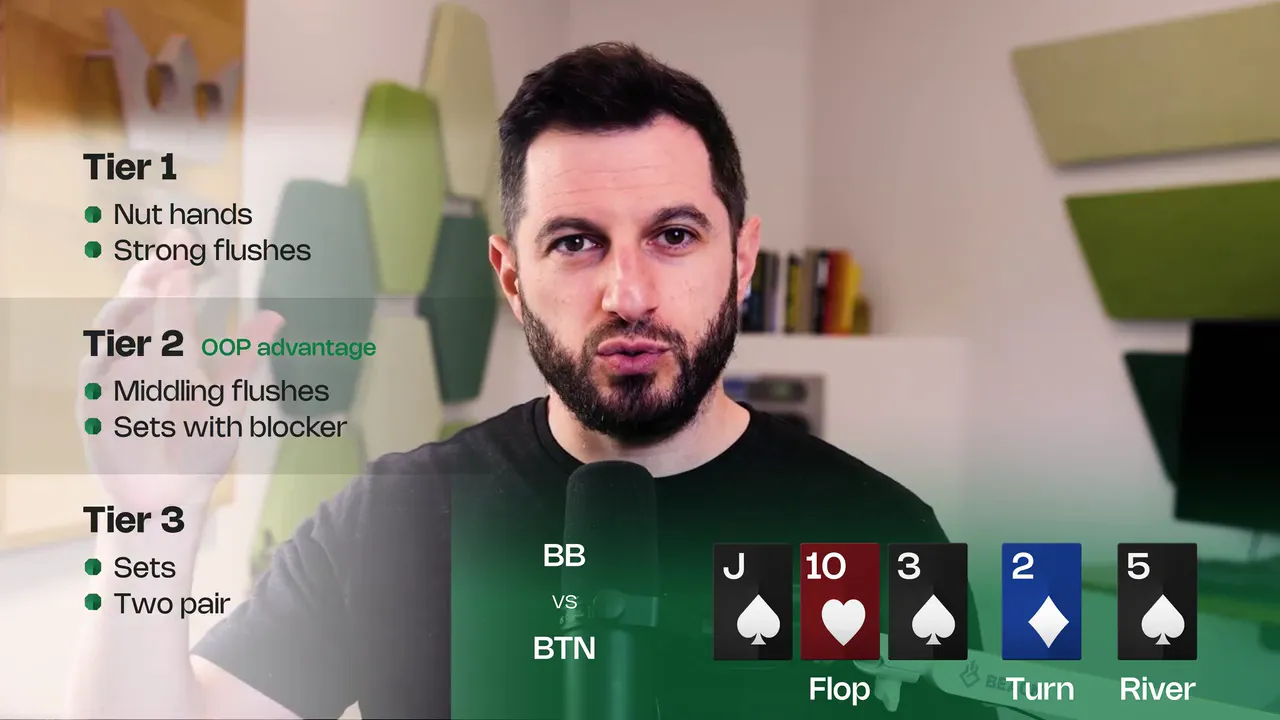
Value First
The first useful rule is simple: identify the value range before worrying about bluff frequencies.
The rule is basic, and that is the point. Clicking individual hands and memorising mixed frequencies creates facts with no structure. Starting with the value threshold shows which hands want to put money in, where thin value begins and what the bluffs support.
Galfond connects that threshold to future streets too. A large flop bet can look clean while leaving the range short of strong hands on later runouts. The range still has to work when the board changes. That idea travels well between games and formats.
Sizing First
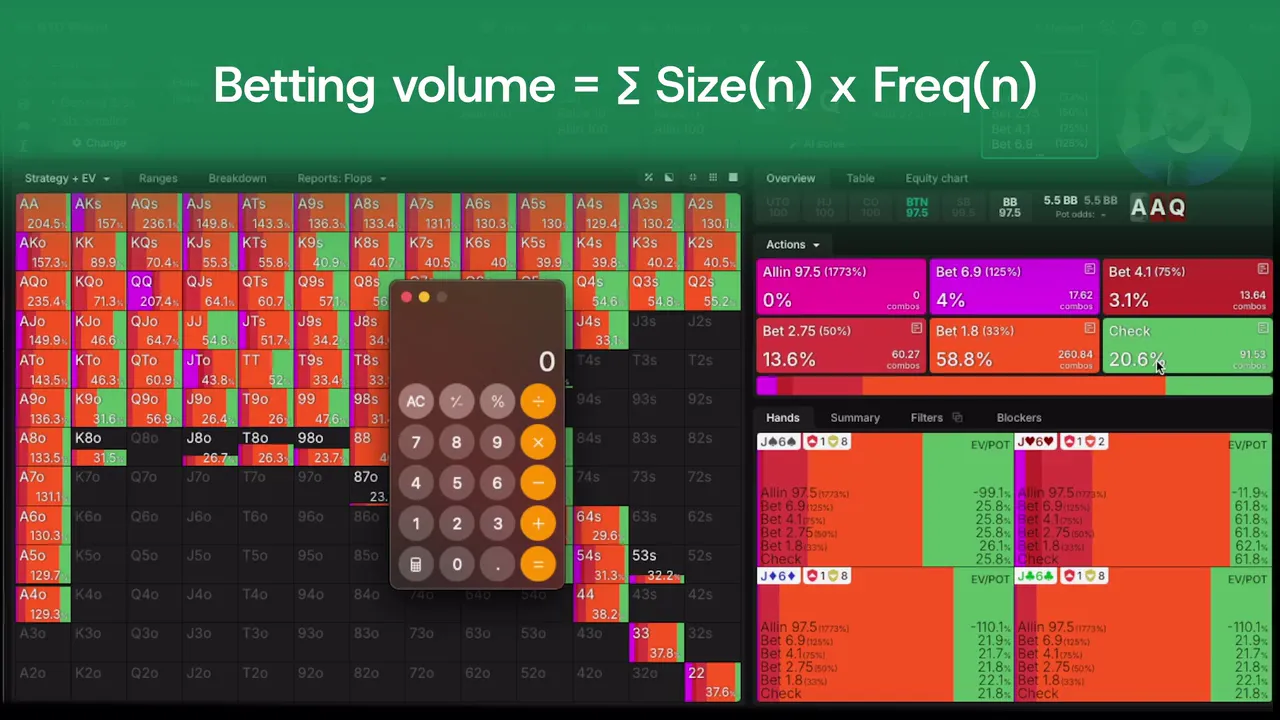
The sizing lesson introduces betting volume, one of the course’s most practical tools. Galfond compares the average amount placed into the pot by a multi-size solver strategy with a simpler strategy that uses one size.
Betting volume does not prove that two strategies are identical. It is a quick first check. If the simplified version invests a similar amount, the next step is finding the hands and runouts where it breaks. That beats copying three sizes just because the solver displays them.
Galfond’s point is practical: one size can be executed more reliably than a complex mix.
River First
River decisions are cleaner because there are no future cards. Galfond uses that fact to work backwards. First establish which hands can value bet and which hands must defend on the river. Then use those ranges to make sense of the turn, followed by the flop.
This gives pot odds, minimum defense frequency and range composition a practical job. MDF supplies a model baseline. Reads, rake and population tendencies can still change the decision.
These three lessons are the core of the course. Their value is highest for players who do not already study in this order.
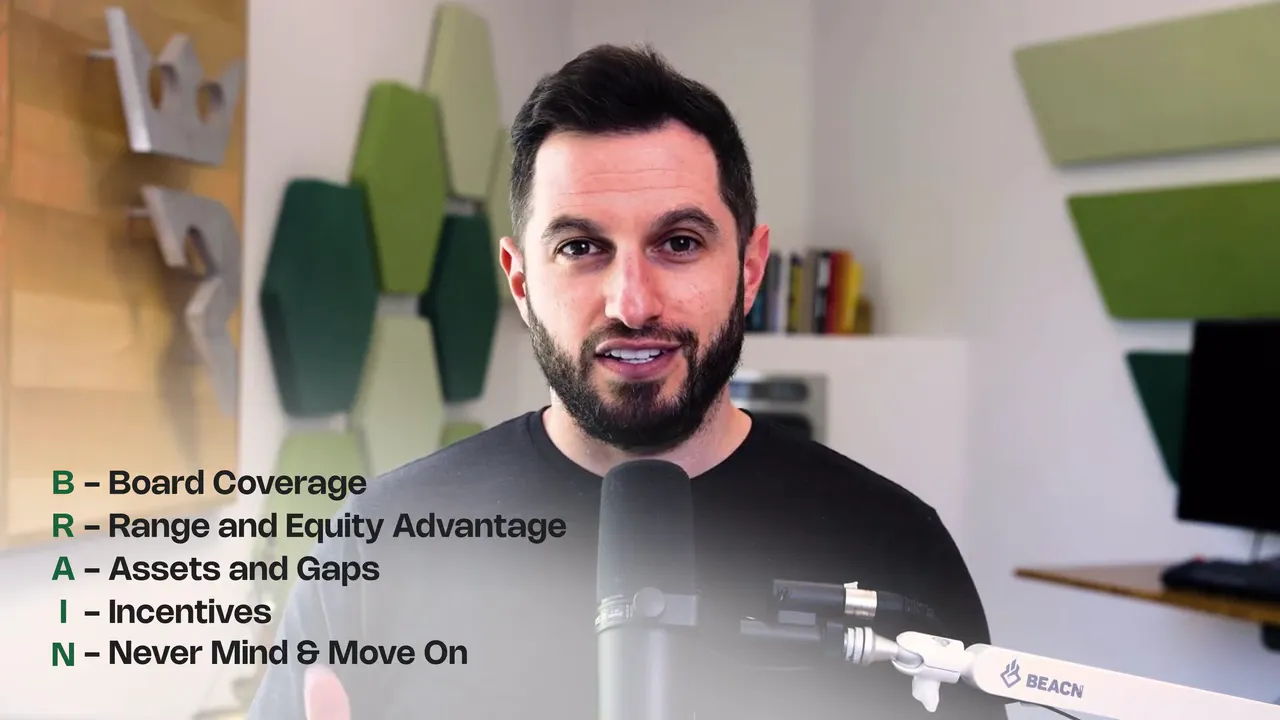
BRAIN puts the study questions in order
BRAIN is used when solver output looks strange:
- B, Board coverage: Which future runouts become exposed if a range leaves out this type of hand?
- R, Range and equity advantage: Which player owns the strongest hands, and which player has more equity overall?
- A, Assets and gaps: Which hand classes are plentiful or missing from each range?
- Incentives: Which response does an action encourage or prevent?
- N, Nevermind and move on: Is this unusual node worth any more study time?
The first four prompts organise the investigation. The fifth stops obscure nodes from wasting the session.
What happens in the guided study sessions
The six street-by-street walkthroughs show you how Galfond does the work. They give you a process to use on other hands, with a much smaller set of ready-made answers than a strategy database would provide.
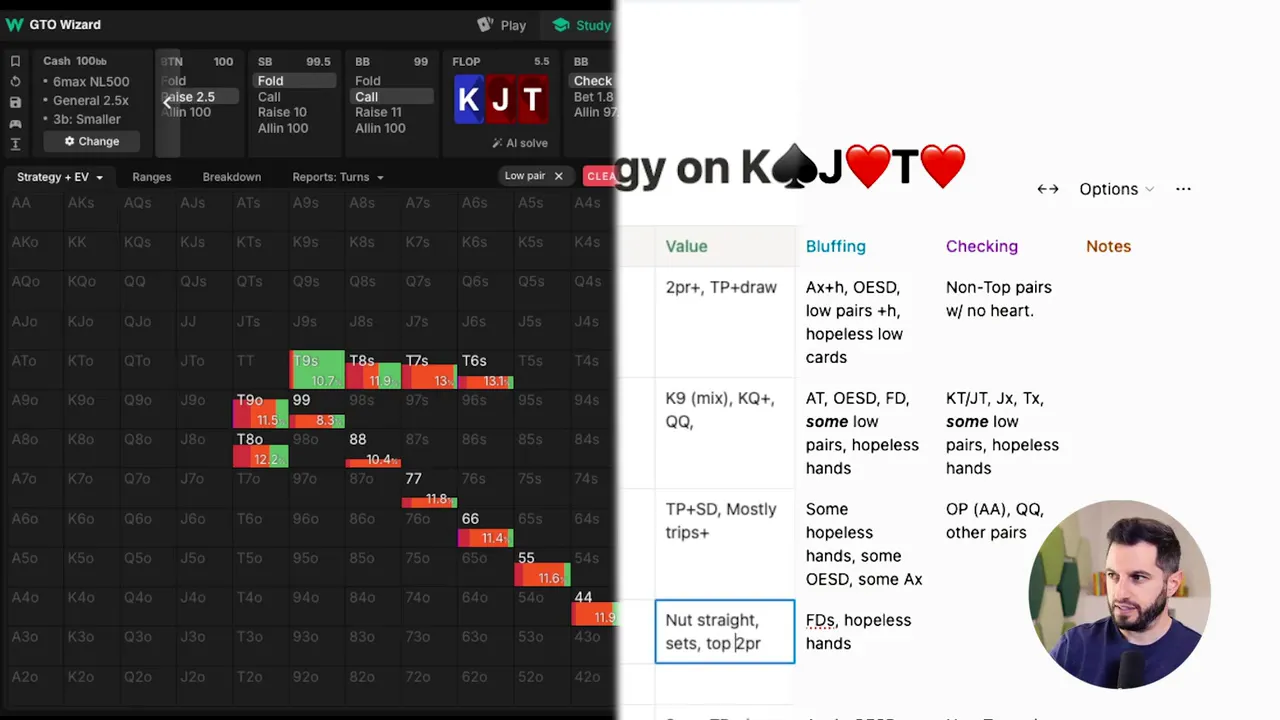
As the aggressor, Galfond starts with a connected button versus big blind flop and searches for a simpler full-range or one-size approach. Turns are grouped into useful buckets instead of treated as unrelated cards. The 55-minute turn lesson shows the actual work: compare reports, locate the value threshold, separate unusual cards and revise the first idea.
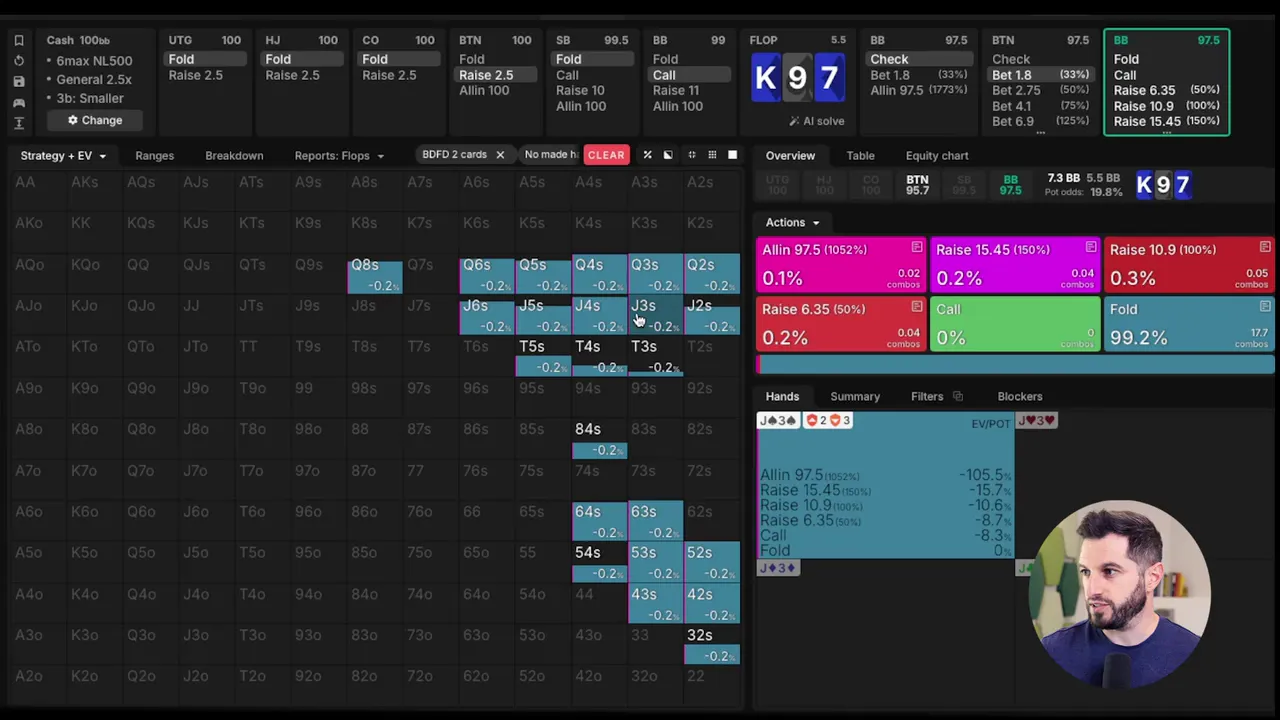
As the defender, continuing thresholds come first, followed by value raises and then bluff raises. The test is repeated against different sizes and board types. That order is easier to recall than a coloured matrix of exact combinations.
Galfond leaves in the failed guesses and redrawn categories, including mixes he decides to discard. That is useful, although the longer videos still meander. Most examples stay close to single-raised cash pots, often button versus big blind. You will need to do the work on other positions yourself, and the sessions do not supply a tournament plan.
NLHE and PLO are both present, but coverage is not equal
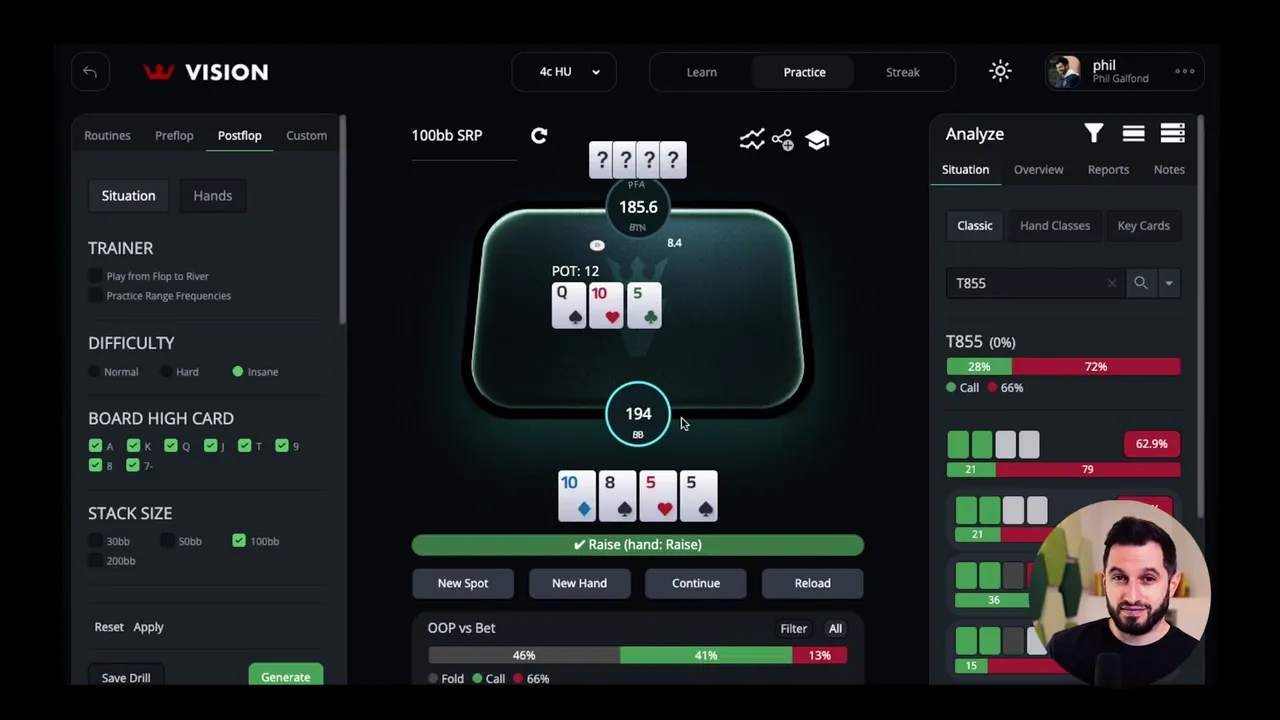
The course uses GTO Wizard and Run It Once’s Vision trainer. Its main ideas apply to No Limit Hold’em and Pot Limit Omaha: start with value, simplify sizes and leave with a rule that survives outside the solver.
Many central walkthroughs use NLHE cash examples. PLO appears in parts of the drilling and heuristic work, and Galfond’s Omaha background shapes the discussion of range percentages and combination classes. Neither game gets a complete strategy course here.
If you study both games, being able to use the method in each is valuable. If you need a complete NLHE strategy, a PLO curriculum or a tournament solution, too much will be left for you to fill in.
Drilling is the strongest application lesson
The drilling lesson is especially good at slowing down after a surprising trainer answer. Galfond opens the range and compares related hand classes to find what changed the decision. You leave with a rule for the next hand instead of simply trying to protect a high trainer score.
“Pulling Heuristics” continues that work. Examples include bluffs drawn from the bottom of a wide range instead of the prettiest blockers, and severe river folds created by a polarized line.
“Optimizing Study Sessions” is weaker. Flow, curiosity and energy management are reasonable subjects, but they are general productivity advice. Fortunately, the lesson is brief.
The extras are thin
GTO Basics PDF
The PDF is 10 pages, including the cover. It explains GTO through rock-paper-scissors, develops an AKQ toy game, covers indifference and pot odds, and finishes with MDF, 1-alpha and a bet-size reference table.
It works as a quick refresher. There is not enough here for a deep game-theory guide, and some beginner-friendly wording needs care. “Unexploitable” can easily be read as “cannot lose.”
Notion study notebook
The notebook uses a sensible loop:
- Record a hypothesis before opening the solver.
- Compare that idea with the output.
- Write down a simplified strategy and a takeaway.
- Repeat across boards and positions.
The public template gives you a placeholder task list, quick links and empty Hero versus big blind areas for BTN, UTG, CO, SB and MP. There is no completed example to show what good notes look like. The headings and study loop are sensible, but every example and conclusion has to come from you.
Custom AI assistant
Run It Once advertises a custom AI assistant for explanations, questions and quizzes based on the course. Those listed features alone do not establish how useful its help will be.
The lessons and study method need to justify the price. Treat the advertised assistant as an extra when deciding whether to pay for the package.
Buyer feedback is positive but scarce
Public feedback is limited. The most substantial independent comment came from a self-described NL50 to NL100 cash player who had nearly completed the course. The buyer said it changed both solver study and hand review, praised the extra explanation behind the outputs and called it the best course they had purchased. The same comment noted that it was their only premium course near the $1,000 level.
That comment fits the course’s main strength, but it is still one detailed buyer’s opinion. Most other search results repeat the sales page or lead to sites selling unauthorized copies. There is little independent feedback to add to the buying decision.
Is Simplifying Solvers worth $999?
For most poker players, no.
The $999 price makes most sense if you already spend hundreds of hours in solvers and keep leaving without usable conclusions. Even then, you have to build the strategy yourself. The notebook does not contain Galfond’s own completed heuristics, and solver access costs extra.
At lower stakes, $999 could instead cover months of software, a database review, targeted coaching or a broader training library. This course only competes with those options if the way you study is the problem holding you back.
Before spending that money, watch the sample lesson on the Run It Once course page. Then try the approach on one spot in the solver you already use. Can you explain a decision more clearly afterwards? That is a better buying test than whether the displayed strategy looks impressive.
Run It Once says the system can cut study time in half and simplify without losing EV. The lessons give reasons to expect a more efficient routine and sensible simplifications. They do not establish a universal number: time saved depends on your old routine, and EV lost depends on the spot and the simplification you choose.
Who should buy it?
Consider it if most of this sounds familiar:
- You regularly use GTO Wizard, PioSolver, Vision, MonkerSolver, Octopi or a similar tool.
- You already understand ranges, equity, pot odds and equilibrium concepts.
- You save plenty of solver screenshots but come away with too few useful conclusions.
- You want a way of studying that can be used in both NLHE and PLO.
- Your volume or stakes make more efficient study worth paying for.
- You will run more boards and positions once the videos finish.
Strong live players can use this work to build a baseline before adjusting to a pool or opponent. You still need to spend time in a solver away from the table. Anyone looking for help reading live players needs a different course.
Who should skip it?
Save the money if any of these apply:
- Core postflop concepts are still new to you.
- You do not have access to a solver or trainer.
- You need help setting up and using the software.
- You want charts, mass-data exploits or a ready-made game plan.
- Tournament ICM is your main study priority.
- You rarely study and expect the videos to do the work for you.
- Spending $999 would put pressure on your poker bankroll or household budget.
Run It Once directs complete beginners to its Foundations material. That is the correct starting point.
Final verdict
Simplifying Solvers gives a clear order to work that can otherwise go nowhere. Find the value threshold and choose a simpler size. Then reason backwards from the river and test the idea in a drill until there is a rule you can use.
Galfond teaches that routine very well. At $999, the six hours of video, 10-page PDF and bare notebook leave little else to justify the price. You have to be a serious solver user with a real problem in how you study.
For that player, the method deserves attention. For most others, the value is weak.
Official course page: Simplifying Solvers at Run It Once (opens in a new tab)
Frequently asked questions
How much does Simplifying Solvers cost?
On October 6, 2026, Run It Once listed the course at $999 with lifetime access. It is sold separately from the site’s video subscriptions. Check the current price and terms before buying.
How long is the course?
The 20 videos total 6 hours, 20 minutes and 7 seconds. Run It Once describes the course as more than six hours across 20 videos.
Is a separate solver required?
Yes. The framework can be used with different tools, but the study work requires access to solver output. GTO Wizard, Vision, PioSolver, MonkerSolver, Octopi or a similar product must be obtained separately.
Does it teach GTO Wizard or PioSolver?
No. The videos use tools including GTO Wizard and Vision, but do not teach installation or software operation. Basic familiarity with ranges and reports is expected.
Is it for NLHE or PLO?
Both. The framework works across the two games and examples draw from Hold’em and Omaha tools. It is not a complete strategy curriculum for either format.
Is it useful for tournament players?
The study process carries over, but most examples are cash-game spots and the course does not include a full ICM framework. Tournament specialists must add stack-depth and ICM work separately.
What is the BRAIN framework?
BRAIN stands for Board coverage, Range and equity advantage, Assets and gaps, Incentives, and Nevermind and move on. It is a checklist for investigating solver output that initially looks wrong.
What extras are included?
Run It Once advertises a game-theory PDF, a study notebook and a custom AI assistant for purchasers. The PDF is a 10-page primer, and the public Notion notebook is an empty study template. The advertised assistant should be treated as an extra in the buying decision.
Sources
- Official Simplifying Solvers course page
- Run It Once plans and pricing
- Phil Galfond’s official Run It Once activity and lesson listings
- Phil’s Challenge Q&A: Simplifying Solvers
- Independent buyer discussion on Reddit
- Matching Two Plus Two discussion
- The complete 20-video course, GTO Basics PDF and live linked Notion notebook
Disclosure
This review is editorial analysis, not a promise of results. Poker is a skill game with financial risk, and even strong study does not guarantee profit. Do not spend course or playing money that cannot comfortably be lost.