Poker course review
Carrot Poker School review: are Grades 1, 2, 3 and E worth £1,299?
Carrot Poker School connects cash-game foundations, advanced theory and population exploits across Grades 1, 2, 3 and E. The reasoning and written exercises stand out; long lessons, solver needs and a substantial study workload make it a selective purchase.

A connected curriculum with a serious workload
Carrot Poker School builds from basic no-limit hold'em cash-game decisions into advanced theory and population exploits. Its strongest feature is the way Clarke compares actions and explains why one performs better. You get a reason for the decision that goes beyond a solver colour.
The lessons are long and full of slides, and the school has a lot of its own language to learn. Homework adds a substantial commitment outside the videos. You also need to check whether the population conclusions fit the games you play.
The verdict: Carrot Poker School
A connected cash-game school, from foundations to advanced theory and population exploitation.
The good
a consistent teaching language carried from basic decisions into range construction and exploits.
The bad
the full package asks for a serious study commitment before that language becomes useful at the table.
Carrot Poker School is not really a bundle of poker tips. It is a cash-game school built around a much better question: why is one decision actually better than the alternatives? Pete Clarke starts with the difference between equity and expected value, then builds a vocabulary for strategy that carries through to advanced play and population exploits.
The four grades make the most sense as one long progression. Grade 1 pulls apart a lot of the flimsy reasons players give for betting, while Grades 2 and 3 get much more precise about ranges, sizing and defence. Grade E then asks what happens when that theory meets the things real player pools actually do.
Expect to work through the school carefully. You will get more from it if you are happy to pause lessons, write out answers and return to difficult spots. If you want a few preflop charts, short daily videos or a tournament system, this is a pretty awkward fit.
What is included in the four-grade school?
Carrot Corner advertises 43 videos and more than 40 hours of material across Grades 1, 2, 3 and E. Grades 1 to 3 each combine theory lessons with exam feedback, while homework and a community Discord are also advertised. That is already a large package, and the work outside the videos makes it larger still.
| Section | Main focus |
|---|---|
| Grade 1 | Equity, EV, reasons for betting, calling, board texture and basic blockers |
| Grade 2 | Range construction, sizing, bluff catching, raising, position and 3-bet pots |
| Grade 3 | Mixed strategies, advanced blockers, extreme sizing and 3-bet and 4-bet pots |
| Grade E | Population tendencies, bluff catching, exploitative sizing, raising and 3-bet pots |
| Exercises and exams | Written explanations, comparison of alternatives and feedback on the reasoning |
The order and connection between those grades matter more than the headline number of hours. When a subject comes back, it is not just the same lesson in a slightly fancier shirt. Grade 1 establishes why a value bet exists, and the later grades connect that foundation with range sizing, balance and practical adjustments.
That continuity is useful, but buying every grade may still be an inefficient answer if your foundations are sound and you only need to fix one leak. The order is also more flexible than the numbering makes it look. Clarke recommends learning at least Grades 1 and 2 before Grade E, but says Grade 3 is not required if you already have the theoretical base for the population material.
Grade 1 asks why the decision works
The first equity lesson makes you stop the video, answer true-or-false questions and explain each answer. It quickly separates hypothetical showdown equity from the money a particular action earns over the rest of the hand. A later river example shows that a profitable bet can still earn less than checking, which is a useful slap on the wrist for anyone who calls every positive-EV play a good decision.
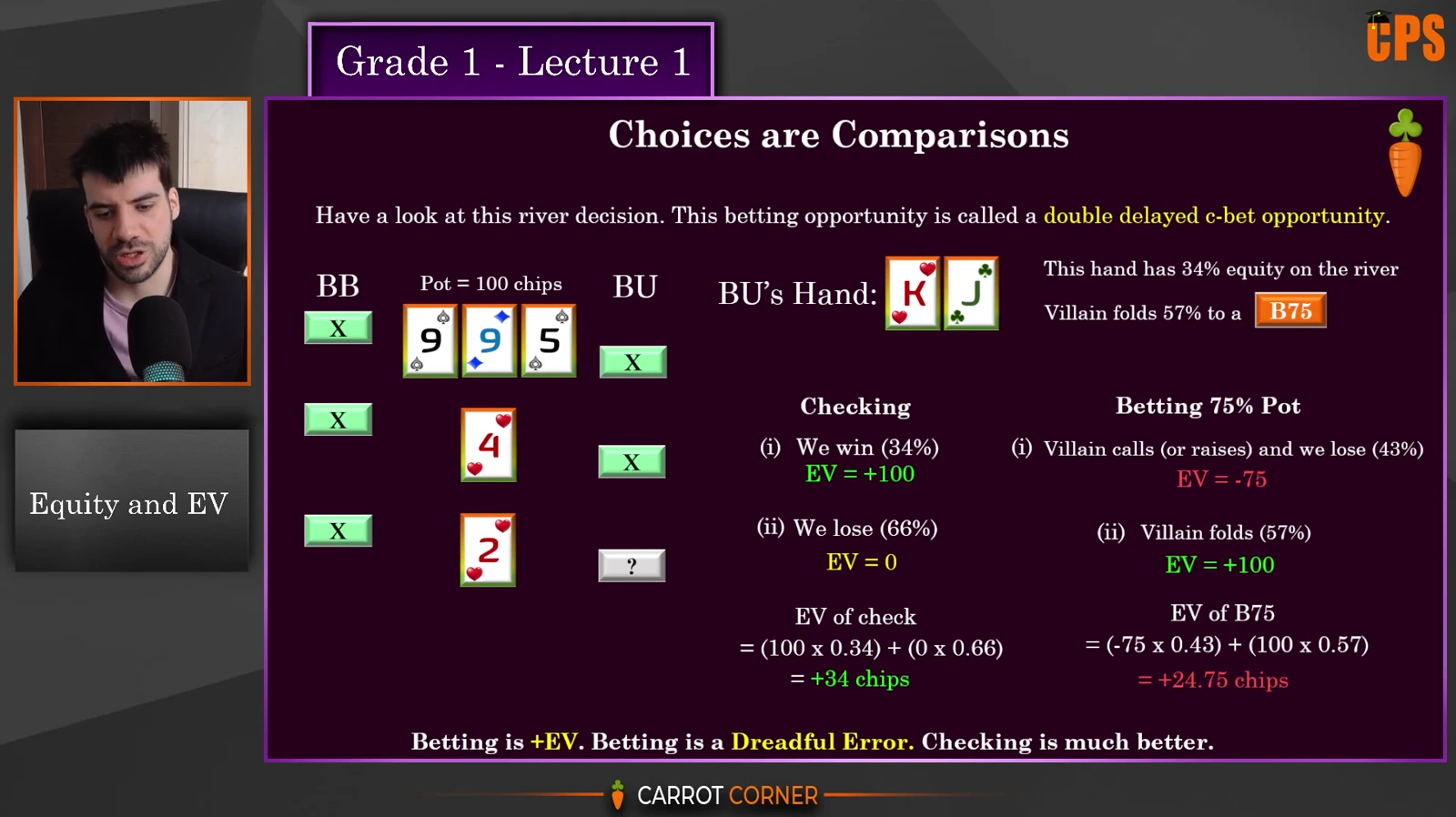
The value-betting and bluffing lessons keep pushing the same discipline. Keeping the initiative, representing a strong hand or making one better hand fold might sound persuasive at the table, but none of it settles the decision. You still have to compare the alternative action and account for the rest of the opponent's range.
Blockers arrive fairly late in the introductory sequence, and that is a good choice. Clarke warns against letting one small removal effect overrule bigger questions such as range advantage or whether the opponent is actually willing to fold. Grade 1 is therefore harder than the name suggests: knowing the rules of hold'em is not the same as being comfortable with range-based explanations, or with admitting that a nice result came from a poor decision.
Grade 2 turns hands into a full strategy
Grade 2 stops treating one hand as though it exists in a vacuum. It asks what the earlier actions have done to both ranges and uses that information to make the next decision, which is far more useful than collecting another default bet size. The opening work also shows why checking behind does not automatically leave a weak range, and why two checks can mean different things when the action before them has changed.
The sizing material follows the same logic. It builds sizes around different strengths of value hand, then finds the bluffs that belong beside them. A delayed-bet example shows why a familiar default size may disappear from a solution. The explanation makes clear why the remaining options fit that range.
None of these toolkits work without an opponent. Some simplifications depend on the other player raising often enough, while a very passive opponent can give you a reason to put more money in with strong hands. The bluff-catching work makes the same point about solver setup: change the sizes available to one player and different hands can reach the next decision. That is a lot healthier than treating every equilibrium output as though it came from one universal poker table.
The out-of-position material also shows why two individually strong hands can prefer different actions, depending on what worse hands remain and how the opponent is likely to respond. You do not need to memorise which set slowplays in one model. You need to understand why the best line can change when the person across from you is especially passive or aggressive.
There is a price for all this precision, and it is not only the price on the checkout page. You have to learn landing equity, finishing equity, hand tiers and how well a hand holds up on later cards. Remembering the action from one screenshot will not get you very far. The official Grade 2 listing also says that solver access is required. You need access to that software separately.
Grade 3 takes the framework into less familiar spots
Grade 3 moves into extreme sizes, mixed actions and the protection of checking ranges. Later lessons carry the same framework into defending 3-bet pots out of position and playing 4-bet pots. The mixed-strategy work separates a genuinely close decision from a spot where an opponent bluffs far too much or too little, so randomising never becomes an excuse to ignore the fact that one action is simply better.
The course then turns precise mixes into broad frequency buckets that are easier to use at the table. That is a sensible compromise when a hand genuinely belongs in a mix and there is no exploitative reason to force one action. Clarke shows you how to simplify it, which makes the discussion much easier to use.
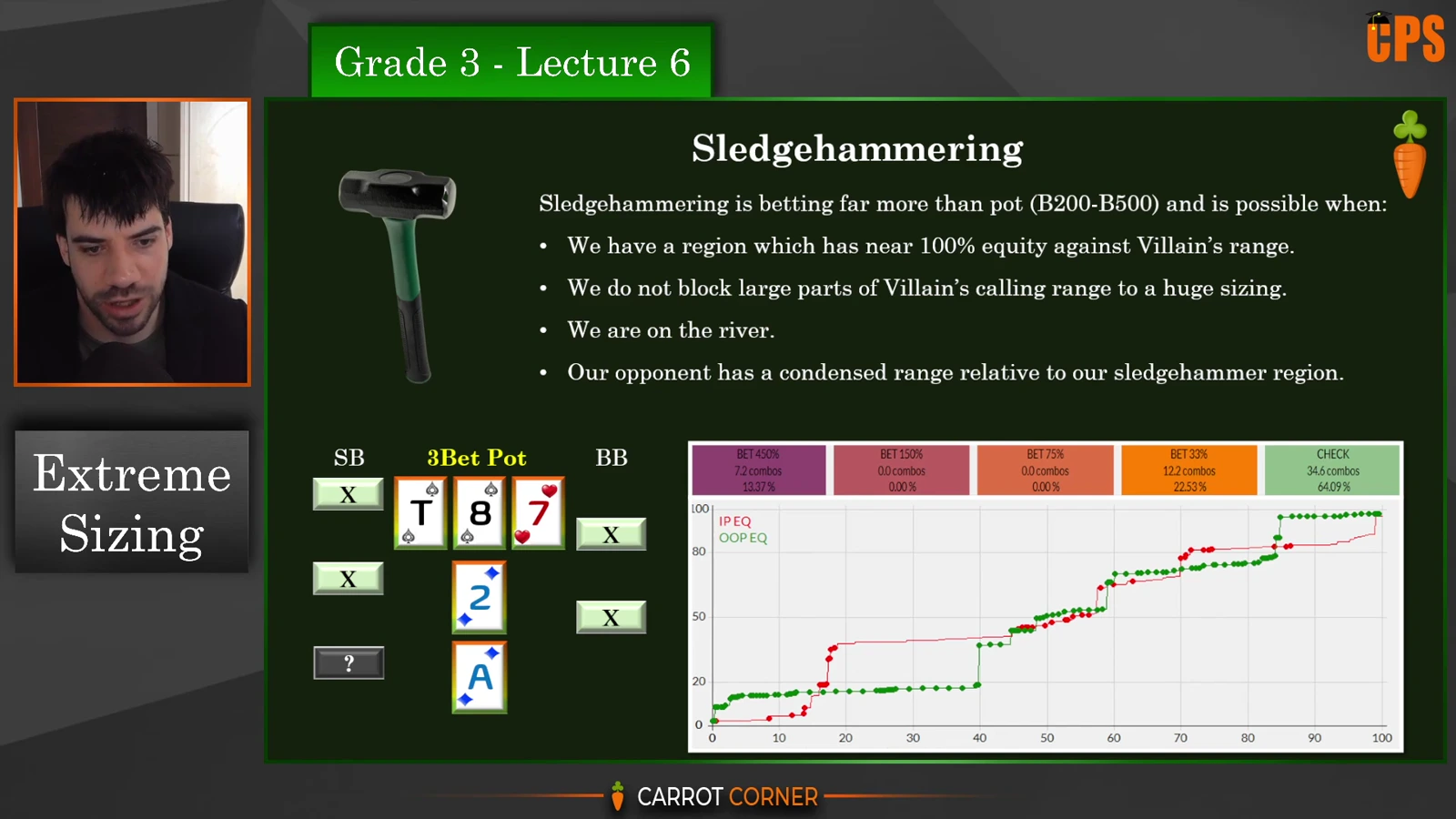
The extreme-sizing lesson explains when very large river bets and very small out-of-position bets can make sense. It does not hand you a shiny new button to press with every strong hand, which is just as well. Clarke is careful not to turn either option into another blind rule or copy it into a different situation without a reason.
The triple-barrelling material brings real players back into the picture. It asks whether a human would genuinely build the ranges assumed by the model, because a delicate blocker preference can fall apart when those assumptions meet a loose live game. That is the important difference between using a solver to understand a decision and copying the colour it gives you.
Practical simplification keeps showing up as well. When an extra size adds very little, Clarke is willing to check, use a simpler size or turn a heavily mixed action into something you can actually play. Those tiny theoretical differences are not the results you will literally achieve in the real world, and thankfully the course does not ask you to drag every branch of a solver tree to the table.
The abstraction still costs study time. The blocker framework is meant to change how you choose bluffs, but you cannot copy it straight into the next session, and Clarke points out spots where a different removal effect matters more. This is strong material for a player who already thinks in ranges. A newcomer can easily get buried under the language, diagrams and conditions, so Grade 3 is not the right starting point just because the lines look more exciting.
Grade E connects the theory with population play
Grade E compares theoretical patterns with observed population behaviour. The river bluff-catching work is only part of it. Later lessons move into exploitative sizing, profitable aggression, raises and 3-bet pots, so you also learn how to build an attacking strategy.
The population work separates recreational players from regulars, then splits the evidence by position, bet size, line and texture. That produces narrower and more useful conclusions than announcing that everyone underbluffs the river. Clarke also interprets the showdown samples instead of pretending that the first raw percentage has already answered the question.
The tables still have to be read on their own terms. The texture work uses 22 Hand2Note categories, some displayed bet sizes are averages across a sample, and Clarke says when a difference is too small or noisy to justify an adjustment. Not all exploitative advice comes from the same evidence either: the measured population reports are separate from an earlier-street checklist of strategic adjustments.
The five-colour system turns those comparisons into recommendations about overinvesting or underinvesting. That makes the evidence usable without asking you to rebuild the analysis in the middle of a hand. Clarke does not want the colours turned into a rigid playbook, though. A small population deviation calls for a small adjustment, not permission to call every bluff catcher and hope for the best.
The attacking lessons show the same restraint with bet sizing. If making a bluff bigger stops producing meaningfully more folds, the largest available size is not automatically the best exploit. Clarke explains that trade-off clearly enough to give you a reason for the size you choose.
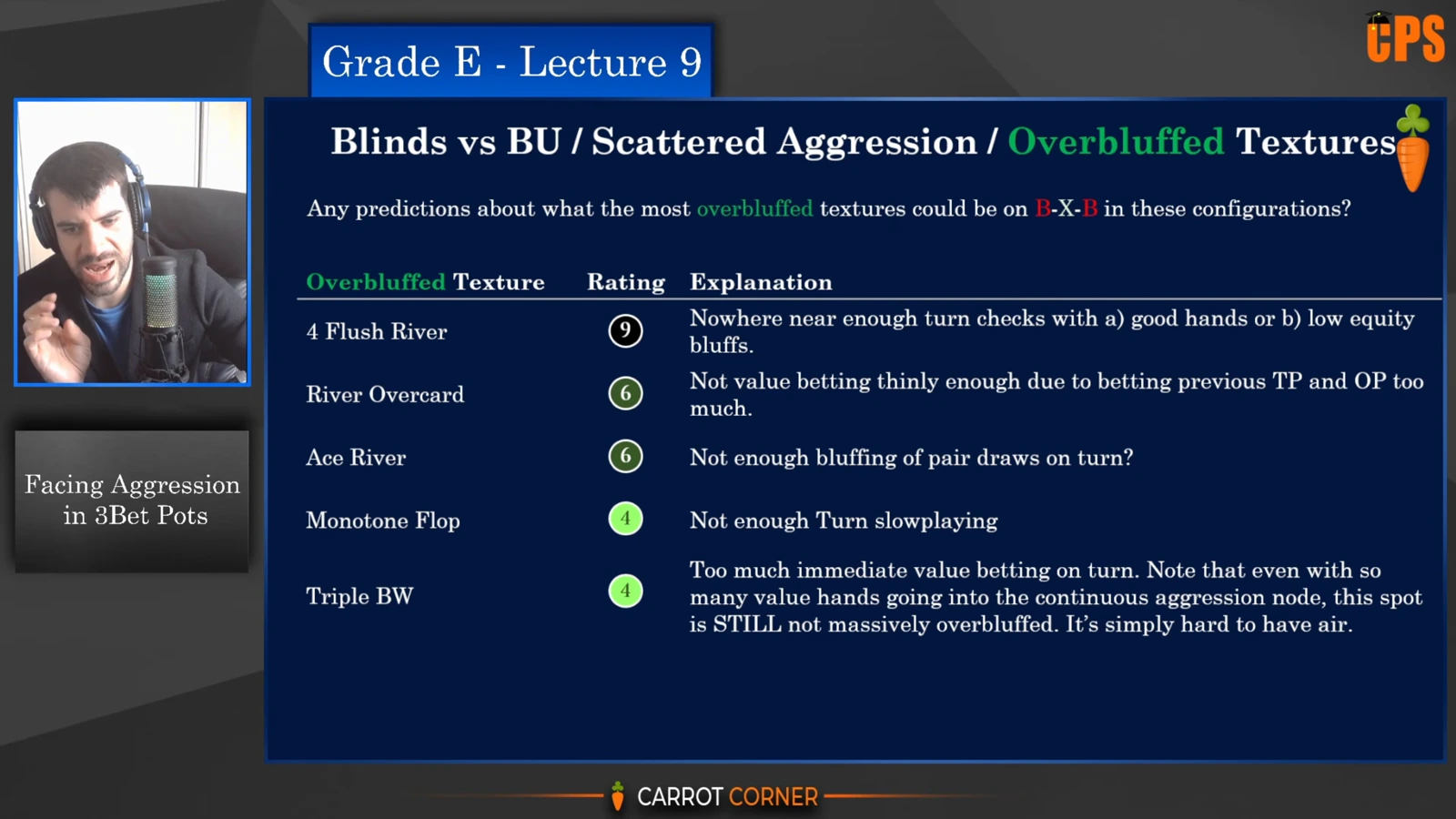
The big limitation is the age and scope of the database. Grade E's introduction says the data was gathered in 2020–2021 from 50NL, 100NL and 200NL regular tables across several sites, while a later lesson separates that pool from tougher Zoom games and higher stakes. These are historical observations, not a fresh survey of the games being played today.
The reasoning is still useful, provided you treat the findings as ideas to test in your own games. No table can tell you what every current pool or individual opponent is doing. The explanation of why an adjustment works should remain useful for longer than any single percentage. Grade E also makes more sense beside the theory grades, which explain what part of a strategy needs to change when the opponent's range changes.
The exercises are part of the real price
The Grade 2 exam allows solver use, but you still have to explain the strategy and compare your reasoning with the feedback video. These are multi-part hand problems, not memory questions stuck onto the end of a lesson. That is a good way to find out whether you understood the material or merely watched it go past.
The feedback is a recorded walkthrough of the exam answers. You compare your work with Clarke’s explanation yourself. That is useful for finding a gap in your reasoning, but do not buy the school expecting a coach to mark each answer you submit. Community access and personal tuition are different things.
It also changes the time commitment by a lot. The advertised 40-plus hours of video are only the beginning once you pause a lesson, check a model, write an answer and work through the feedback. If you buy the complete school, that extra work needs to be part of the plan from day one.
Clarke appears next to dense slides, with examples and solver grids placed inside the lesson frame. The presentation gets the job done, but a larger screen helps when you need to read small numbers and range cells. Expect to sit down with these lessons and study them carefully.
Where the complete school falls short
There is a real vocabulary cost. Clarke's labels connect the grades, but you have to learn them before the system starts to feel compact. If you already use another coach's framework, some familiar ideas may need to be translated into new terms before everything clicks.
The lessons need your full attention. Long explanations and text-heavy slides are much better suited to deliberate study than casual viewing. Some lessons spend several minutes building back through familiar ideas, which may help a learner but can feel painfully slow when those foundations are already in place.
This is a cash-game school. Four grades do not magically turn it into a complete poker curriculum. It should not be confused with tournament, ICM or PLO training.
Solver work adds another commitment. Grade 2 requires solver access, and recreating the exercises takes setup and study time beyond the videos. Check the software requirements separately, because the school itself is not an all-in-one analysis tool.
The population evidence is old. Grade E's database comes from 2020–2021. It is useful for generating ideas, but it is not a current read on your pool. No colour or percentage should overrule what the game and the opponent in front of you are actually doing.
Full Scholarship, Golden Carrot or a smaller start?
The four-grade Full Scholarship page currently shows a price of £1,299. Golden Carrot shows £1,499 and includes the school along with more courses and training. With £200 between the displayed prices, Golden is worth comparing before you commit, especially if you would genuinely use the extra material.
Before choosing, ask whether you will work through the school and whether the larger package contains training you need. A saving over buying the grades separately only matters if you use them. Check the exact access terms for each product too. The two packages should not be assumed to come with identical entitlements.
Carrot Corner’s published refund policy also matters at this price. It does not offer a refund just because you change your mind, stop studying or get different poker results than you hoped for. Rights that apply to faulty or misdescribed content remain in place.
If you are still working out whether Clarke's teaching style suits you, try a public sample before buying the school. For a smaller online cash course, From the Ground Up is a separate option from Run It Once. Buying the full school because it contains more hours is not a good reason. Forty-plus hours you never study are not a bargain.
Upswing Lab 2.0 is a relevant comparison if you want a broader training library that continues over time instead of one fixed four-grade school. Precision Poker solves a different problem. It is built around organising the research of a player who already has solid strategy foundations and analysis tools, so it is not a replacement for learning those foundations.
Is the complete Carrot Poker School worth £1,299?
The main reason to buy Carrot Poker School is the way its explanations stay connected. A basic choice between betting and checking grows into a decision about sizing an entire range, then into advanced play and adjustments to real opponents. The exams make you explain that reasoning yourself. Recognising the answer on a slide is much easier than producing it without the prompt.
For a committed no-limit hold'em cash-game student who wants that kind of connected education and will complete the exercises, this is a credible package. It is much harder to recommend as a default purchase for a complete beginner, anyone focused on another poker format, or an experienced player who only needs one narrow area of improvement. £1,299 is too much money for a syllabus that does not match the problem you are trying to solve.
Bottom line: Carrot Poker School is a serious cash-game programme, and the connected teaching gives you a good reason to consider it. The written work is a large part of that value. Before spending £1,299, compare Full Scholarship with the broader package and make room for the exercises as well as the lessons. The solver requirement and pace of the teaching need to suit you too.
Official course page: Carrot Poker School at Carrot Corner (opens in a new tab)
Frequently asked questions
Who teaches Carrot Poker School?
Pete Clarke teaches the school through Carrot Corner.
Is Carrot Poker School a tournament course?
No. It is focused on no-limit hold'em cash games, not tournament-specific strategy.
Is a solver required?
Solver access is required for Grade 2. Before buying, confirm which software is needed and whether the access you already have is suitable.
Must Grade 3 be completed before Grade E?
No. Clarke recommends building the theoretical foundation first, especially with Grades 1 and 2, but he explicitly says that Grade 3 is not required to benefit from Grade E.