Poker course review
Precision Poker review: a better way to study or too much work?
Precision Poker teaches experienced players how to turn solver output, population data and opponent reads into a repeatable study process. The method is strong, but the workload and separate tools make it a selective buy.
A strong study system with a heavy workload.
Precision Poker is built for experienced players who already understand ranges and analysis software. It gives them a repeatable way to ask better questions, use the right tools and keep the useful answers. The catches are the extra software, the work outside the videos and population claims that sometimes need more proof.
The verdict: Precision Poker
A structured research system for experienced players who want to study more effectively.
The good
experienced cash-game and tournament players who want a better way to research their own games.
The bad
most of the time, effort and tool cost sits outside the video player.
Precision Poker is Alexandre Vuilleumier’s course about learning how to study poker.
And that distinction matters right away. This is not a stack of preflop charts or a complete strategy for one format. Vuilleumier wants you to ask a clear question, choose the right tool, put the result into words and save the useful pattern for later.
That is also where the course does its best work. It takes vague advice like “go work with a solver” and turns it into something that you can actually repeat the next time you sit down to study. That is more distinctive than another folder full of hand reviews.
Here is the short answer though:
Precision Poker is a useful option for experienced cash-game and tournament players who already understand the tools but need a better way to study. However, the homework is the real product, the supporting software costs extra and some of the broad population claims need more proof. All of that matters when the price is $499.
What do you get with Precision Poker?
Upswing currently lists 18 lessons and roughly five hours of training. The course starts with learning principles and research methods, then carries that process into preflop work, multiway pots, ICM and full cash-game and tournament session reviews.
| Section | Main focus |
|---|---|
| Study foundations | Active learning, creative destruction and building ranges by hand |
| Solver work | Node locking, aggregate reports and comparing stack depths or board groups |
| Exploitation | GTO baselines, mass data analysis and opponent-specific reads |
| Personal system | Pattern libraries, top-down research and preflop study |
| Applications | Multiway play, ICM, tournament review and cash-game review |
The order makes sense. The early lessons build the study habits, while the later material applies them to more difficult cash-game and tournament questions. You are not bouncing between unrelated tactics just because somebody needed to fill 18 lesson slots.
The downloads are useful too. Every video comes with English subtitles and a written transcript, membership includes access to a private Discord, and the files include useful-link guides, prebuilt aggregate reports and editable spreadsheets. There is a categorized 93-flop report, an RFI workbook organized by stack depth and position, a written PioSOLVER exercise and links for continuing the HRC work.
Upswing also advertises the private Discord as a place to ask Alex questions about the material. That is useful to know if an exercise leaves you stuck, but it is not a promise of scheduled private coaching or a particular reply time.
These are working materials, not decorative bonuses. But they also tell you what kind of course this is. You are expected to open the files, do the exercises and build something of your own after the video stops.
The course came out on 19 February 2024, and Upswing has not identified a newer numbered edition. The method should age better than a fixed chart, but the individual software screens, sample ranges and population observations still need to be checked before you treat them as current.
The pen-and-paper work tells you exactly what you are buying
One of the clearest early exercises asks you to build ranges by hand before checking the solved answer. Yes, actual pen and paper makes an appearance in a course full of analysis software. But the important part is that Precision Poker asks you to produce and explain something yourself, instead of testing whether you can sit through another video.
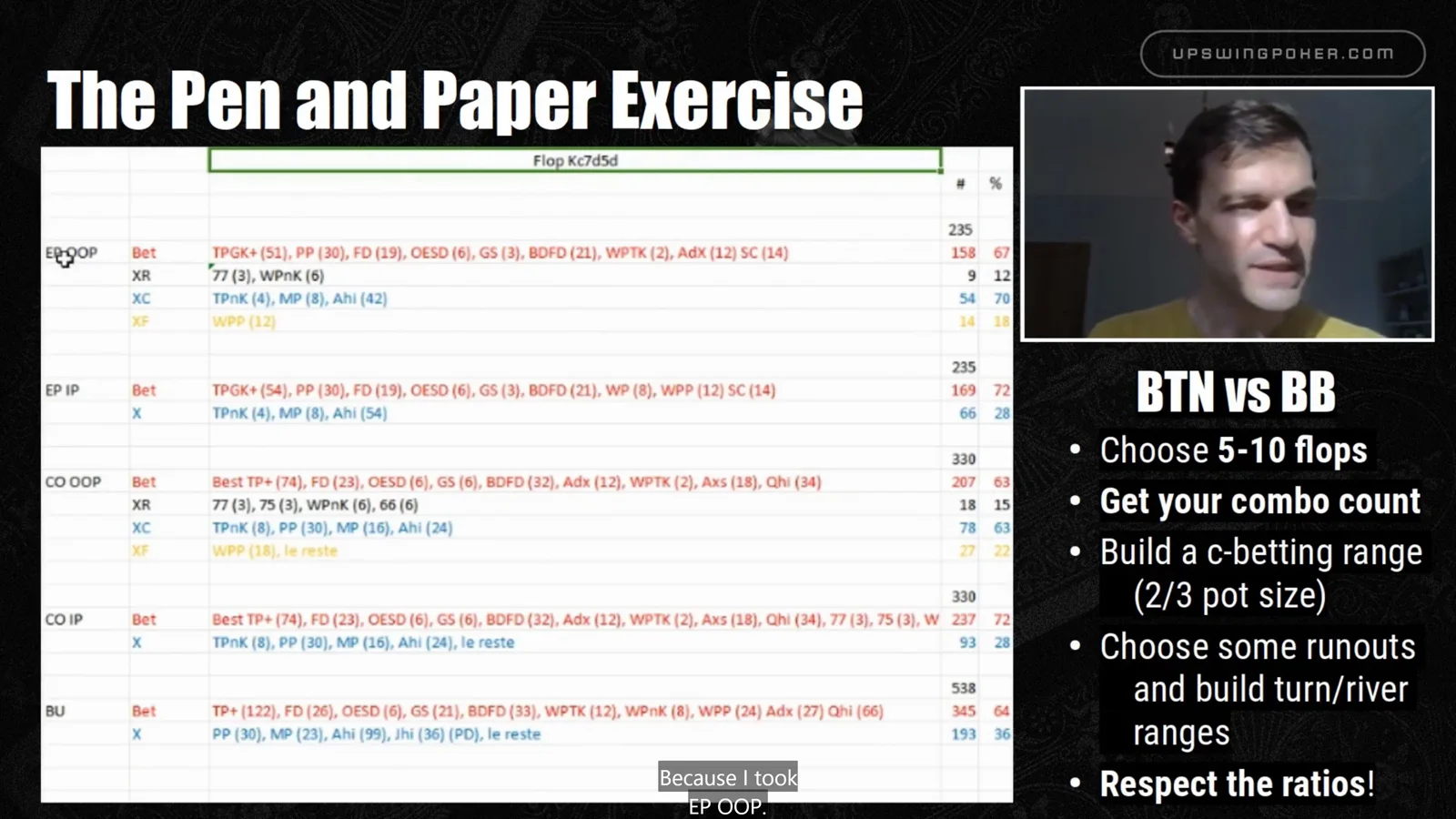
A follow-up lesson on turn bluffs shows the same approach. It points out a common blind spot, then warns you not to overcorrect in the other direction. That is more useful than swapping one shortcut for another, and it keeps the lesson focused on how to think rather than handing over a line to copy.
Passive viewers will still get very little from this section. Watching Vuilleumier do the work for you is a bit like watching somebody else use the treadmill.
Aggregate reports become more than a wall of numbers
The aggregate-report lessons follow the same idea. Vuilleumier treats the numbers as raw material, with the student expected to find a useful pattern and explain it clearly.
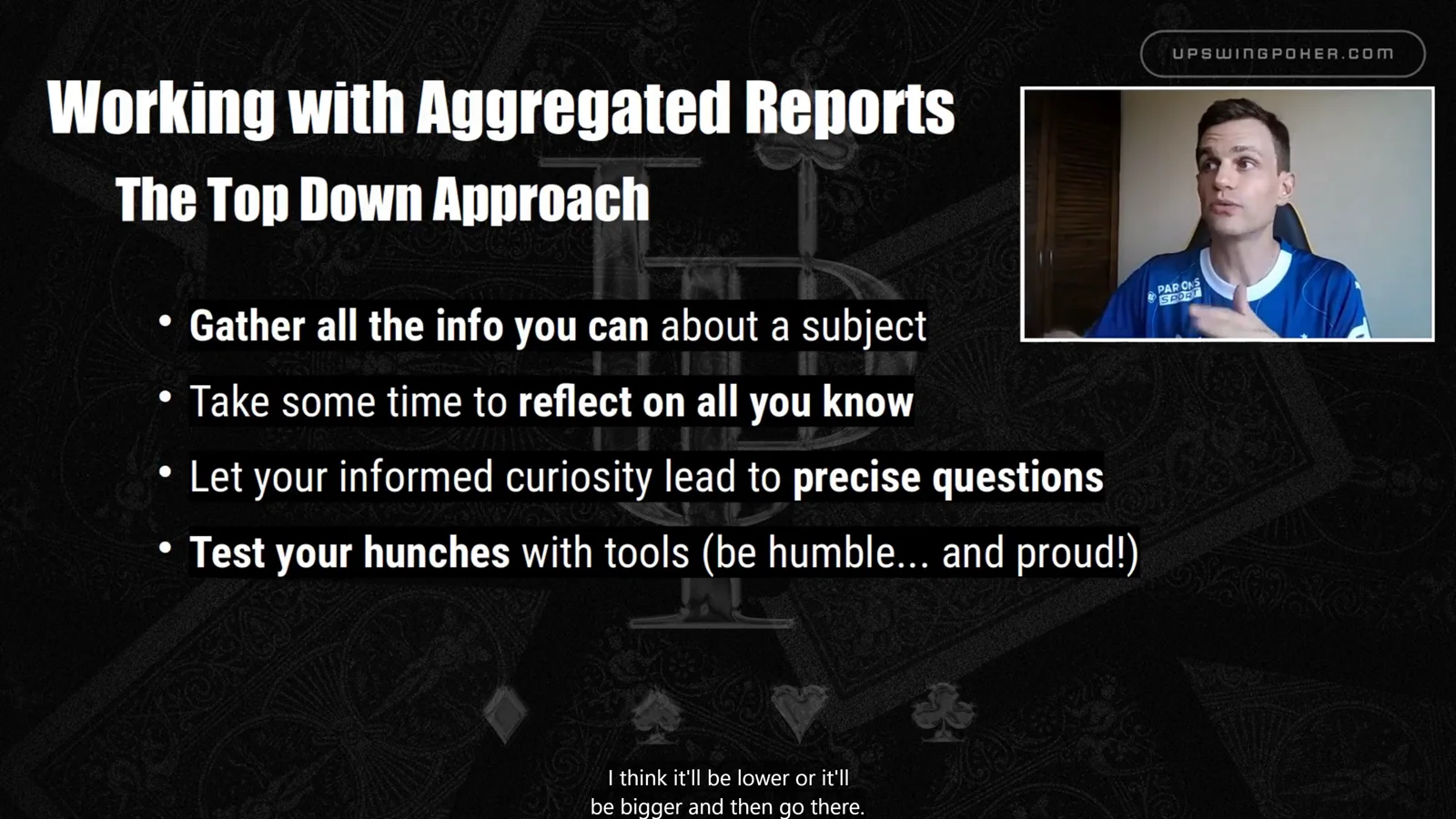
The method is useful in three broad ways:
- Compare groups of spots that actually belong together.
- Describe board patterns in more useful language.
- See how a strategy changes when one important variable moves.
This is much better than opening random solver outputs until something catches your eye. It gives the study session a purpose, and it leaves you with a result worth keeping. The catch is that somebody still has to run the reports, sort them and check the setup.
What does that work leave you with? In the aggregate-report lesson, Vuilleumier groups flops in a spreadsheet, compares the results at different stack depths and finishes with a written summary of what changes. The useful end product is a set of notes you can explain and return to during hand review. A page of percentages without that explanation is only half the exercise.
Bottom Line: If you only want to borrow the final summary, you will miss much of the value here.
GTO, population data and reads belong in the same conversation
The best overall framework in Precision Poker splits the evidence into three parts:
- GTO: the baseline.
- Mass data analysis: evidence of how the player pool moves away from that starting point.
- Opponent-specific reads: evidence about one player, as long as the sample and observation deserve your trust.
Vuilleumier calls this the ultimate trifecta. One read should not wipe out everything you know about the game, but theory should not become an excuse to ignore somebody who keeps making the same mistake.
The opponent-ranging lesson then turns the framework into a short checklist that is realistic enough to use under pressure. It does not ask you to rebuild every exact combo while the time bank disappears.
Now there is one important problem here though. Some lessons move from a population tendency to a broad conclusion without showing enough about the sample, filters or uncertainty behind it. The three-part framework is convincing, but every population claim still has to earn its place in your own games.
The course price is only part of the bill
The official page names Flopzilla or PowerEquilab, PioSOLVER, Hand2Note, Hold’em Resources Calculator and Excel. The lessons also mention software for preflop and multiway analysis. These programs are used in the teaching, but their licenses are not included.
Which tools do you need for the work you want to do?
You do not need every program open for every lesson. The software matters when you want to reproduce a particular exercise. That is a much better way to judge the extra cost than treating the list as a shopping basket.
| The work | Tools used in the course | What that means for you |
|---|---|---|
| Comparing ranges and equity | Flopzilla or PowerEquilab | These are alternatives for this kind of work. There is no reason to buy both just because both are named. |
| Postflop solves and aggregate reports | PioSOLVER | Following the explanation is different from generating the reports yourself. Check that your software and edition support the exercise you want to repeat. |
| Researching player tendencies | Hand2Note and hand histories | A postflop solver alone will not give you a database of how your opponents actually play. |
| Tournament payout and stack experiments | Hold’em Resources Calculator | This serves the ICM work. A cash player does not need to buy it simply to study cash-game postflop reports. |
| Keeping the results | Excel | The spreadsheets organise comparisons and written conclusions. You still have to understand the result you put in them. |
If you already own a solver, start by checking what it can actually do. A library of solved hands does not necessarily let you change ranges, node-lock an opponent or run your own aggregate reports. Another program may support similar work, but the course demonstrates particular tools; do not assume the steps will match.
You can begin the manual range-building exercise with paper and follow the explanations before buying anything else. Reproducing the software exercises is a separate commitment. There is no honest single all-in price without knowing which tools you own and which parts you want to work through.
You may also need suitable hand histories and enough computing power for the larger simulations. So the $499 gets you the instruction and lifetime access, not the complete research setup around it.
That does not make Precision Poker incomplete. It does make the economics much easier to justify if you already own and understand several of the tools. Starting from zero means extra spending and a steep technical climb before you can reproduce every workflow.
Multiway pots and ICM show what the method can do
The later lessons move away from standard heads-up postflop spots and into multiway and ICM work. That is a sensible place for this course to go. If the study method only works in neat solver examples, it is not much of a method.
In the multiway section, Vuilleumier starts with tendencies that he says show up in the player pool, then builds a practical adjustment from them. He is not handing you another set of fixed answers to copy.
Now there is one problem here though. The lesson is memorable, but the conclusion sounds more certain than the evidence on screen. The pattern is described as clear and proven by data, while you are not shown enough about where the hands came from, which filters were used or how the sample was built.
Treat it as a good question to test in your own games, and not as a law of multiway poker.
The ICM lesson handles this better. Vuilleumier uses Hold’em Resources Calculator to test individual assumptions, instead of asking you to memorize one displayed range. So the focus stays on how to investigate the spot.
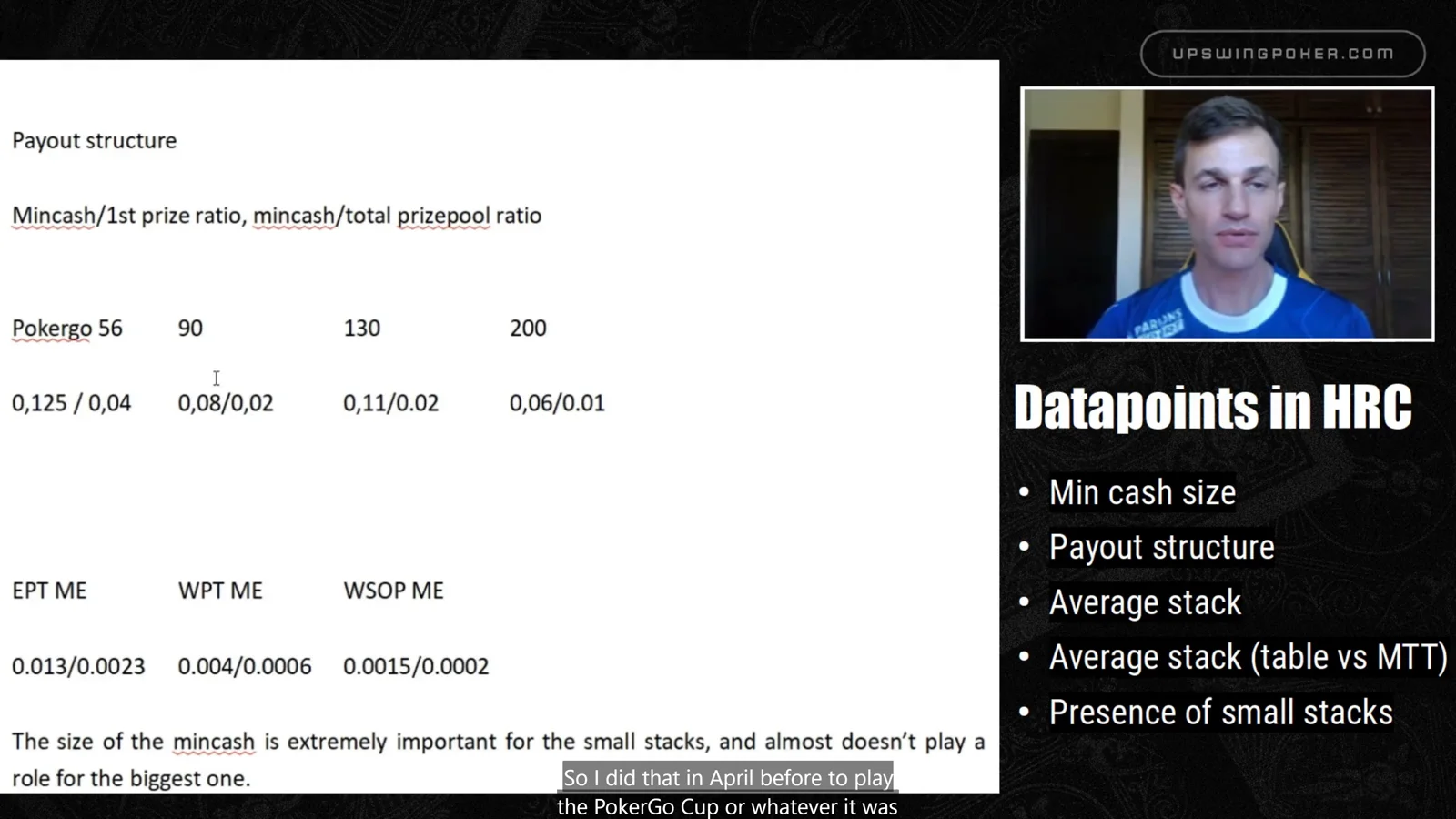
This is the kind of lesson that should age well. A fixed output can go stale pretty quickly. Knowing how to test it again is much more useful when structures or software change.
The method is better than some of the proof
Precision Poker is at its best when you finish a lesson with something that you can use again. That might be a document, a pattern or a short framework for making a decision. It is much less convincing when a big claim gets ahead of the proof.
Some comments about player pools, win rates and how certain an exploit really is go further than what appears on screen. The multiway example is the clearest case.
The mass-data section also treats purchased or datamined hands too casually. Before you use them, you still need to check the rules of the poker room and the data source.
Then there are the detours. Vuilleumier’s enthusiasm and chess background give the course some life, which is good to see. But he does not always take the shortest road to the point, and every so often you have to work out what the useful part actually is.
None of that breaks the central idea though. Precision Poker keeps pushing you to stay curious, write down your reasoning and test it again. Just make sure that the instructor’s claims get the same skeptical treatment as the solver output.
Precision Poker or Simplifying Solvers?
Simplifying Solvers is the more focused option when the solver itself is the problem.
Precision Poker starts one level higher. It assumes that you can already use the tools, then tries to stop you from opening them without a good question.
The two courses can work together, but they answer different first questions. Choose dedicated solver instruction if you are still fighting the software. Choose Precision Poker if the tools are already there but your study sessions keep going nowhere.
Upswing Lab 2.0 is the broader alternative. It is a better fit if you want a guided path through poker strategy.
Precision Poker is shorter and expects you to do more on your own. It teaches you how to produce and organize useful answers, instead of walking through every strategic foundation.
Where Precision Poker falls short
Five hours makes the course sound smaller than the job really is. That number only measures the time inside the video player. The exercises create the value, and doing them properly can mean a lot more setup, analysis and writing after the video stops.
You also need to be comfortable with the technical side. Ranges, nodes, aggregate reports, HUD filters and solver output are everyday language here. The course does not stop and teach them from the beginning, so a newer player can get lost before the study method has a chance to help.
Some examples are better demonstrations than current strategy. Vuilleumier points out older ranges in places, and they can still show you how to investigate a spot. But do not copy them straight into a 2026 game without doing fresh work.
The same warning applies to the population claims. Looking beyond equilibrium is one of the course’s strengths. Showing how widely every tendency applies is not.
The full setup can get expensive. Software, database access and computer requirements all sit outside the course price. If you are starting from zero, that means extra spending.
Is Precision Poker worth $499?
For the right player, it can be. And “the right player” is doing a lot of work here.
Precision Poker does something that many much larger courses never manage. It helps experienced players decide what to study after the easy leaks have already been found. But you need to be comfortable working on your own.
The strongest lessons do not hand you one more chart. They show you how to frame a question, test it, put the answer into words and keep the useful part. You can carry that process into cash games, tournaments, preflop and postflop work, multiway pots and ICM.
But if you see five hours of video and expect a complete modern strategy, this is the wrong product. Without the right software, time and discipline, the exercises stay unfinished and a large part of the value never leaves the video player.
Bottom Line: At $499, Precision Poker makes sense for an experienced player who already owns the tools and genuinely wants a better study routine.
The workload is heavy, the software costs extra and some broad claims need more proof. So this is not an automatic Upswing purchase. The study process is the reason to buy it.
Official course page: Precision Poker at Upswing Poker (opens in a new tab)
Frequently asked questions
Who teaches Precision Poker?
Alexandre Vuilleumier, a poker professional and chess International Master. The chess background is easy to spot in the focus on testing ideas, organizing the work and saving useful patterns.
Is Precision Poker suitable for beginners?
No. Precision Poker assumes that you already understand ranges, solver concepts, databases and the usual poker-study language. If those still feel new, a structured fundamentals course is the better first step.
Does Precision Poker cover cash games and tournaments?
Yes. Vuilleumier uses the method in both cash games and tournaments. The course includes dedicated session reviews, along with work on preflop study, multiway pots and ICM.
What software does the course use?
The official page names Flopzilla or PowerEquilab, PioSOLVER, Hand2Note, Hold’em Resources Calculator and Excel. The lessons use those tools, but the software licenses are not included.
Is there a recurring course fee?
No. Upswing currently describes Precision Poker as a $499 one-time purchase with lifetime course access.
Does Precision Poker include Exploit & Conquer?
Do not count it as a confirmed bonus. Precision Poker’s FAQ still says Exploit & Conquer is free if you sign up “this week,” but gives no current dates. Upswing’s original launch announcement tied the free-course offer to 19–23 February 2024. Budget for Precision Poker on its own unless your current order explicitly includes both courses or Upswing confirms the offer in writing.