Poker course review
The GTO Blueprint review: is it worth $997?
Saulo Costa simplifies GTO play into one bet size and one frequency bucket per spot, and his best lessons explain why solver strategies look the way they do. The postflop chapters are mostly lists to memorise, though, and you’re largely on your own for drilling them and for the river.
The GTO Blueprint is a good course for one kind of player and a hard sell for pretty much everyone else. Saulo Costa's idea is simple enough: one bet size for each flop and turn spot, and one rounded frequency bucket for every hand. The lessons that explain why solver strategies look the way they do are the best part by a distance. After that it turns into a lot of numbers to memorise, and the river is left to you on purpose.
The verdict: The GTO Blueprint
Strong GTO reasoning for online regulars who can drill it themselves.
The good
You already study online 6-max cash with a solver at 100NL or above, and you want the reasons behind its lines in a form you can play.
The bad
Solver language is still new to you, or you want a drillable system with exercises and a river plan included.
Who this course is for
Costa says it's for regular online cash-game players who take the game seriously, mostly from 100NL up, and that it isn't recommended if you aren't familiar with GTO. Take that literally.
The spots are 6-max at 100 big blinds, and nearly all of them are heads-up pots, 3-bet and 4-bet pots included. Terms like block bet and reopening range show up with no introduction at all, and a lot of the teaching happens on solver and tracker screens. If you can't read a solver output comfortably yet, learn that first. Paying $997 to be lost early is a bad deal.
Live players and anyone grinding soft low-stakes games can stop here. When a lesson gets anywhere near exploitative play, Costa says that belongs somewhere else, possibly not in this course at all.
One size, one bucket
The method really does fit in one sentence, and Costa repeats it so often you will be able to recite it in your sleep. Pick the best single bet size for the board from a short pool of sizes you chose in advance. Then put your hand into one of your mixed-strategy buckets, such as 20, 40, 60 or 80 percent. If the hand is mixed, a random number decides whether this time is a bet or a check.
As a way to play something close to GTO without a solver running in your head, that is sensible, and for a 100NL+ regular it is probably the right level of simplification. The catch is that everything rides on choosing the right size and the right bucket, and that is the hard part.
He explains where the shortcut comes from: solvers use plenty of bet sizes that only turn up now and then, so he strips those out and rounds the frequencies into buckets. He backs it up with his own bot tests and a comparison of his staked students' ranges against his bots. That is his evidence, so read it as his. To his credit, the comparison also shows the turn line where his students drift furthest from the bots.
The practice demonstration is the most useful early lesson. Costa plays hands in his own Spot Trainer, calling a size and a bucket for each one, then opens the solver to see how close he got. He misses the bucket several times and owns up to it every time. Honestly, that is a fair picture of playing this way: quick decisions and plenty of small mistakes.
The first lesson is the slow part. It spends a long stretch on equilibrium theory and a productivity book before the method even shows up, and then it tells you what you have to decide without telling you how to pick the bucket yet. Don't judge the course by it.
The reasons are the reason to buy
This is where the course earns its money. The early lessons on how solver strategies build their ranges each take one thing Costa says you are probably not doing yet, and give you a reason you can carry to another board. If you look at solver output but can't always say why it does what it does, this is the part that will change how you think.
A quick example. On a king-high flop, why would the solver check ace-king more often than king-queen? Because the ace removes a lot of the ace-high hands your opponent would simply check with, so when you check, more of what he has left is going to put money in. On the solver screen he uses, ace-king offsuit checks about 40% of the time against roughly 17% for king-queen offsuit.
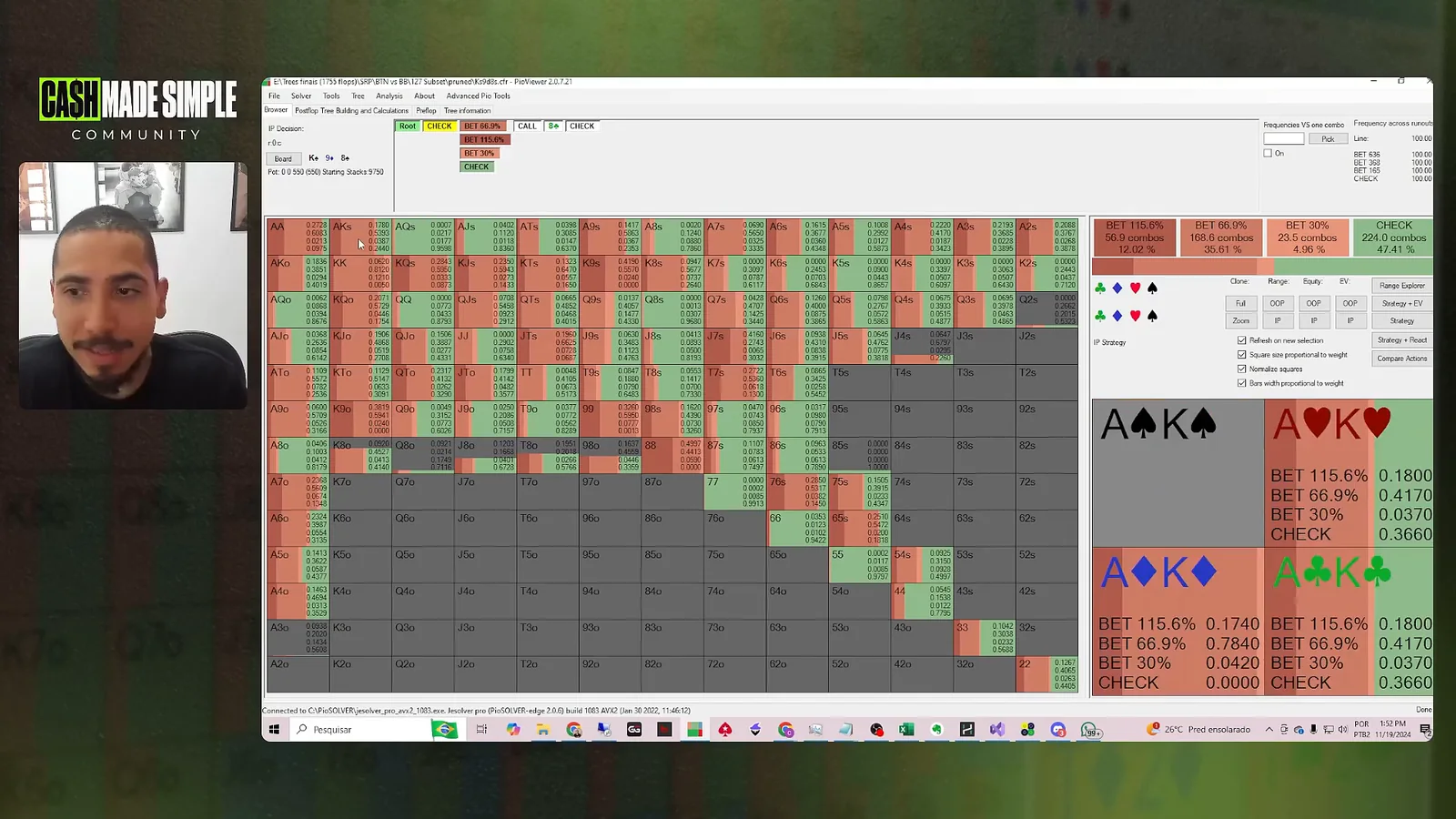
Once that clicks, you see the same idea behind slow-plays all over the place, which is exactly what a good lesson should do.
The draws lesson is just as practical. If you bet every draw on the turn, your turn checks never hold a flush draw. So when the flush card comes on the river after a check-check, a thinking opponent knows you can't have it and fires away. Some draws have to check. It sounds obvious once you hear it, and it changes how you build ranges in a lot of spots.
Costa is also straight with you when one of his own rules bends, which is refreshing. In the bluff-catching lesson the rule is to call with hands whose kicker doesn't block your opponent's bluffs, which usually means an ace or a low card. Then he lands on a river where the opponent bluffs plenty of ace-highs, so ace-five becomes a fold. He keeps it in anyway. In the pocket-pair lesson he admits other variables matter, and the solver screens show his rule as a tendency, with some pairs calling almost every time either way.
Take these lessons slowly. Open your own solver on a handful of boards after each one and check that the idea holds. They are good enough to be worth that effort.
How often is the hard part
Here's the thing though. Those early lessons are great at telling you which hands to use and why. They are much less helpful on how often. You are told to slow-play some of the time or barrel at some frequency, while the actual numbers sit right there on screen and mostly go unread. Costa says outright that the exact numbers come later, in the postflop chapters.
That is a real weakness, because the bucket is the whole point of his method. You will finish the early chapters knowing that ace-king slow-plays more than king-queen, and still have no idea whether that means a 20% check or a 60% check in your own game. Don't expect to play from those chapters yet.
The postflop chapters: answers to memorise
So the frequencies finally show up in the postflop chapters, as lists to learn. A typical lesson takes one line, such as a flop c-bet in position or a check-raise from the small blind, and picks the bet size from a board or runout lookup. Then it reads how often each hand class bets or raises, either from a hand database in his tracker or straight off the solver. Those numbers become the bucket notes you are supposed to take to the table.
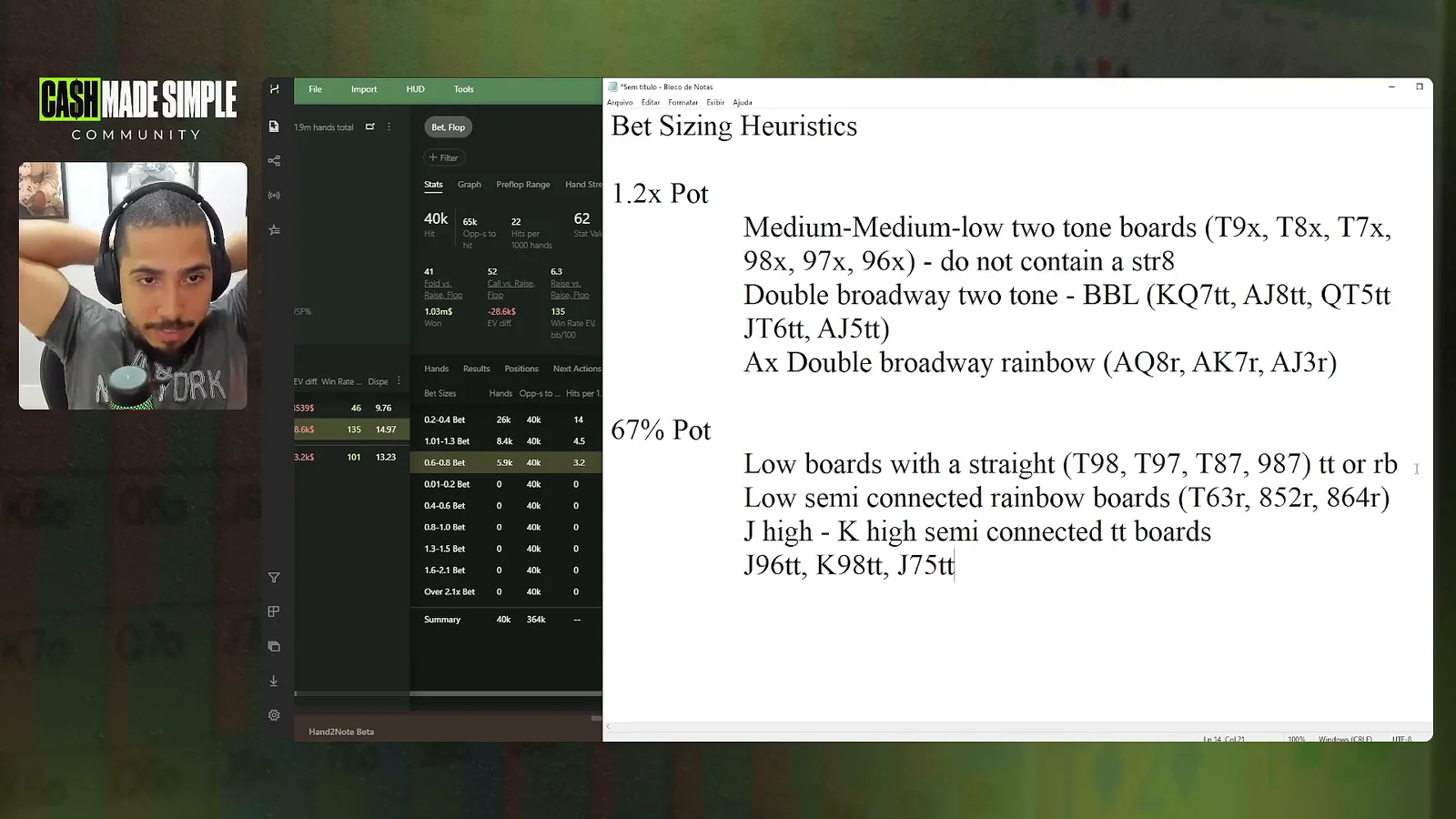
This is the part you will actually use at the table, though the teaching gets thinner here. A few hand classes get a real reason. Bottom pair makes a good multi-street bluff because it blocks the top of your opponent's range and still has outs against the pairs that call. Middle pair just calls a flop stab from the small blind because it catches bluffs well over several streets. Plenty of others get no reason at all. At one point Costa says plainly that he can't tell you why the solver bets a certain hand, only that it does. That matters more than it sounds. A memorised number works until the spot changes a little, and without the reason behind it you have no idea which way to adjust.
The numbers are also looser than the neat notes suggest. Frequencies of around 30% and 10% get rounded up to the 40 and 20 buckets, and some buckets rest on small hand samples, which he admits in one lesson. In the small-blind check-raise lesson the raise size is simply left as any medium size you like. He also warns that you won't remember the lists after one viewing. Believe him.
To be fair, the size rules do get clearer as the course goes on. The chapters for the preflop caller pick a turn size by runout type, and the best of the 3-bet pot lessons print the rule right on the notes with a reason attached: a bigger bet on ace-low and king-low boards, because the opponent's checking range is full of strong bluff-catchers. The buckets underneath stay the same rounded read-offs, though.
The 4-bet pot chapters simplify hardest of all. Out of position the advice is to bet your whole range small on every flop, on Costa's word that what you give up is tiny, with no numbers shown.
If you buy the course, build your own cheat sheet from these chapters and spot-check a few of the rounded buckets in your own solver before you rely on them at the table.
Much of the proof comes from his own bots
There is another catch. A lot of the evidence on screen doesn't come from a solver at all. Many lessons read their totals from Costa's own bot database, filtered in Hand2Note, and he regularly calls that "the solver". The numbers he reads match what is on screen, and bots are a fair way to show how a strategy behaves over a lot of hands. But you are trusting that his bots play close to equilibrium, and you can't rebuild those filters without his data.
For a buyer, that decides how much of the advice you can check. Where a lesson uses a solver screen, you can test the idea in your own solver. Where it uses his bots, you mostly have to take his word for it. Give more weight to the solver-backed lessons and treat the bot numbers as his baseline.
Rivers sit outside the system
The one-size rule only covers the flop and turn. On the river Costa keeps several sizes, and he says plainly that he won't include videos on river lines because he plays rivers exploitatively. What you get instead are river rules of thumb, such as when to block bet or bluff-raise, plus a picture of how often a balanced strategy calls and gives up.
It is a reasonable position, and he is upfront about it. For a course at this price it is still a big hole, because the river is where the pot is biggest. Plan on getting your river game somewhere else.
The theory is short and useful
The short theory chapter is better than it sounds. Costa works out how many bluffs a bet can carry and how often you have to defend, then checks the answers in a solver. He wants you to memorise the numbers for a few common sizes, and he's right. A three-card toy game then shows why betting to make a worse hand fold is a real reason to bet, which explains why he likes small river bets so much.
It is maths-heavy, and the course doesn't connect it back to the buckets for you. If maths isn't your thing, take the memorised numbers and move on, because that is the part you will actually use.
What you need besides the course
The lessons run on Costa's own solver trees and bot database, and the early demonstration uses his own Spot Trainer. The sales page doesn't say whether any of that comes with the course. If you are buying partly to drill in his trainer, ask before you pay, because $997 is a lot to spend on an assumption.
The postflop demonstrations work the same way. Following them means filtering a hand database in a tracker or opening his own solver trees, and the sales page doesn't list either of those. Realistically, you need a solver of your own to get full value, both to check his numbers and to cover spots the course doesn't.
The bonus, which Costa describes as hand histories of GTO play, is meant to be imported into your own tracker, and nothing on the course page says whether it is the same data the lessons filter. It is only useful if you already run a tracker and know how to filter it. If you don't, count it as a bonus you won't use.
Practice and feedback are where the course is weakest. The closing chapter is a recorded real-money session in which Costa plays several fast-fold cash tables and runs the system out loud: he picks the size and the bucket, then lets the random number on screen decide. It is useful to see the method at real speed, and he is open about where he plays differently in practice from the theory. It is still something you watch, though. Outside it, the exercises come down to a pause-and-predict moment in the toy game and an instruction to redo the bet-size maths in a spreadsheet. Nothing tells you how to drill the buckets yourself, and there is no student Discord, just a support email. You will have to build your own practice routine.
What if you are not ready for The GTO Blueprint?
If you still need help understanding ranges and why a bet makes sense, From the Ground Up is the better place to start. It teaches online cash foundations in order. You still have to practise, but it does not expect you to arrive comfortable with solver output.
Carrot Poker School goes further into cash-game theory and asks you to write answers and compare them with exam feedback. It is a much larger study commitment. Costa makes more sense when those foundations are already in place and your problem is turning solver study into decisions you can make at the table.
Price and value
$997 buys 12 months of video access from the date of purchase. It is not lifetime access, and for a course this dense that matters. Plan to get through it, and go back over the parts you need, inside the year.
Costa also advertises a guarantee of twice the course price back if you play at least 250,000 hands following the course's protocols and are still losing at your normal stakes. Those are some serious conditions. Read the full terms, including what counts as following the course's protocols, before you count on it.
So is it worth it? For a 100NL+ online regular who already studies with a solver, the reasoning in the early lessons is worth real money, because it turns solver output into rules you can remember at the table. The postflop lists are a decent head start on your own notes, as long as you check them. For anyone below that level, or anyone who wants a finished system to drill, $997 for a year is hard to justify.
Final verdict
The GTO Blueprint suits one kind of player well: a serious online 6-max regular who already studies with a solver and wants simpler rules built on real reasons. For that player the early chapters are really good. They explain the reasons clearly and show honestly where Costa's own rules bend. The postflop chapters then turn the method into notes you can take to the table, and the closing session shows it in use at real speed.
Skip it if solver language is still new to you, or if you want a drillable system with exercises and a river plan included. The postflop frequencies are mostly rounded lists to memorise with few reasons attached, and much of the strategy on screen comes from his own bots and solver data you may not have. At $997 for a year of access, that leaves far too much of the practice work to you.
Official course page: The GTO Blueprint at Saulo Costa (opens in a new tab)