Poker course review
PLO Launch Pad review: is it worth $99?
PLO Launch Pad is a solid $99 course for hold’em players moving over to Omaha. But some dated content and a tool you have to buy separately hold it back.
A clear PLO introduction with dated edges
A clear PLO on-ramp with dated edges.
Price and access: $99 one time · Lifetime access · 8+ hours of video across 6 sections.
The verdict: PLO Launch Pad
A clear PLO on-ramp with dated edges.
The good
Hold’em players and newer low stakes PLO players who want a simple system for picking hands, reading ranges and planning the turn and river.
The bad
You want up to date player pool research, a complete multiway playbook, advanced tournament strategy, or the PLO Matrix included in the price.
PLO Launch Pad is the beginner Pot Limit Omaha course from Upswing Poker, taught by Dylan Weisman.
And it is aimed at a very specific type of player.
It gives hold’em players a clear structure for switching to Omaha. The scope stays deliberately small, so don’t expect an encyclopedia of every possible spot.
Here is the short answer:
PLO Launch Pad is a solid option for beginners. It is at its best when it turns the huge complexity of four card poker into a few simple questions you can ask yourself in every hand.
Parts of this course are dated, though. And it leans on tools that Upswing sells separately.
Both of these things matter more than the modest $99 price tag suggests.
So in this PLO Launch Pad review you will get a complete walkthrough of everything inside the course. The good and the bad.
This way you can decide for yourself whether it is worth it for you or not.
Alright, on to the review!
1. What is Included in PLO Launch Pad?
Upswing currently advertises 8+ hours of video content in PLO Launch Pad, split across 6 sections.
The course starts with the rules and how to evaluate a hand. From there it moves into preflop, flop, turn and river decisions.
And it finishes up with practical sessions at several low stakes cash game levels, plus a PLO tournament review.
| Section | Main focus |
|---|---|
| PLO 101 | Rules, pot-size calculations, terminology, equity and an introduction to an equity calculator |
| Preflop | Raise-first-in ranges, the PLO Matrix, three-betting, four-betting and playing aces |
| Flop | Stack-to-pot ratio, continuation betting and board textures in single-raised and three-bet pots |
| Turn / River | Range polarity, turn-card classes, river sizing and blocker selection |
| Miscellaneous Fundamentals | Study and career advice plus a primer for a first live PLO game |
| Play & Explains | Cash-game sessions from PLO10 through PLO100 and a PLO MTT review with Pav |
Now the first thing you will notice is how the hours are split up.
Five of them are in the Play & Explains section. These are videos of Dylan playing and explaining his decisions as he goes.
The more formal theory part of the course is pretty compact by comparison.
So this is a course where you learn one framework and then watch it being used, again and again. It is not a complete reference for every possible spot.
There is also a supporting raise first in guide included, which makes the preflop material a lot easier to use.
It organises the opening ranges by position and by hand class. So you can study the exact same information from two different directions.
It also leaves out tri-suited and quad-suited hands on purpose, in order to keep the system manageable.
This makes sense for an introduction. But it also tells you a lot about this product.
In other words, keeping things simple comes first here. Covering everything comes second.
2. The Best Lesson: How to Read a Four Card Hand
The best part of PLO Launch Pad comes early on in the course.
Instead of asking you to memorise thousands of starting hands, Dylan gives you four connected qualities to judge a hand by:
- Nuttiness
- Connectedness
- Suitedness
- High-pair power
Now this might sound pretty basic. But it fixes the single biggest problem that hold’em players bring with them to Omaha.
And that is thinking that four good looking cards automatically make one strong hand.
They don’t.
For example:
A low rundown can make plenty of straights, but it is still vulnerable to a higher straight.
A medium flush draw can get there and still leave you holding an expensive second best hand.
And a high pair only gains value when the side cards give it a strong suit or a connected draw.
Dylan then carries those same hand qualities over to the later streets. How well will the hand hold up as the board changes?
Basically here’s the deal:
What you have right now is only the starting point. The course also asks how many turns and rivers will let the hand keep applying pressure.
So instead of asking “did you flop something?” the question becomes whether your whole hand can keep working as the board changes.
That is a much better question for a beginner to be asking.
The course also avoids a really common mistake with high pairs.
Kings and queens in Omaha are not just weaker versions of an overpair in hold’em. Their value comes from:
- Set over set potential
- A high flush draw
- Connectivity
- The ability to dominate lower draws
The framework is simple enough to remember and broad enough that it keeps coming back throughout the course.
3. Preflop Section (And the PLO Matrix Problem)
The raise first in material makes a smart teaching choice.
You can study the ranges both by hand class and by seat.
So instead of memorising an entire under the gun chart, you learn how kings, queens or a certain type of rundown change as you move from early position to the button.
There is also a “worst open” method which gives each category a clear boundary. This way you don’t have to memorise every single combination.
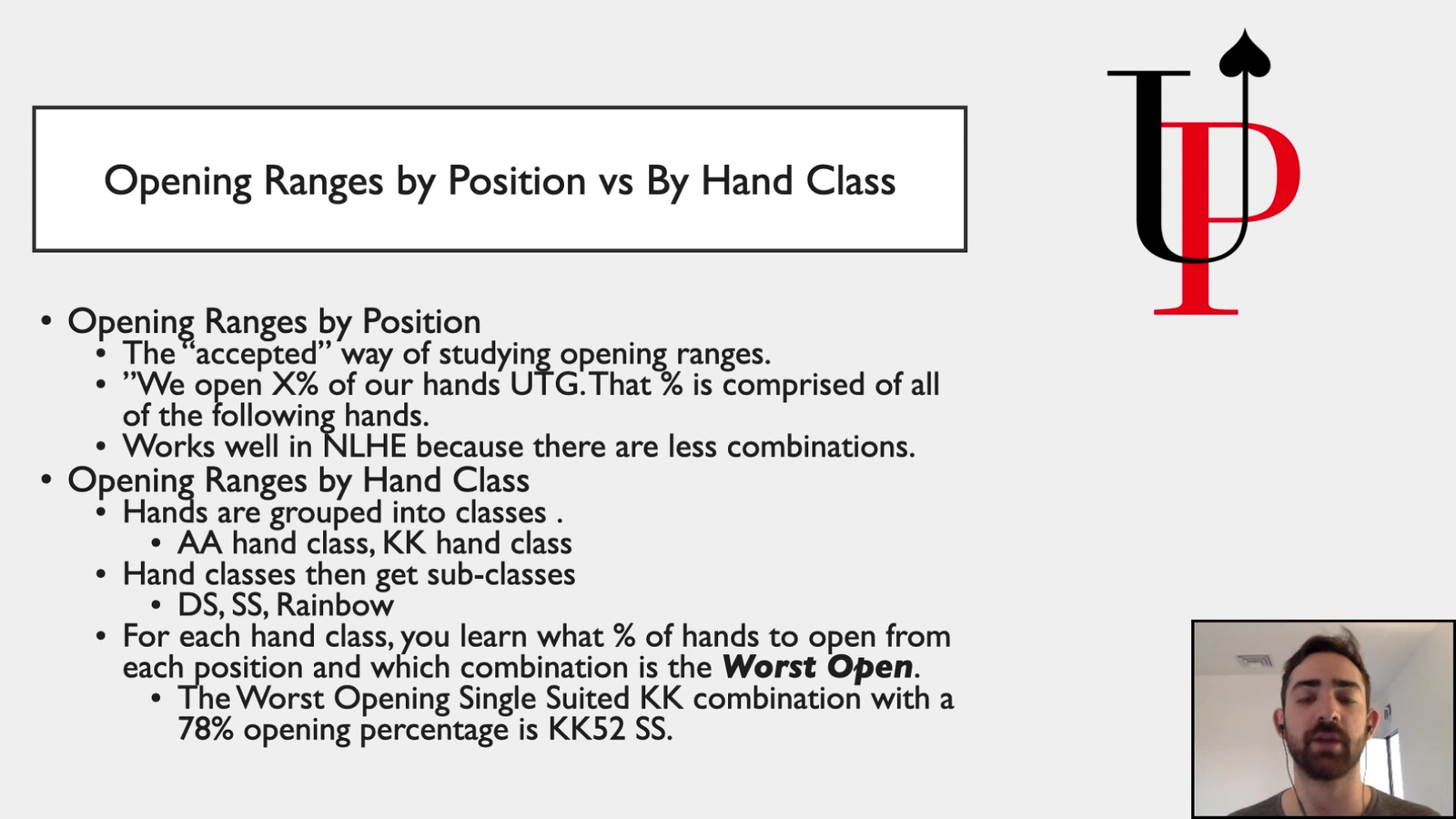
The included guide backs all of this up with position tables, hand class tables and examples of the weakest opening combination in each bucket.
This is way more useful than a static chart with no explanation of how the hands are grouped.
Here’s the thing though.
The very next lesson is where things start to get a bit problematic.
A big tutorial is built around Upswing’s PLO Matrix. This covers:
- Cold calls
- 3Bets
- 4Bets
- Different stack depths
- Multiway nodes
The problem is that this tool is not listed as part of the $99 course package on the current product page. Upswing currently sells the PLO Matrix separately for $49 per month.
Now you can still learn the raise first in fundamentals without it. And the supporting guide is still useful on its own.
But don’t assume that a tutorial on the Matrix means you get ongoing access to the Matrix. You don’t.
The lesson also repeatedly encourages you to review your decisions with the tool. So part of the recommended study routine points to something outside of what you actually paid for.
There is also a recurring push toward Advanced PLO Mastery.
To be fair, Dylan is usually pretty clear about what Launch Pad leaves out. And that is a lot better than pretending the introduction covers everything.
However, several lessons stop right at the edge of a topic and then send you to another product for the detailed answer.
4. Postflop Section: Flop, Turn and River
The flop section is where this simplified approach works best.
Continuation betting comes down to two simple questions:
- How do the ranges interact with the board?
- How wide or narrow are those ranges?
The first one helps you decide how often to bet. The second one helps you pick which hands belong in your betting range.
This leads to a practical rule that you can actually use at the tables.
With wide ranges on the flop, the course prefers a more polar betting range. This means strong hands that hold up on later cards, plus low equity bluffs with useful backdoors.
As the ranges get narrower on later streets, individual blockers start to matter more.
There is plenty more to learn before this becomes a complete strategy.
But it is a clear way for a beginner to stop betting every middling made hand for “protection.”
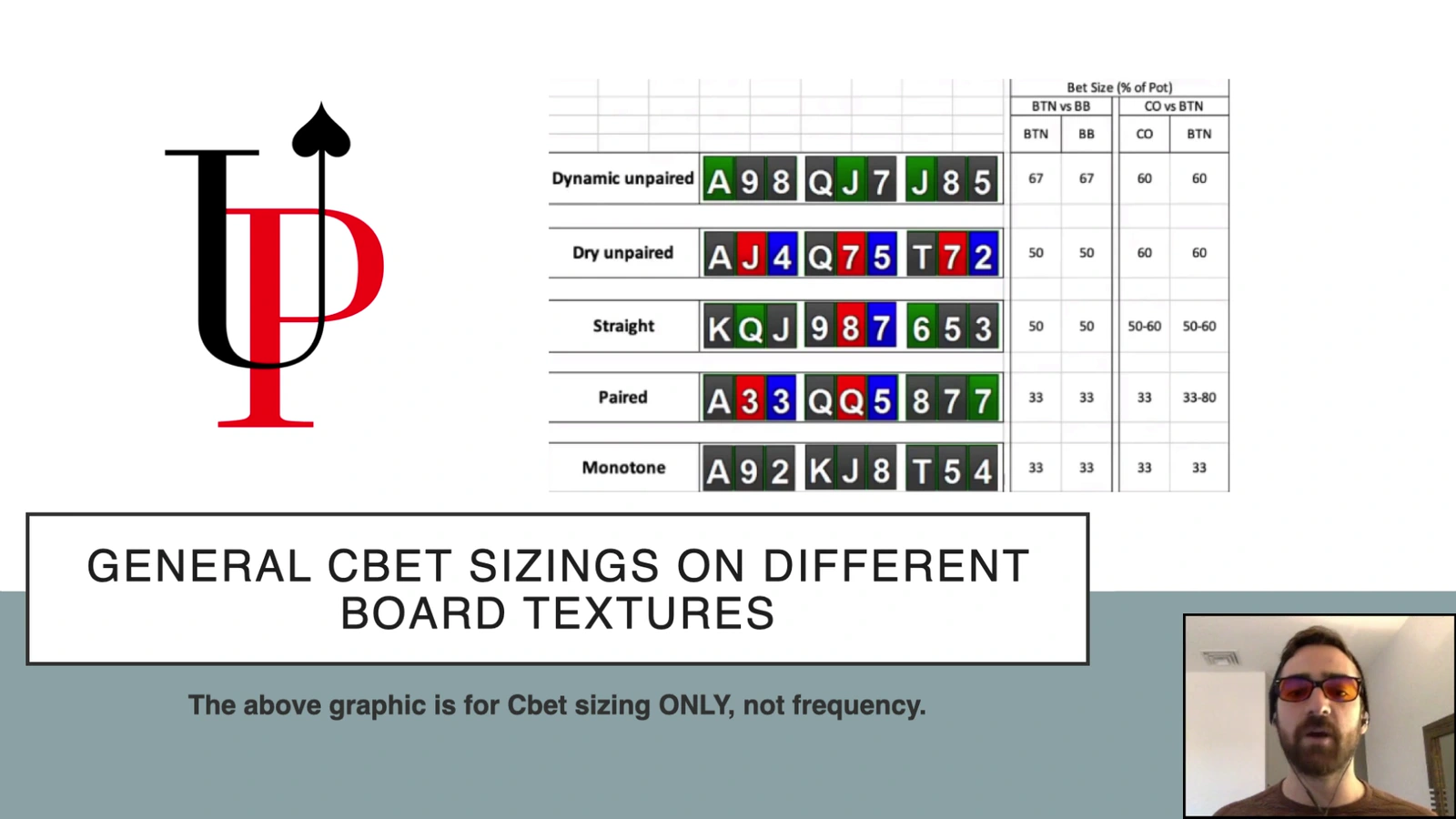
Now the board texture lesson adds a compact sizing map for the common single raised pot flops:
- Dynamic
- Dry
- Straightened
- Paired
- Monotone
And it keeps bet sizing and betting frequency separate. This matters, because it stops you from using the table like it hands you the answer every time.
So what about 3Bet pots? They add another layer.
Instead of using one size everywhere, the lesson connects your bet size with the stack to pot ratio. And it asks whether the hand wants to get the stacks in over two streets or three.
This is useful because every sizing has a clear purpose.
However, this is also where the “introductory” promise starts to stretch a bit. A new player already needs to understand range advantage. The lesson also expects you to judge how a hand holds up on later cards and plan the rest of the hand.
Then you get to the turn. And here the course continues the story, instead of treating each street on its own.
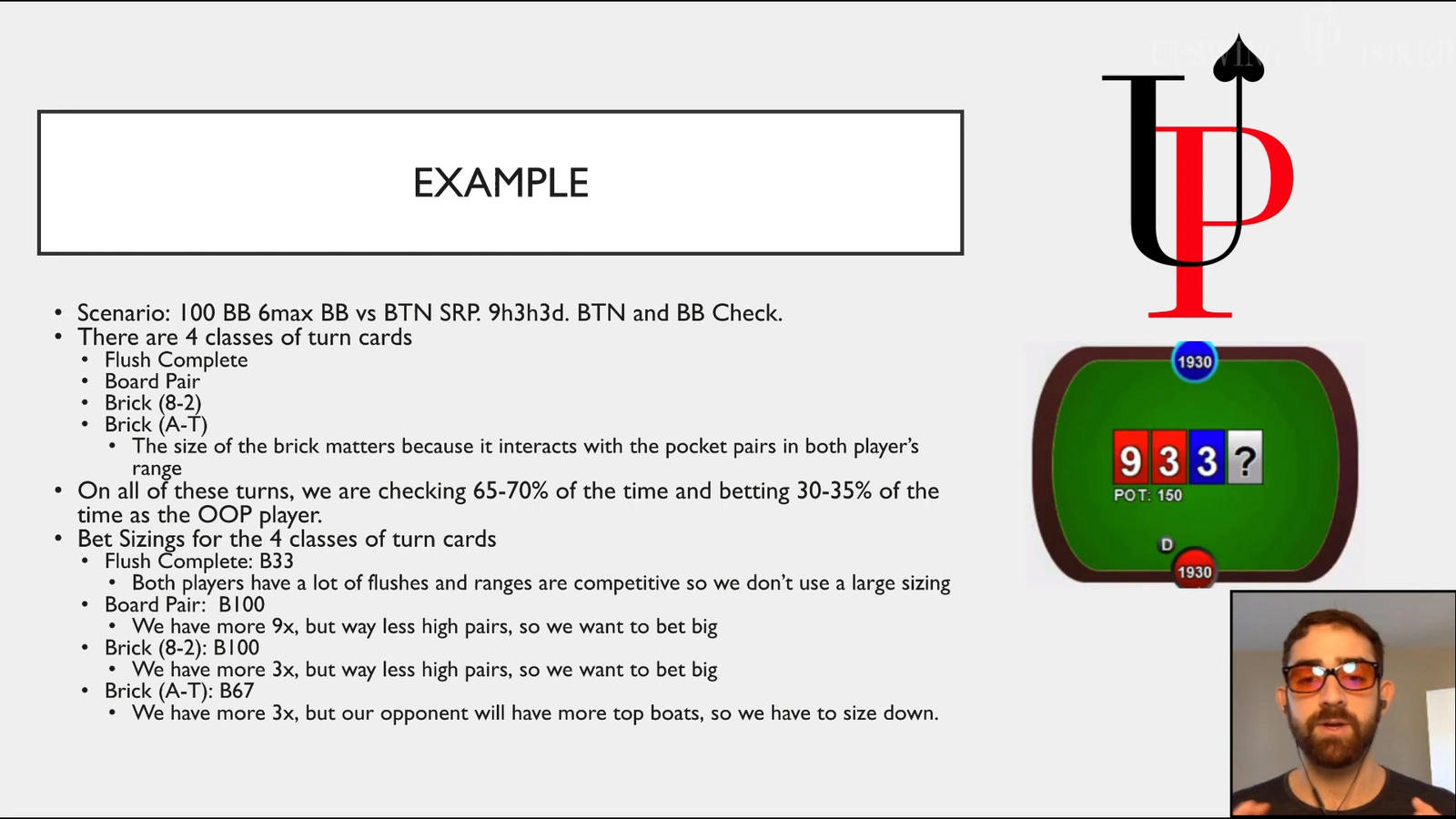
Turn cards are grouped by how they change both ranges:
- Completing a flush
- Pairing the board
- Completing a straight
- A brick
The checks and bets earlier in the hand then tell you which player can realistically have the strongest hands. And that tells you which bet sizes make sense.
And on the river, the course explains why blockers become more important as the ranges narrow.
Basically, taking away even one relevant combination matters a lot more when there are fewer combinations left.
The lesson also throws out the idea that the bottom of your range automatically has to bluff. With four hole cards in PLO, it is especially important to think about what your hand blocks before you turn it into a bluff.
The later-street ideas give beginners a useful starting point, with clear gaps still to fill.
The river section is pretty short, and the course is upfront about that. It sticks to a few chosen examples instead of covering every single line, position and board type.
5. Play and Explains Section Review
The Play & Explains section is pretty much exactly what it sounds like.
Dylan plays and explains his decisions as he goes.
The sessions move through these cash game stakes before the tournament review:
- PLO10
- PLO25
- PLO50
- PLO100
The progression is useful because you see the same concepts come back under different conditions. This includes rake pressure, wider or tighter ranges, multiway pots, effective stacks and opponent tendencies.
The PLO10 material shows you why disciplined preflop hand selection is so important when your opponents keep entering pots with disconnected or dominated hands.
It also teaches an important live poker lesson, even though it is played online.
In multiway pots, the course generally favours tighter hand selection because second best flushes and straights become way more expensive.
At PLO100 a lot more of the commentary turns into “it depends.”
Dylan discusses reg versus reg adjustments. And he admits that the recording itself can affect how his opponents play against him.
That kind of honesty is refreshing to see. It also gives you a reason to watch for his thought process and be careful about drawing conclusions about the player pool from these sessions.
The tournament review feels the most out of place in this course.
The discussion gets a lot more advanced than the opening modules. And at one point it openly admits that the analysis is based on cash game and final table work. There is no complete tournament simulation with antes for that spot.
It is interesting bonus material. But it is not a beginner tournament course.
Production:
The production gets the job done. Nothing fancy though.
The theory lessons use readable slides with Dylan on webcam in the corner. The Play & Explains use recorded poker clients, multiple tables and Dylan talking through the hands at length.
You get to see real decisions, which is great. But they are a lot harder to go back and find again than if the hands were all sorted and labelled.
The course would be a lot stronger with some summaries or drills after each practical block.
6. Downsides: Dated Content and Sales Pitches
Now with all of that said, there are some downsides to this course that you need to know about.
One of the fundamentals lessons explicitly describes what PLO looked like in 2021.
Several claims about weak player pools, live profitability and how easy it is to move up are all based on how things were back then.
The strategy itself may still be useful. But don’t use those market claims to judge any site, stake or live room today.
The Miscellaneous Fundamentals section is the weakest part of the entire package.
Some of the advice here is good. For example:
- Define success for yourself
- Build patiently
- Don’t rush into a professional poker career
But the same lesson also recommends investing heavily in coaching. And it makes expensive training sound like something that will pay you back many times over.
This moves way beyond poker strategy and into financial and career advice. And it does this without any real talk about bankroll, risk or protecting yourself as a buyer.
The live primer has some useful stuff on effective stack sizes, patience and the danger of overvaluing non-nut draws in multiway pots.
However, it also makes some broad claims about how soft and profitable live PLO games are.
Look, game quality varies a ton depending on the location, the stakes, the lineup, the rake and even the time of day.
So keep the technical multiway advice. And take the earnings talk with a big grain of salt. It is based on stories, it is dated, and it reads like a sales pitch.
PLO Launch Pad vs Crushing PLO Tournaments: Which One Should You Get?
Another common question is whether you should get PLO Launch Pad or Crushing PLO Tournaments.
PLO Launch Pad is the introductory choice. It starts with the rules, pot size calculations, hand construction and rules of thumb for low stakes cash games.
It does include some tournament footage. But tournaments are not what this course is built around.
Crushing PLO Tournaments is a much more specialised and expensive product. It is built around stack depths, tournament dynamics and advanced study.
By the way, there is already a full Crushing PLO Tournaments review on this site, right here.
A complete PLO beginner should not choose it just because the production is newer or there is more content.
The choice depends on how much PLO you already understand.
Choose Launch Pad if your immediate goal is to stop bringing hold’em assumptions into four card poker.
Only look at the tournament course once basic PLO hand selection and postflop terms feel comfortable, and tournament specific study is what you actually want.
What is the Price of PLO Launch Pad?
Lastly, time to discuss what it will cost.
PLO Launch Pad is currently $99 as a one-time purchase, with lifetime access to the 8+ hours across 6 sections.
At that price, the core theory, the practical footage and the raise first in guide make for a reasonable beginner package.
However, it is a different story if your study routine depends on the PLO Matrix.
That tool currently costs $49 per month on its own. And the Launch Pad product page does not list Matrix access as included.
So if you don’t want to pay for anything else, stick with the course framework and the guide. Don’t assume that every tool you see in the videos comes with the course.
The $99 price is easiest to justify for a hold’em player who will work through the course in order, pause the practical sessions and compare the decisions with the framework.
It is a lot harder to justify if you are:
- An experienced PLO player
- Looking for current player pool data
- Expecting software that comes with it and keeps getting updated
PLO Launch Pad Review Final Verdict – Is It Worth It For You?
PLO Launch Pad succeeds at its main job.
It gives a new PLO player a simple language for evaluating four card hands. And a clear way to think through the later streets.
Going step by step from hand quality, to range interaction, to stack to pot ratio and blockers is a lot clearer than just a random collection of tips.
However, the limits are just as clear:
- The course is stuck in 2021 in places
- It repeatedly points you toward other paid products
- Part of the running time goes on broad career and profitability claims
- The Play & Explains are useful, but they are not set up so you can easily find and drill specific hands
So is it worth it?
At $99, PLO Launch Pad is worth considering as a first structured PLO course for a disciplined beginner.
Just don’t expect a current guide to how the PLO games are running today, a complete multiway manual or an all-in-one subscription to Upswing’s tools.
The framework is the reason to buy it.
Official course page: PLO Launch Pad at Upswing Poker (opens in a new tab)
PLO Launch Pad FAQ
How much does PLO Launch Pad cost?
It costs $99 as a one-time purchase. That gets you lifetime access to the 8+ hours of video across 6 sections.
Is PLO Launch Pad good for beginners?
Yes. It is built for hold’em players moving over to Omaha and for newer low stakes PLO players.
The 3Bet pot lessons ask more of you. You need to understand range advantage, judge whether a hand can keep applying pressure as the board changes and plan the rest of the hand.
Is the PLO Matrix included?
No. The PLO Matrix is not listed as part of the $99 package on the current product page. Upswing sells it separately for $49 per month.
You can still learn the raise first in fundamentals without it, and the supporting guide is useful on its own.
What is included in the course?
Six sections: PLO 101, Preflop, Flop, Turn and River, Miscellaneous Fundamentals and the Play & Explains. You also get a supporting raise first in guide.
Which suits a beginner: PLO Launch Pad or Crushing PLO Tournaments?
Get Launch Pad first if you are new to PLO. Crushing PLO Tournaments is a much more specialised and expensive course, and it only makes sense once the basics feel comfortable and tournament study is what you actually want.