Poker course review
Elite Cash Game Exploits review: is Uri Peleg's course worth $999?
Elite Cash Game Exploits review: who Uri Peleg’s $999 solver-backed exploit course suits, what the preflop maths gives you, and why the bonus charts are not exploit charts.
A solver-backed method for finding and pricing opponents' mistakes, taught to regulars who can already read the output.
Price and access: $999 · lifetime access in the Upswing members area · about 25 hours of video by Upswing's count · preflop chart viewer, a late-position steal calculator and a private group included · no free trial · checked 27 October 2026
The verdict: Elite Cash Game Exploits
A solver-backed method for finding and pricing opponents' mistakes, taught to regulars who can already read the output.
The good
his main claims are backed by a solver EV or a calculator, and the preflop steal maths is usable at once
The bad
the sizing drills need your own PioSolver, and the 539 bonus charts are solver equilibrium ranges
Elite Cash Game Exploits is worth $999 to one kind of player: an online cash regular who already studies with solver output or preflop charts and wants a method for leaving them behind on purpose, with numbers to justify each step. Uri Peleg teaches you to read an opponent, put a price on his mistake and take it, then move on before he notices. If that is the game you want to play, this goes much further than Upswing's cheaper Exploit & Conquer.
It is a demanding course. Peleg argues rather than lectures, and most of the arguing happens on a solver screen. You need to be comfortable reading a range grid, following a node lock and doing simple expected-value arithmetic, because that is how his main claims are backed up. The sizing drills assume you own PioSolver, and the bonus viewer with 539 preflop charts holds solver equilibrium ranges, as its own page says, rather than anything exploitative.
Players who want a clean set of adjustments to memorise should look elsewhere. Players who have read enough theory to be bored by it, and who suspect their regulars are not as solid as their stats suggest, will find a coach who thinks the way they do and goes further.
What you are buying
The course runs in four parts. Exploitative Poker 101 makes the case for playing this way and sets up the tools: how a solver reaches its answer, what a node lock shows you, how to read a HUD without fooling yourself, and the difference between a hard exploit and a soft one. Preflop is the most practical part. Postflop covers bet sizing, c-bet strategies, two player archetypes with a drill session each, and the follow-up question of what happens after the flop once your preflop range is no longer normal. Play and Exploit is Peleg at the tables and in a tracker, building reads on real players from NL50 Zoom to $25/$50.
Peleg says at the start that exploitation was hard to put in order because everything connects to everything else, and he means it. Later lessons lean on earlier ones, a solver riddle posed in the first hour is only answered deep in the postflop chapter, and the live play sessions are meant for after you have seen the rest. Work through it from the top. Dipping in when a spot comes up will leave you missing the lesson the current one leans on.
The lessons themselves alternate between two looks. Some are branded Upswing slides with Peleg on camera. Others are raw screen capture of PioSolver or an Excel sheet with his voice over it. He swears now and then, which fits the tone.
The pitch, with the money on screen
The opening lesson does not just assert that deviating from theory makes money. Peleg takes a 3-bet pot on an ace-high board, shows the in-position player's river expectation at equilibrium, then locks the opponent into the habits of a player who does not like bluff-catching. Keeping the balanced strategy against that opponent gains almost nothing. Firing every hand that cannot beat ace-ten lifts the in-position expectation by about 15 percent. That number, on a solver screen, is the argument for the whole course.
He follows it with a smaller example, an opponent who never leads into you on a particular river, where the gain is a few dollars rather than a windfall. The point is the comparison. Some mistakes are worth a big swing in your strategy, others are worth a nudge, and the course keeps asking which kind you are looking at.
His line on where the money comes from is blunt and quotable: whoever is playing your stake is not playing higher because he is making mistakes, and your job is to find them, charge for them and move up at his expense. The clip at the top of this review is that passage.
Preflop is the part you will use first
The preflop chapter is the strongest reason to buy. Peleg's view is that charts give you a baseline and no protection. In multiway raked games, a player who defends every zero-expectation hand costs the opener money without gaining any himself, and a table with one loose player or one tight player shifts the correct ranges far more than most regulars realise. He states this as fact, more than once, and invites you to challenge it. The rake argument underneath is sound even if the slogans run ahead of it.
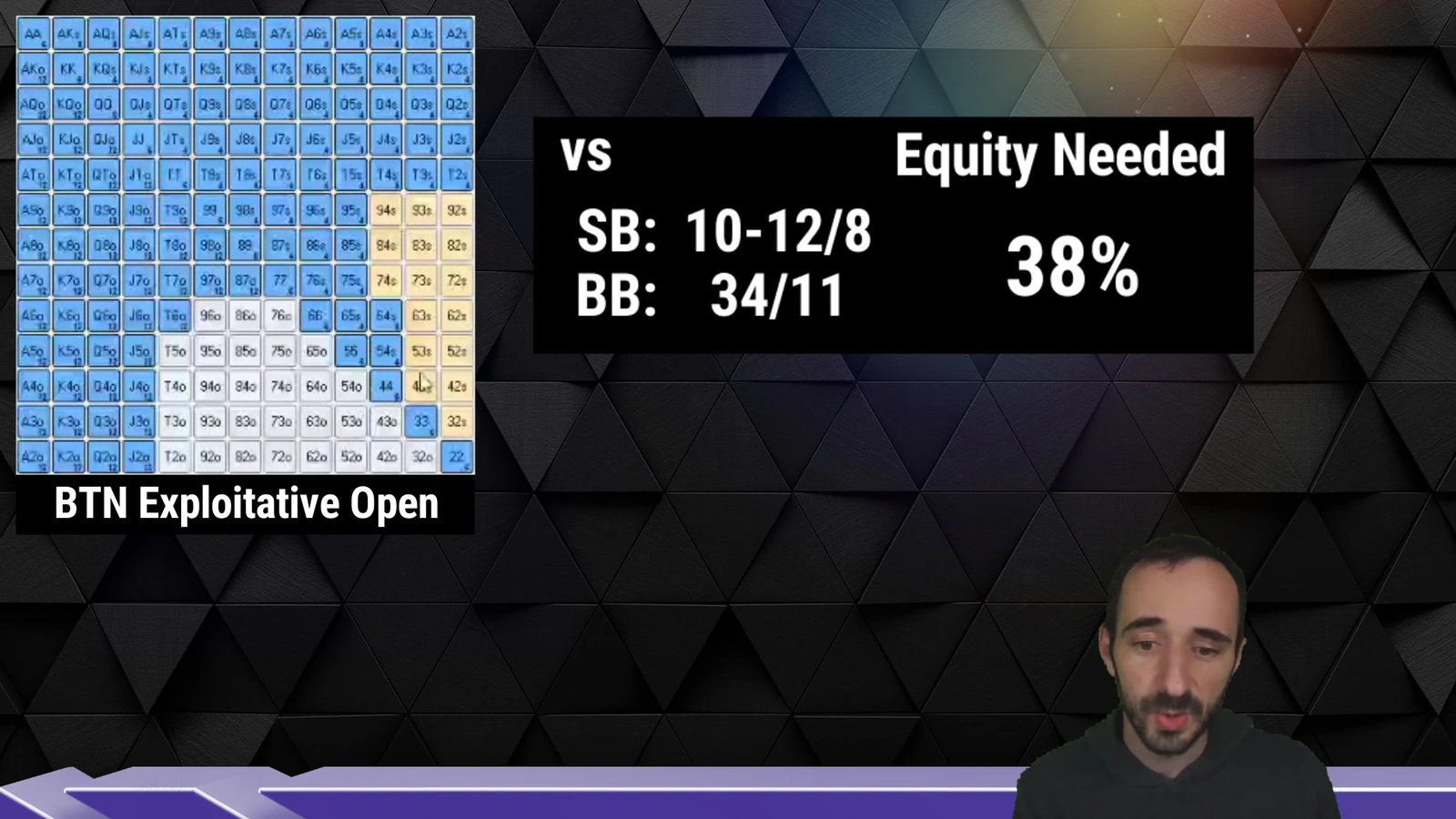
What makes the chapter usable is the arithmetic. A spreadsheet takes an open size, the blinds' calling and 3-betting rates and an equity-realisation factor, and tells you the minimum equity a hand needs to open. Peleg walks the numbers both ways. Against blinds that play roughly by the book, the button opens about what the charts say. Make the big blind 3-bet a little less and call a little more, which Peleg describes as how many regulars and semi-professionals actually play, and the required equity drops until most of the deck opens. Push it the other way, to a big blind who 3-bets a fifth of the time, and the same sheet tells you to stop opening any hand that folds to a 3-bet. The lesson is how unstable these spots are, and it lands.
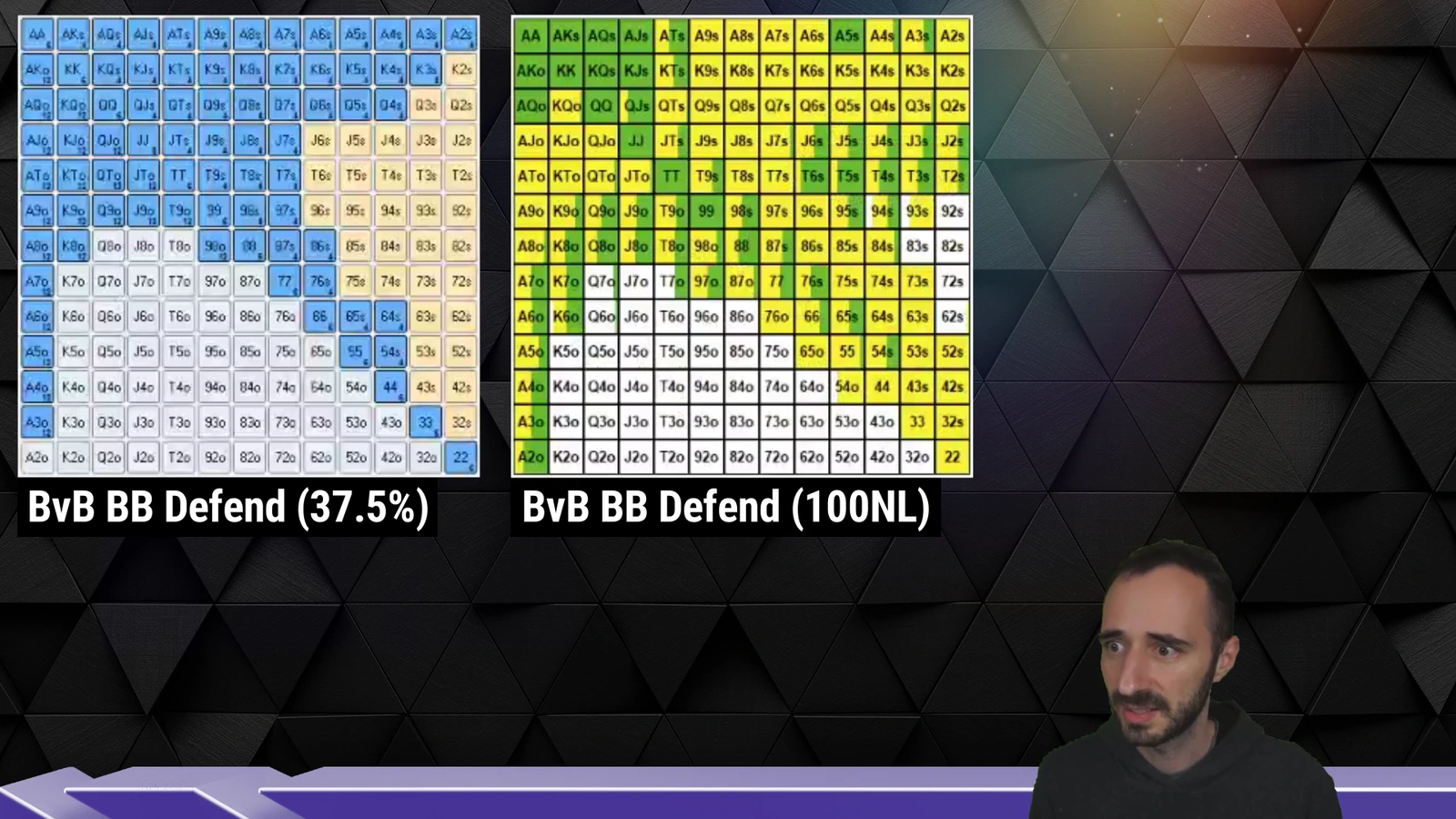
Blind versus blind gets the same treatment, with two numbers to remember for the big blind's call and 3-bet rates and a total below which any two cards become an open. He shows how to put those two stats in a HUD and colour them, so a player who is all green stands out and a single stray number gets ignored. He also makes the case for the min-raise as a steal size, since players who defend badly tend to defend worse against a smaller raise.
Two things keep this honest. First, he shows his own database samples opening junk from the small blind and button at high stakes, winning at a rate that matches the sheet, and says in the same breath that the samples are far too small to prove anything. Second, he keeps returning to the cost side: a junk hand that reaches showdown advertises what you are doing, so you fold the close bluff-catches and bluff the close bluffs to keep it off the table.
The answer to loose-passive tables is the chapter's most surprising moment. A solver experiment where the opponent cannot fold and 3-bets too small never picks the standard raise size. It limps or it opens big. Peleg's message to online players who sit in a live game and sneer at the limpers is that the limpers had it right.
Postflop: reasons first, then drills
The postflop chapter opens by tying itself back to preflop. A sticky recreational in the blinds is not a licence to open wider, because your weak hands are the ones that suffer against someone who will not fold. Sometimes the right answer is fewer hands and a bigger raise. Then comes the lesson that best explains the course's philosophy. On a turn where the solver is indifferent between betting and checking a bluff, Peleg models a river opponent who calls only top pair and shows the bluff gaining several big blinds on the river, which in turn makes the turn bet clearly right. His question is whether you want those big blinds or a random number generator.
The useful core of the bet-sizing material is a set of solver runs he calls punching bags, where the opponent can only call or fold, so you can see how much each class of hand wants to bet across three streets. Top two pair and better start big and grow. Top pair with a good kicker bets three times, each smaller than the last. A middle pair bets once for protection and then stops. He is careful to say the real opponent will raise sometimes and the thresholds move, but as a default against passive players it is immediately playable. The drill session that follows runs those sims in PioSolver's trainer, which is where the course's tool dependence shows: without your own copy there is nothing to click.
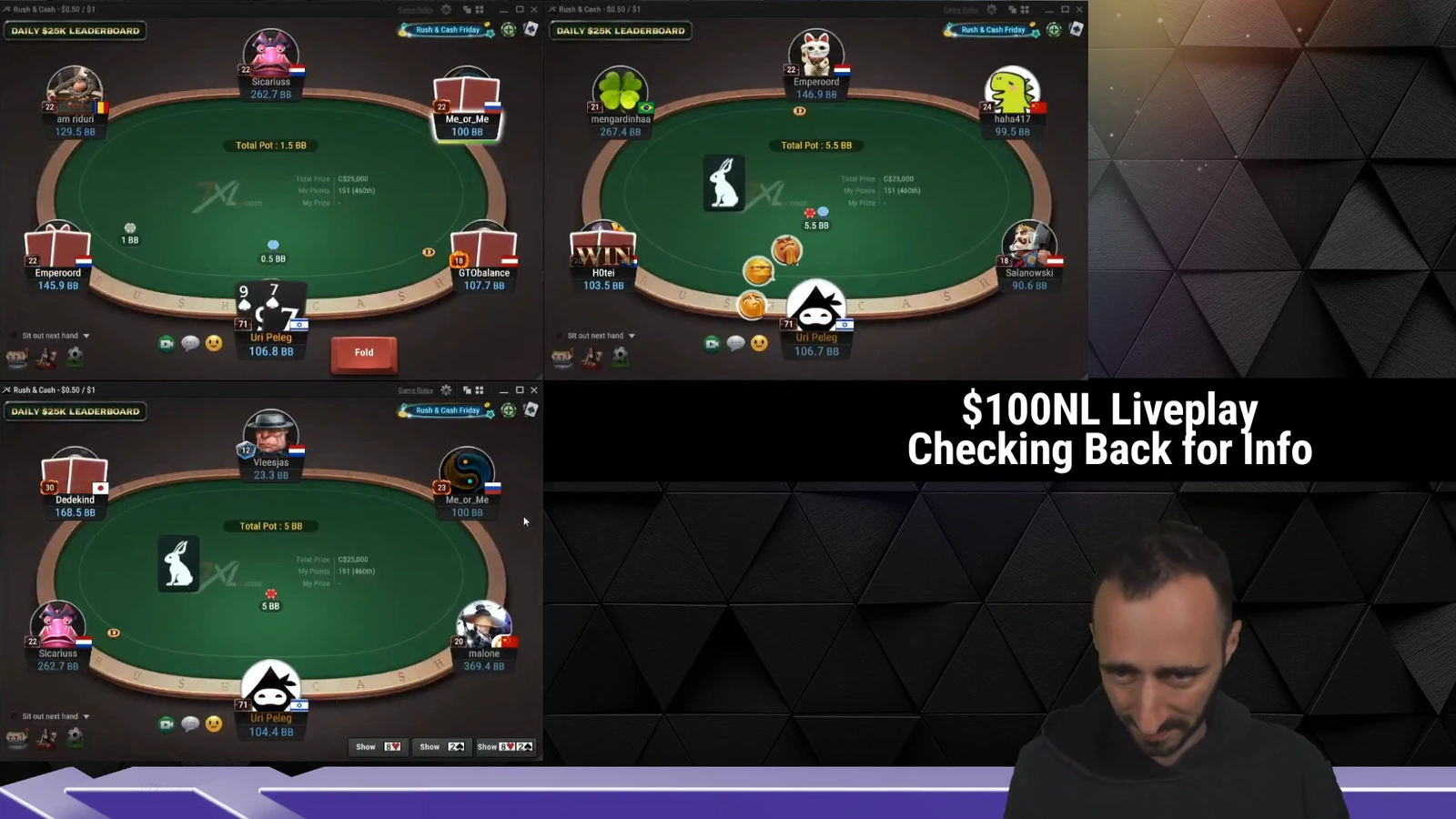
The sizing-tells live session is the most entertaining lesson and a fair warning about what the course asks of you. Peleg opens almost every hand at NL100 purely to reach spots where he can check and watch what sizes come back, then spends another lesson decoding what he saw. Within a few hands he has one opponent marked as a player whose bets mean what they look like, and another as a man with a 75 percent hotkey. He says plainly that nobody should play like this for money. The lesson is in how fast a careful note-taker learns what an opponent's sizes are telling him.
The two archetype lessons, the aggressive player and the calling station, each pair a theory session with a drill. Against an aggressive player, calling down more is called a level-one adjustment; the fuller answer involves slow-playing, cutting the hands that call once and fold later, and understanding that a called-down bluff burns the read. Against stations, the drill walks through hand after hand asking what changes if the opponent floats flops, calls turns or calls rivers, and it is specific about which hands stop barrelling. The drills here are the coach thinking aloud over his own hands. You watch him decide; you do not get exercises to complete.
The chapter ends with a lesson on the cost of all this. Once you are opening most of the deck against a tight big blind, your range on the flop is weaker than his, the solver bets it only a third of the time with a narrow polarised range, and the preflop maths that said the open was profitable assumed a normal flop. Peleg offers ways to handle it and admits there is no clean answer.
Reads without a HUD
The HUD lesson in the first chapter deserves a mention of its own, because it changes who this course suits. Peleg shows, with a sample-size calculator, that most of the stats players act on are noise. Won money at showdown needs well over ten thousand hands to be trusted to a single point. A fold-to-3-bet figure for one position needs tens of thousands, because the spot is rare. Players who act on a low sample, he says, are using something worse than nothing.
His alternative is to profile players from the whole picture of their numbers and their showdowns, and to let one confirmed trait tell you four others. That method works at a live table with a notebook as well as it works online with a tracker. It also means a live player can take the preflop and archetype chapters at face value, which is unusual for a course sold to online grinders.
The player analysis sessions
The last chapter is where the method becomes work. In the analysis videos Peleg opens a tracker on one player at a time, filters for hands that went to showdown so he only sees what a real opponent could have seen, and writes notes in a compact notation: board, positions, hand, line, exact sizes. He then infers. One well-chosen turn overbet from an opponent tells him the player studies and likely plays from chart ranges, so he can relax against that one and spend his attention on the rest. A player who checks back a flush draw is filed as someone who can still have the flush when it comes in after a check, so the usual wide bet into that river is off.
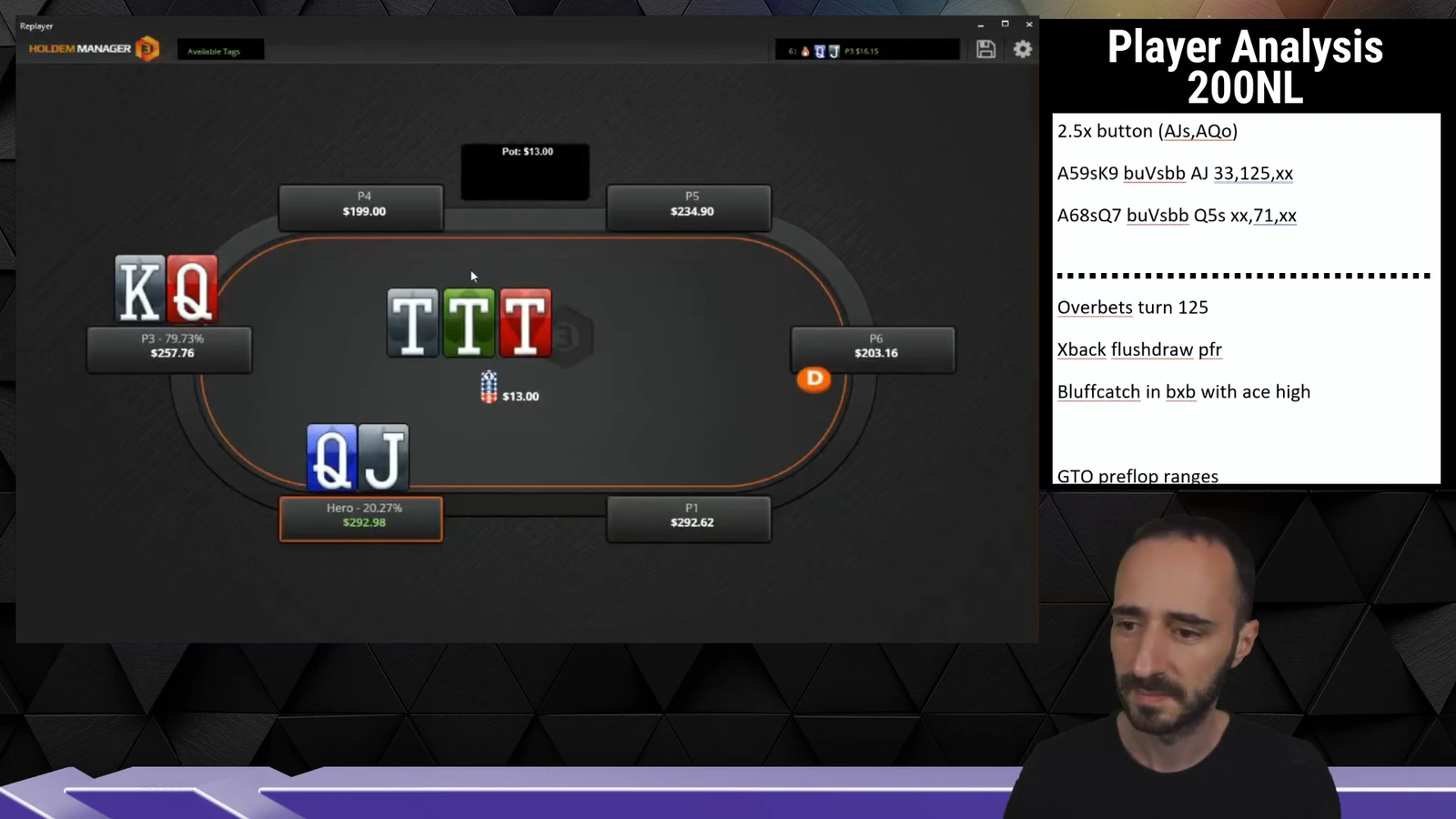
His advice is to give every regular you meet daily fifteen minutes of this, and the session on an NL50 Zoom player shows how to do it in two passes a month apart so you can see whether the player changed. The live play sessions, at NL200, NL500 and NL1000, are the same exercise in real time: non-standard raise sizes to test whether opponents adjust, more checks than usual to collect information, and notes dictated as he goes. He ends the first session down a little and says so. These sessions exist to build reads. Anyone expecting to watch a high-stakes player print money will be bored.
What the bonuses are and are not
The chart viewer is the bonus Upswing makes the most of on the sales page, and it needs a plain description. It holds the same set of preflop spots at five open sizes, from 2x to 3.5x, covering opens, defences, squeezes, 4-bets and 5-bet shoves. The sales page calls them solver generated and sells them as Peleg's own charts for playing preflop without mistakes; the page that hosts them says they were built in Monker Solver with 200NL rake. In other words, they are equilibrium charts with mixed frequencies, the kind Peleg spends the first chapter telling you not to copy. Inside the course's logic that is fine: you need a baseline before you can deviate from it, and he says so. Buy it for exploit charts, though, and you will not find any.
The late-position steal calculator appears in the lessons as a spreadsheet with a goal-seek button, and it is the tool behind the preflop chapter's best material. The sales page also offers a private group where you can ask Peleg questions and discuss hands with other members.
The sales page lists nothing else: no quizzes or workbook. Peleg's own Guerrilla Poker site sells two separate courses, on check-raising and on red-line play, which are not part of this package.
Who should pay $999
Pay if you are an online cash regular, somewhere between NL50 and the mid stakes, who already has a theory baseline and keeps bumping into the same regulars. The preflop chapter alone gives you a repeatable way to turn their small tendencies into opens and 3-bets with numbers attached, and the player-analysis method gives you a study routine that compounds. If you also own PioSolver and are willing to build your own sims, the postflop drills become usable too.
Live players who take notes are a second good fit. The HUD lesson tells you that you were never as far behind the online crowd as you thought, and the archetype and sizing material transfers.
Do not pay if solver output still looks like noise to you. The course explains its tools as it goes, but it does not teach you to read a strategy grid, and the first lesson assumes you can. It is also the wrong buy if what you want is exploit charts to memorise, short lessons on single spots, or exercises you can complete without a solver of your own. And anyone expecting balance-first teaching with exploits as a garnish will get the opposite, argued with conviction and occasionally overstated.
At $999 with lifetime access it costs a couple of dollars more than Saulo Costa's GTO Blueprint, which teaches the opposite philosophy at the same stakes and gives you twelve months of access for $997. Exploit & Conquer, Upswing's cheaper exploit course at $299, supplies the reads for you and drills the responses. Elite Cash Game Exploits is for the player who wants to find the reads himself and understand what each one is worth.
Elite Cash Game Exploits on upswingpoker.com
Official course page: Elite Cash Game Exploits at Upswing Poker (opens in a new tab)