Poker course review
Exploit & Conquer review: is it worth $299?
Alexandre Vuilleumier’s workbook-led course connects opponent leaks to decisions across streets. The reasoning and exercises are useful; validating the read remains the player’s job.
A useful exploit workbook with one important gap
A useful exploit workbook with one important gap: it gives you the read, but proving that read at the table is still your job.
Price and access: $299 one time · Lifetime access · Around three hours of video plus the workbook.
The verdict: Exploit & Conquer
Connected exploit drills for players with credible reads.
The good
Intermediate and experienced no-limit hold’em players who spot recurring mistakes but are not always sure how far the adjustment should go.
The bad
You need a beginner strategy, automatic leak detection or exact ranges for one particular game.
Exploit & Conquer is Alexandre Vuilleumier’s course on what to do after you think an opponent has a leak. On paper, that sounds simple enough: someone folds too much, so bluff more; someone calls too much, so value bet wider. If only poker stayed that tidy.
What the course does well is follow the read after the first adjustment. A preflop mistake changes the range that reaches the flop, while a flop mistake affects which hands are still around on the turn. A player can also use the right frequency while choosing completely the wrong hands. These connections are where the neat little labels stop being enough.
The catch, and it is an important one, is that most of the exercises tell you what the opponent is doing wrong. They ask you to build the response, but they do not teach a complete process for proving that the read is real.
What is included
The course opens with Vuilleumier’s thoughts on preparation, poker habits and how to think beyond one isolated hand. Then it gets to the main event: a workbook built around 62 opponent leaks, with written answers and video explanations covering preflop through river.
| Section | Main focus |
|---|---|
| Conceptual opening | Preparation, poker habits and thinking beyond one hand |
| Preflop: 26 leaks | Opening, calling, three-betting, four-betting and range construction |
| Flop: 17 leaks | Continuation bets, check-raises, probes and multiway pots |
| Turn: 12 leaks | Barrels, delayed bets, leads and checking ranges |
| River: 7 leaks | Probes, bet-check-bet lines and what the earlier streets leave behind |
| Workbook and summary | Writing your own plan, checking the answer and organising common tendencies |
Upswing lists around three hours of material. Don’t read that as three hours of study and a job well done. The workbook is supposed to be completed before you look at the answers.
If you use it properly, you pause, write out the adjustment and then compare it with Vuilleumier’s explanation, so the study time quickly grows. Let the videos roll in the background and you have missed most of the point.
The workbook is the reason to buy it
Each exercise hands you an opponent tendency and makes you commit to an adjustment. The written answer gives you the short version, while the video is where Vuilleumier explains the reasoning. You also get a printable PDF and an online quiz option that sends the answers by email. This is not a workbook full of equity calculations.
Instead, a quantitative leak means that someone takes an action too often or not often enough. A qualitative leak means the frequency may look fine, but the wrong hands are doing it. That sounds like a small distinction, but it matters because the useful response depends on what sits behind the number.
Write the answer down and a vague “bluff more” plan starts to look exactly as vague as it is. The workbook makes you commit to an actual idea before you see Vuilleumier’s. You don’t need a solver subscription to complete it, although a solver or database becomes useful later when you want to check whether the leak actually exists and how far you can push the adjustment.
Does Exploit & Conquer suit your game?
The workbook is useful across no-limit hold’em formats, but it does not give each format its own complete strategy. The real question is whether you can recognise the mistake in your games and explain what should change because of it.
| Your game | Where the workbook helps | What you still need |
|---|---|---|
| Online cash | Turning a credible stat or range read into a plan for later streets. | Enough relevant hands to trust the read. A high percentage over a tiny sample proves very little. |
| Live cash | Thinking through repeated mistakes you have observed, including what a passive or draw-heavy range leaves behind. | Reliable observations. A slow game gives you fewer hands, so be careful about treating an impression as a settled read. |
| MTTs | Following an opponent’s mistake through the rest of the hand. | Your own tournament knowledge. Stack depth and payout pressure can change the response; this is not a complete ICM course. |
The hardest part happens before the exercise starts
This is the main weakness of Exploit & Conquer.
The workbook might say that the opponent opens too tightly, under-bluffs the river or builds a check-raising range around too many draws. Your job is to respond. At the table, nobody hands you that first sentence, so you still need enough hands, showdowns or reliable history to know whether the read is genuine.
The more specific the read becomes, the more evidence you normally need. The course does warn about sample sizes, which is good. But it is not a full guide to database filters, noisy statistics or current player-pool research. The conditional answers are still useful; just don’t pin one on the first opponent who looks slightly unusual.
A preflop read follows you to the flop
One of the better lessons starts with an opponent who opens too tightly. What makes it useful is not the first preflop adjustment, but the way the course follows that read into the range that arrives on the flop. That is exactly the kind of connection the workbook is built to teach.
There is a nice bit of restraint here too. Vuilleumier warns you not to make the same adjustment twice, because your own range and the board still get a vote after you have changed the preflop plan. That is an easy trap once you have finally spotted something useful.
The merged three-bet lesson makes the same point from another angle. Here the issue is hand selection, not one pretty headline frequency. And the course is clear that this kind of read needs a large sample.
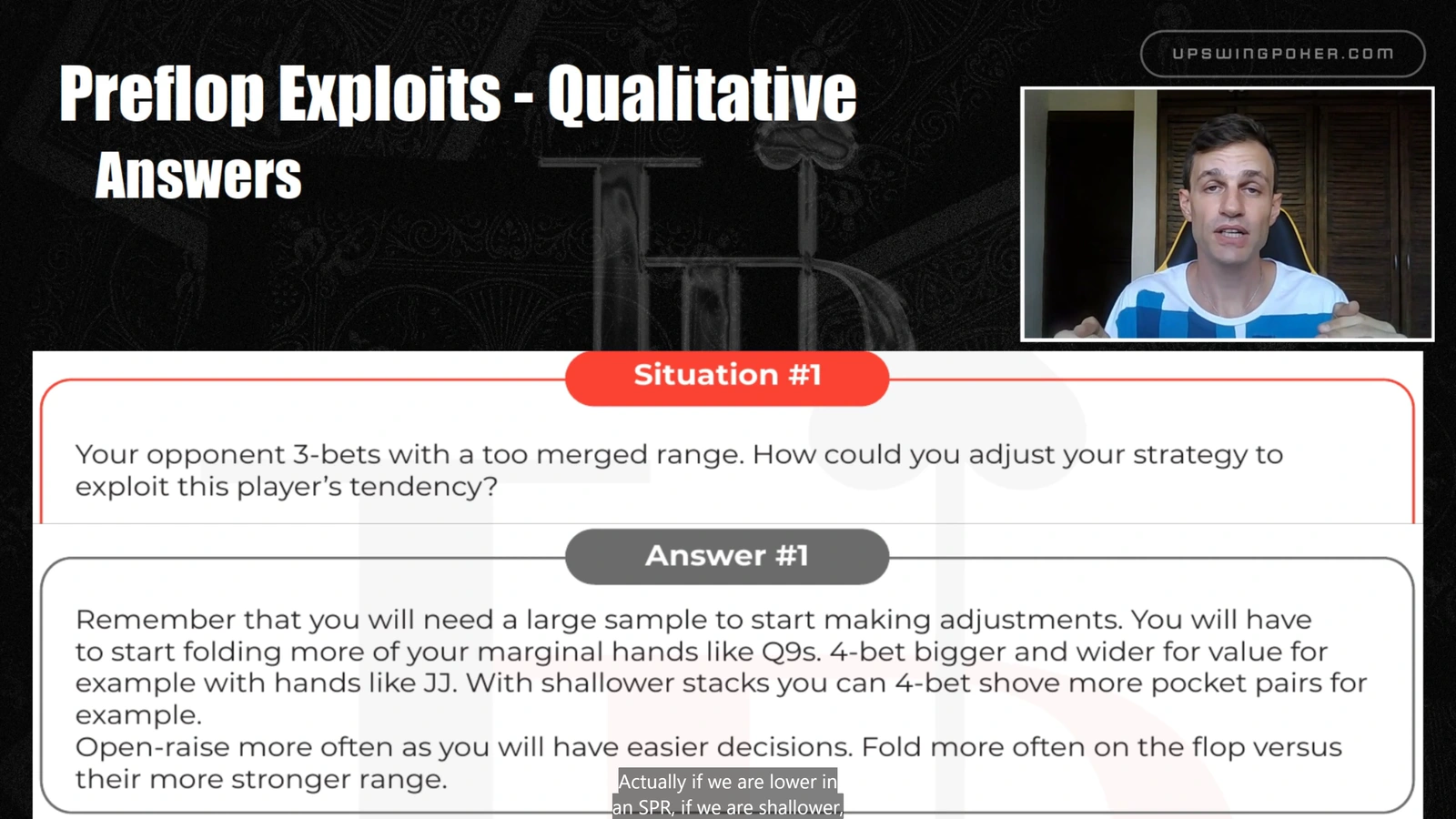
Seeing two strange three-bets at showdown still tells you little about the opponent’s entire range. The course makes that point plainly. Where it gets less precise is how far you should move. Many prompts leave the effective stack, rake, payout pressure or exact size of the leak unspecified. You are working through possible adjustments, so you still need to account for those details before taking an answer into your game.
Frequency and hand selection are not the same thing
A normal-looking stat can still hide a badly built range. The course is good at separating how often a player acts from which hands are taking the action, because the wrong mix changes what follows on later streets. That sounds basic, but it is the difference between having a read and having a usable plan.
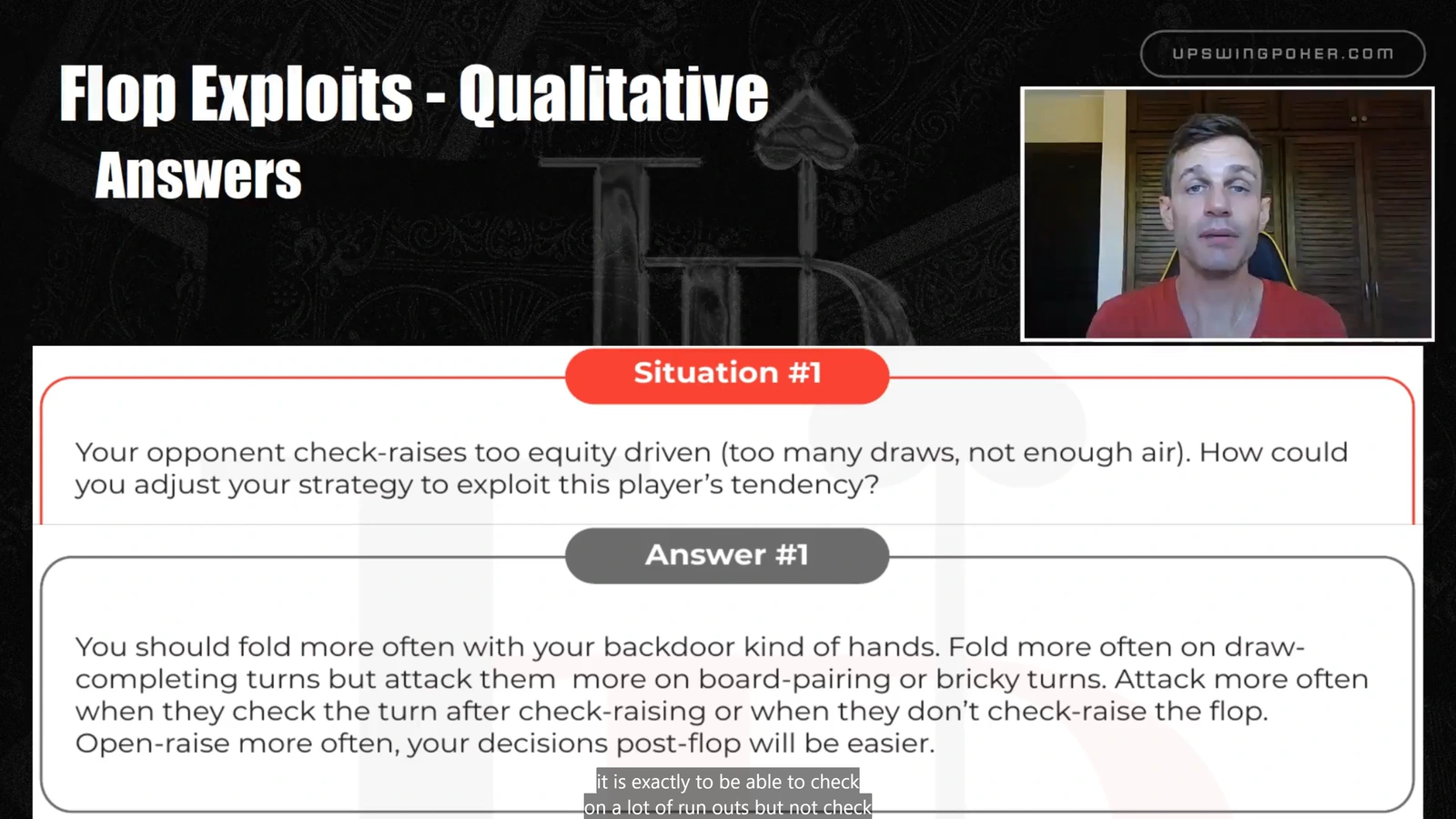
What matters is what sits behind the stat. Later cards do not affect every range in the same way, so the same headline number can call for a different response. That may sound obvious when it is written out, but it is easy to forget in a real hand. This kind of across-street reasoning is where Exploit & Conquer earns its money.
It doesn’t stop at “passive player” or “aggressive player.” It asks what the range contains, what changes on the next card and whether your adjustments still agree with each other. That is the right question. The warning is that range composition is harder to observe than raw frequency, and a believable story is not automatically a reliable read.
The turn and river keep the same logic
The turn section keeps the same idea moving. A read can make one line more attractive without making every other line profitable too. That sounds obvious, but it is exactly how a useful note turns into an expensive blanket rule.
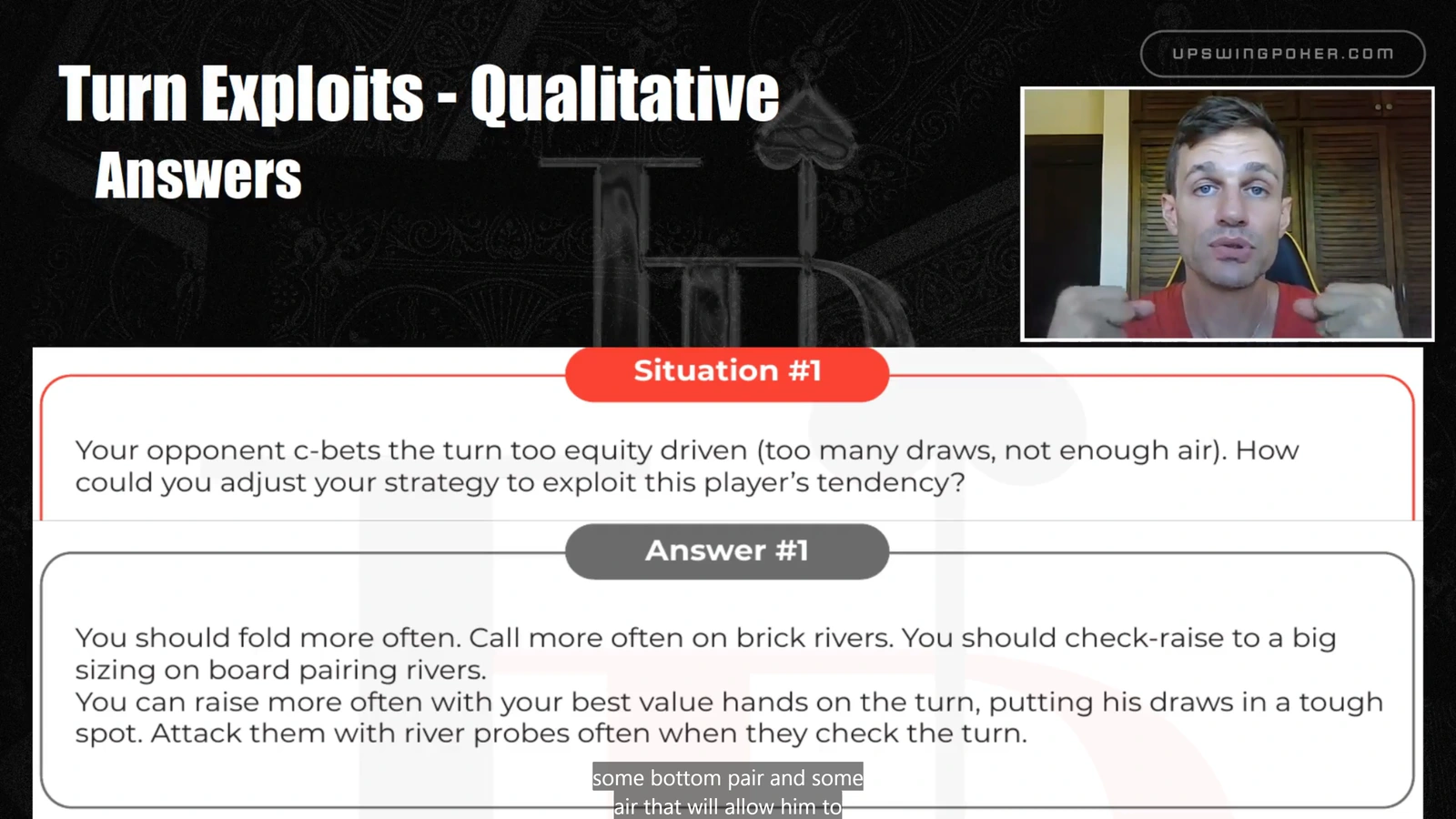
The river section is short, but it is not filler. It takes the same thinking into passive river lines, where the earlier read only helps if the opponent is still following the line it applies to. You are learning how that read changes the final decision, not memorising one response for every opponent who looks passive.
That last point is worth keeping in front of you. These are conditional examples, not blanket rules to open wider, raise larger or fold more. The adjustment only makes sense while the original read and the same line are still present.
Where the course falls short
It does not find the leaks for you
This is the practical hole in the course. It starts after the messiest question has already been answered, so you learn what to do against a stated leak without getting a complete system for deciding whether that leak exists in your current game. If that was the main problem you wanted to solve, you will not find the full answer here.
Some population claims need checking
Several lessons talk confidently about common player tendencies. Treat those tendencies as starting points that need checking against your own game. A live cash game, a fast-fold pool and a tournament near a pay jump can call for very different adjustments. The claim still needs to fit the opponents in front of you.
The opening takes a while to reach the poker
The early lessons spend time on poker culture, preparation, behaviour and “protathletism.” Some of the advice is sound: explaining a poker concept aloud without a script is a good test of whether you understand it, while tracking pot sizes and preparing for decisions also matters. But the longer philosophical sections wander when the workbook is clearly the main attraction.
You need a baseline strategy first
Vuilleumier uses ideas such as polarised ranges, equity realisation, blockers and delayed continuation bets without rebuilding them from the ground up. That is fine if those terms are already part of your working poker language. If you are a beginner, it leaves one rather important question unanswered: what are you adjusting from?
A useful check before paying: can you explain why a tight opening range changes the hands that reach the flop, or why a player who rarely bets the river may need a different response? You do not need a precise solver answer. But you should be able to describe the ranges and give a reason for your adjustment. If the terms themselves are the difficult part, build that foundation first.
Exploit & Conquer or Precision Poker?
These two courses solve different problems. Vuilleumier’s Precision Poker review covers a broader system for studying and making decisions, while Exploit & Conquer gives you specified opponent mistakes and asks you to build a sensible response.
Choose Exploit & Conquer if you already have a workable strategy and struggle to turn a read into a plan across several streets. Look at Precision Poker if the larger problem is organising your study and understanding how the decisions fit together.
The Carrot Poker School review is another thing altogether. It covers a much larger progression through Grades 1, 2, 3 and E, not a direct substitute for this short workbook course.
Should you choose this or Upswing Lab?
Upswing Lab 2.0 makes more sense if you still need a connected route through poker strategy for your main format. Exploit & Conquer is the more focused choice when you already have that base and keep spotting mistakes without knowing how to build the response.
The workbook also suits someone who wants a one-time purchase and will work through written problems. Do not choose it just to avoid a subscription if what you actually need is help learning the strategy those problems assume.
Price and value
The current standalone price is $299 with lifetime access. Upswing includes the downloadable workbook, English subtitles and transcripts. The nice part is that you do not need another paid tool to answer the exercises, although validating real tendencies may involve the solver or database tools you already use.
Do not assume that an old launch bundle is still available. Buy on the contents of the current order, especially if another course is the reason you are interested.
There is no free trial. Under Upswing’s published refund policy, first-time buyers of the course can request a refund or exchange within 30 days and must give specific reasons. Watching a significant portion can make you ineligible. Upswing decides what counts as significant and whether to approve the request, so do not treat the policy as permission to finish the course and return it.
The price makes the most sense if you will stop, write down your answers and revisit the ones you got wrong. If the workbook stays unopened while the videos run in the background, save the $299.
Final verdict
Exploit & Conquer is a good course for players who already understand poker strategy but struggle to build clean adjustments. The workbook is the best part. It forces you to connect one opponent mistake with decisions across the rest of the hand, instead of memorising one counter and forgetting everything that follows.
But it does not solve the whole problem.
The course usually hands you the leak. A real game does not, so you still have to prove that the leak exists, decide how reliable the evidence is and avoid pushing the adjustment too far.
If you are an intermediate or experienced player who will actually complete the exercises, the workbook earns its keep. If you are a beginner, or you want the course to diagnose the player pool for you, this is the wrong purchase.
At $299, the workbook and the reasoning have to justify paying for a course with three hours of video.
Official course page: Exploit & Conquer at Upswing Poker (opens in a new tab)