The short version
- Lines move on new information, on money, and on the operator's own risk position.
- A move tells you what someone believes, not what is going to happen.
- "Steam" is frequently a lagging signal by the time a retail customer can see it.
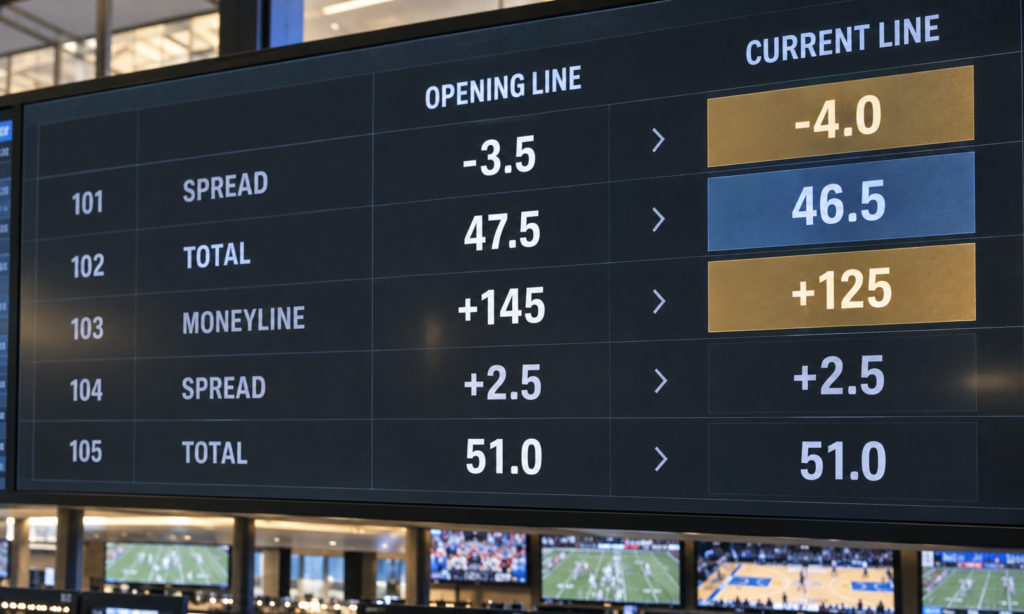
Open a market a week before an event and watch it until kick-off and the price will almost certainly have changed, often several times. The movement is real information about something. The difficult part is working out about what.
Reason one: information
The clearest driver. A starting goalkeeper is ruled out; a pitcher is scratched; a court is resurfaced; the forecast turns to heavy rain. The underlying probability of each outcome genuinely changes, and the market re-prices to reflect it.
Information-driven moves tend to be fast, roughly simultaneous across operators, and sticky — the price does not drift back, because the new fact has not gone away.
Reason two: money
Sportsbooks hold liability. If a disproportionate amount is staked on one side, the operator's exposure grows, and one way to manage it is to shorten the price on the popular side and lengthen it on the other, encouraging money towards the balance.
This kind of movement is not a statement about probability at all. It is inventory management. A team with a large, enthusiastic following will frequently be priced shorter than a neutral estimate would justify, simply because that is where the money goes.
The important consequence: a price moving towards a selection does not mean that selection has become more likely. It may only mean that a lot of people like it.
Reason three: respected money
The third case sits between the other two. Some customers are believed by the operator to have a genuine edge — syndicates, models, people close to a sport. When they bet, operators frequently move the price much further per unit staked than they would for ordinary volume, because the bet itself is treated as information.
This is what people mean by "sharp money" or "steam". The move is fast, it often starts at a small number of books known for taking large early bets, and it propagates outwards.
There is an obvious problem with trying to follow it. By the time a move is visible on a consumer-facing site, the price that prompted it has usually gone. Chasing steam at a worse number than the people who caused it is a reliable way to bet into a market that has already corrected.
Closing line value, and why it is used as a yardstick
Among people who bet seriously, the most common measure of skill is not profit over a season — that is far too noisy — but whether the price you took was better than the price at the moment the market closed. This is called closing line value.
The logic is straightforward: the closing line is the market's most informed price, arrived at after every piece of news and every serious bet. Consistently getting a better number than the close suggests you are finding something before the market does. Consistently getting a worse one suggests the opposite, whatever this month's results look like.
It is worth adding the honest counterweight. Operators watch this too. Customers who beat the closing line reliably are the ones most likely to have their stakes limited or their accounts closed, which is a legitimate commercial decision on the operator's part and a fact anyone approaching this seriously should know in advance.
What "line shopping" is really buying
Because different operators respond to information and to money at different speeds, the same selection is frequently available at meaningfully different prices at the same moment. Taking the best available number is the least glamorous and most dependable habit in sports betting.
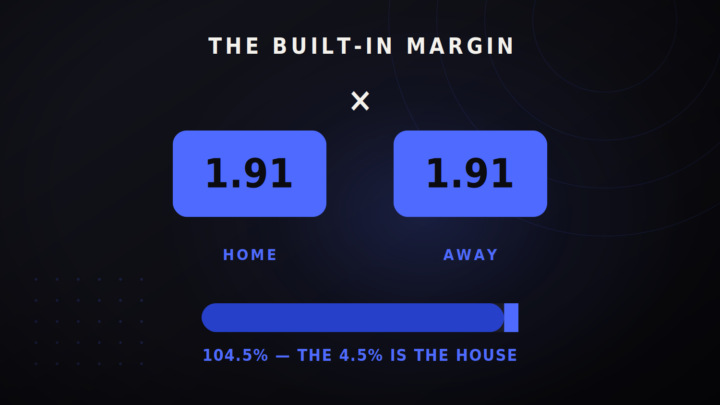
The effect is not small. A bettor who wins 53% of bets at 1.91 is roughly break-even; the same bettor at 1.95 is comfortably ahead. That difference is the entire gap between a losing and a winning record, and it comes from nothing more than having accounts in several places and checking before staking.
What movement cannot do
It cannot tell you an outcome. Markets are wrong constantly — that is what makes them markets. A heavily backed favourite that shortens from 2.00 to 1.70 still loses roughly a third of the time if the closing price is accurate, and accurate prices are the best case, not the norm.
Treat line movement as a description of what other people currently believe and how much the operator wants to hold. It is a useful input into your own estimate. It is not a forecast, and no pattern of movement is a system.
Sources and checking
Closing line value is a widely used concept in sports betting analysis. The arithmetic examples here are straightforward calculations and can be checked directly.