The short version
- A handicap adds or subtracts goals, points or runs so that both sides can be priced close to evens.
- The half-point exists to remove ties, which is a commercial decision as much as a sporting one.
- A "juice" of −110 on both sides of a spread is a margin of about 4.5%.
If one team is overwhelmingly likely to win, a straight match bet is unattractive in both directions: the price on the favourite is tiny, and the price on the underdog looks like a lottery ticket. Handicap markets solve that by moving the goalposts — literally — until both outcomes are close to equally likely.
The mechanism
A handicap applies a notional adjustment to the final score before the bet is settled.
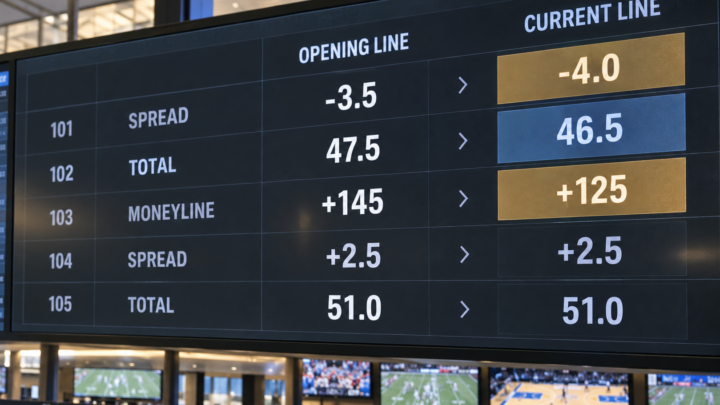
Take a basketball game where one team is a heavy favourite. The sportsbook sets the spread at −7.5 for that team, which means:
- Betting the favourite at −7.5 wins only if they win by 8 or more.
- Betting the underdog at +7.5 wins if they lose by 7 or fewer, or win outright.
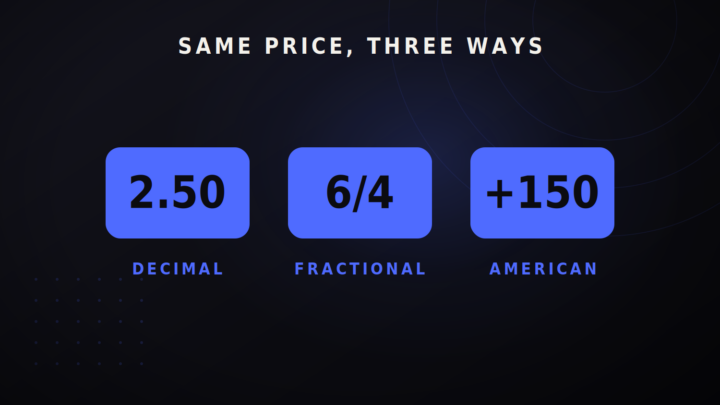
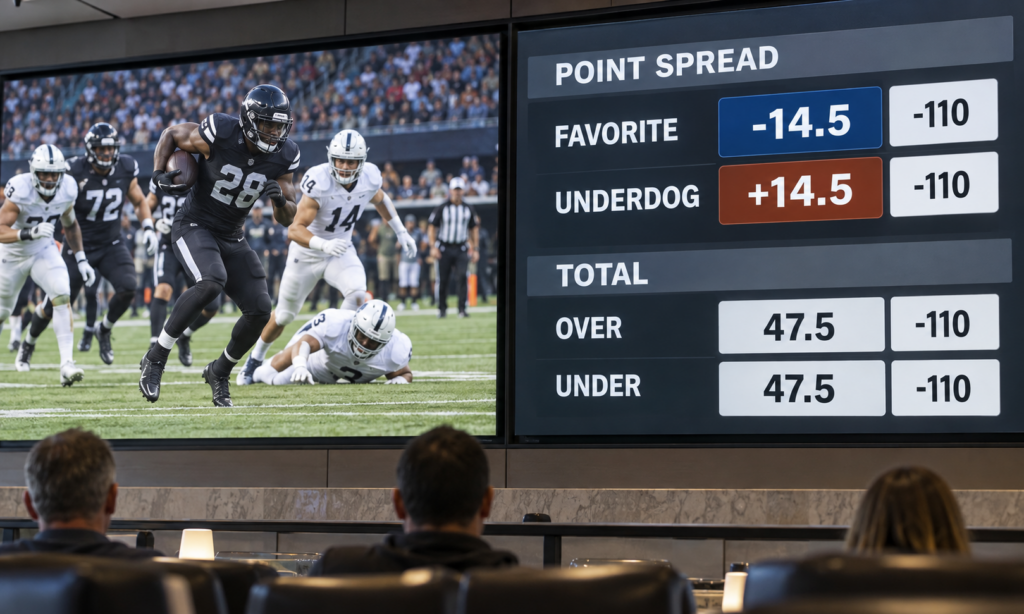
Both sides are then priced at or near the same number, commonly −110 in American odds (1.91 decimal). The handicap, not the price, carries the difference in strength between the teams.
Totals — "over/under" — use the same idea on a different quantity. The book sets a line for combined points, goals or runs, and you bet on whether the real figure lands above or below it.
What the half-point is doing
A line of −7.5 cannot produce a tie. A line of −7.0 can: if the favourite wins by exactly seven, the bet is a push and stakes are returned.
Operators use whole numbers and half-points deliberately. A whole number introduces the possibility of a push, which reduces variance for both parties and is often paired with a slightly better price. A half-point removes it, which produces a clean win-or-lose settlement and a market that is easier to price and easier to sell.
In sports where certain margins are far more common than others, the half-point matters a great deal. American football is the standard example: scores cluster around three and seven because of the scoring system, so moving a line from −3 to −3.5 removes a genuinely likely outcome rather than a rare one. Buying or selling half a point around those numbers costs far more than it does around, say, −5.5.
Asian handicaps and the quarter line
Asian handicap markets extend the idea by allowing quarter-point lines such as −0.25 or −0.75. A quarter line splits your stake across the two nearest half-point lines:
- A bet at −0.25 is half your stake at 0 and half at −0.5.
- If the match is drawn, the half at 0 pushes and the half at −0.5 loses. You lose half your stake, not all of it.
This produces four settlement outcomes instead of two: win, half-win, half-loss, loss. It is not a way of reducing the operator's margin; it is a way of reducing the variance of the bet, which is a different thing entirely.
Asian handicaps also remove the draw from football markets, which is why they are often quoted with tighter margins than the equivalent three-way market. Fewer outcomes to price usually means a narrower book.
Where the charge sits
On a two-way handicap priced −110 on both sides, each side implies a probability of 110 ÷ 210 = 52.38%. The two add to 104.76%, so the margin is about 4.5% of the amount matched.
That figure is worth holding onto because it is the benchmark most spread markets are measured against. A book offering −105 on both sides is charging roughly 2.4%; one offering −120 both ways is charging around 9%. The line can be identical in all three cases. What differs is the fee.
Two practical consequences:
- Compare the price, not just the line. A friendlier line at a worse price is often the worse bet.
- Watch for alternative lines. Operators offer the same match at several handicaps. The alternative lines are frequently priced with a much wider margin than the main one, because they attract less attention.
What handicaps do not do
A handicap does not make a match more predictable. It makes it closer to a 50/50 proposition as priced, which is the opposite of an information advantage — the operator has deliberately removed the part of the outcome that was easy to forecast.
It is also worth being clear that the ability to construct an elaborate bet is not the same as the ability to find value in it. Combining several handicaps into one wager multiplies the margin: a four-leg parlay at 4.5% per leg carries a compounded charge in the region of 17%, which is casino territory rather than sportsbook territory. Operators promote parlays heavily for exactly this reason, and it is the single clearest example in sports betting of a product designed around its margin rather than around the bettor.
Sources and checking
The margin calculations here follow directly from converting American odds to implied probabilities, as set out in our article on odds formats. No operator-specific claim is made.