The short version
- Odds are a probability with a fee attached, not a forecast you can take at face value.
- The implied probabilities of a market add up to more than 100%. The excess is the book's margin.
- Margin is the most reliable thing to compare between operators, and almost nobody advertises it.
A sportsbook is not in the business of predicting football. It is in the business of pricing risk so that, across thousands of markets, it takes in more than it pays out. Understanding how a price is built is the difference between reading odds as a forecast and reading them as a product with a price tag.
From probability to price
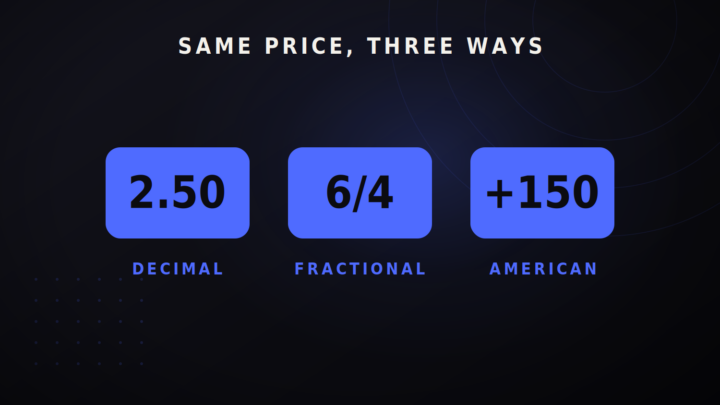
Start with a coin toss. A fair coin lands heads half the time, so the fair price for heads is 2.00 in decimal odds: stake 10, get 20 back, profit 10. Over many tosses you break even.
The conversion works in both directions. To turn decimal odds into an implied probability, divide one by the odds:
- Odds of 2.00 imply a probability of 1 ÷ 2.00 = 0.50, or 50%.
- Odds of 4.00 imply 1 ÷ 4.00 = 0.25, or 25%.
- Odds of 1.25 imply 1 ÷ 1.25 = 0.80, or 80%.
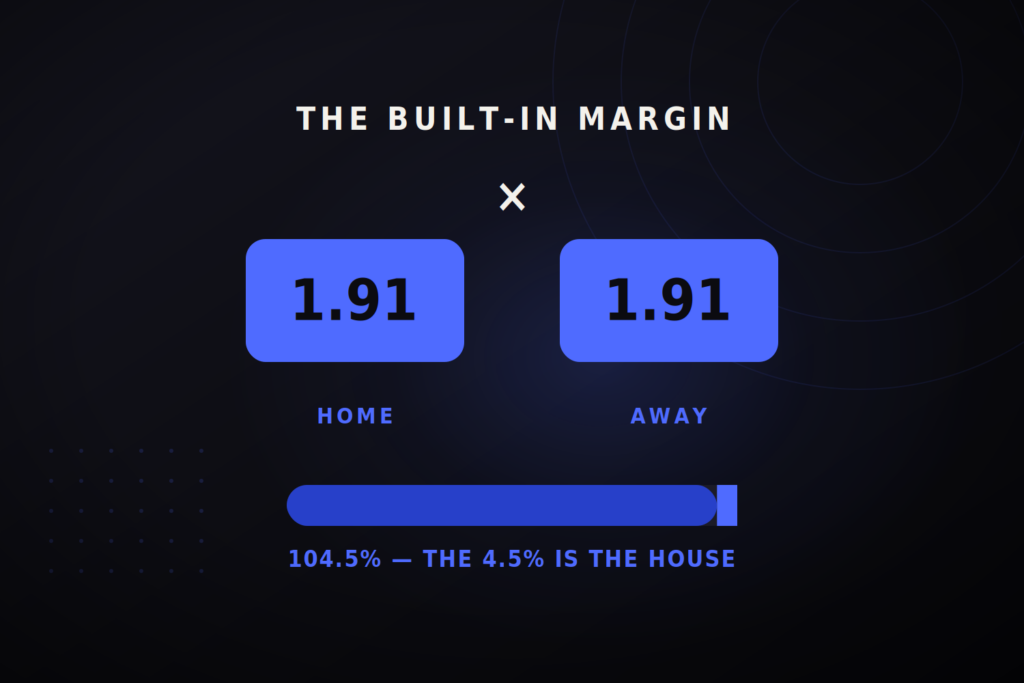
Now price that coin toss the way a bookmaker would. Instead of offering 2.00 on each side, the book offers 1.91. The implied probability of each side becomes 1 ÷ 1.91 = 0.5236, or 52.36%. Two outcomes, each priced at 52.36%, add up to 104.72%.
That 4.72% is not a rounding error. It is the charge.
The overround, and how to measure it
The sum of the implied probabilities in a market is called the overround or the book percentage. A market that adds up to exactly 100% is a fair book, and no commercial operator offers one. Anything above 100% is the operator's margin.
To work out the margin on any market, convert every price to an implied probability, add them up, and subtract one:
- Take a three-way football market priced 2.10 / 3.50 / 3.75.
- Implied probabilities: 0.4762, 0.2857, 0.2667.
- Total: 1.0286, so the overround is 2.86%.
Do the same for the same match at another operator and you can compare like for like. A market at 2.86% and a market at 7% are the same event with two very different prices, and the second one costs you roughly two and a half times as much to bet into.
Rough figures worth carrying around: major football match-odds markets are often priced somewhere between 3% and 7%; big tennis and basketball moneylines are frequently tighter; niche competitions, player props and long-range outrights are usually a great deal wider, sometimes above 20% for an outright market with many runners. The wider the market, the less the individual prices tell you about anything except the operator's appetite for risk.
Why margin is not shared out evenly
A book does not apply its margin uniformly across the outcomes. It shades prices towards the side it expects to take more money on, and towards the outcomes casual bettors prefer — favourites in some sports, outsiders with a story in others. Two operators can post an identical overround and still disagree about which side is being charged for it.
This is why "best odds" comparisons on a single selection are weak evidence. An operator can post a market-leading price on the popular side and recover it several times over on everything else in the same market. What you are being shown is the loss leader.
What this means when you read a promotion
Almost every sportsbook promotion is expressed in terms of stake, not in terms of price. "Bet 20, get 20 in free bets" says nothing about the odds you must accept to qualify.
Work through the arithmetic. Suppose a qualifying bet must be placed at minimum odds of 1.80, and the operator's margin on the relevant market is 6%. Your expected cost on that qualifying bet is roughly 6% of 20, or 1.20. If the free bet that follows is a stake-not-returned token — you keep the winnings but not the stake — its real value is meaningfully below its face value, typically somewhere between 60% and 80% of the printed figure depending on the odds you use it at. A "20" free bet may be worth 14 or 15 in practice.
None of that makes the promotion bad. It makes the headline number the wrong thing to compare. The questions that matter are the minimum odds, whether the stake is returned, what the free bet can be used on, and how long it lives.
A short, honest caveat
Understanding overround will not make you a winning bettor. A lower margin is a smaller headwind, not a tailwind, and the people who consistently beat sportsbooks are a tiny group who are very good at estimating probabilities and are usually restricted quickly when they succeed. What this knowledge does is let you see what you are paying, which is a reasonable thing to want before handing over money for anything.
Sources and checking
The arithmetic here is standard probability and can be checked with a calculator. No external source is needed for it, and none is cited so that nothing on this page implies an endorsement that was not given.