The short version
- Decimal odds include your stake; fractional and American odds do not.
- Converting any format to an implied probability is the only reliable way to compare prices.
- A minus sign on an American price means the stake needed to win 100, not a negative return.
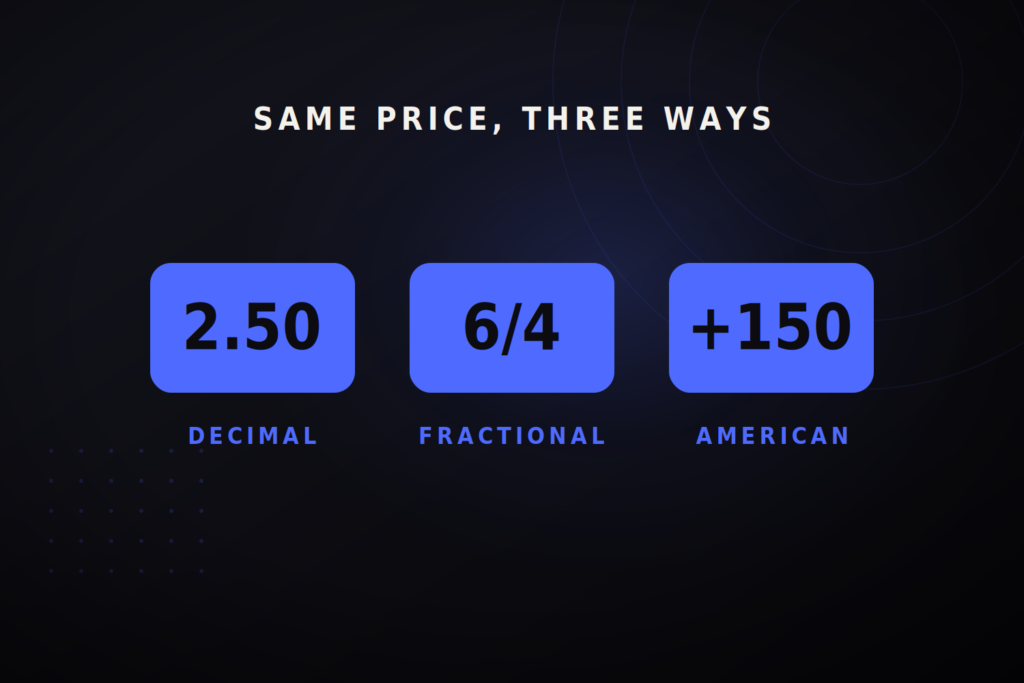
The same price can be printed three ways. Which one you see depends on where the operator is licensed and what it thinks its customers are used to. None of them contains more information than the others, but it is easy to misread an unfamiliar format, and the mistakes are not symmetrical — they tend to make a bad price look acceptable.
Decimal odds
Decimal odds tell you the total return per unit staked, stake included.
- Stake 10 at 3.50, and a winning bet returns 35: your 10 back, plus 25 profit.
- The minimum possible decimal price is just above 1.00, which would return your stake and nothing else.
Because the stake is included, decimal odds are the easiest format to turn into a probability: divide one by the price. 3.50 implies 1 ÷ 3.50 = 28.6%.
This format dominates in continental Europe, Australia and Canada, and it is what most exchange platforms and most trading software use.
Fractional odds
Fractional odds tell you the profit per unit staked, with the stake excluded.
- 5/2 means five units of profit for every two staked. Stake 10, win 25, receive 35 in total.
- 1/2 — "odds on" — means one unit of profit for every two staked. Stake 10, win 5, receive 15.
- Evens, written 1/1 or EVS, is the same as decimal 2.00.
To convert: decimal = (numerator ÷ denominator) + 1. So 5/2 becomes (5 ÷ 2) + 1 = 3.50. Going the other way, subtract one from the decimal price and express the result as a fraction: 3.50 → 2.50 → 5/2.
Fractional odds are traditional in British and Irish racing. Their weakness is comparison: it is not obvious at a glance whether 15/8 is better or worse than 17/9. Converting both to decimal — 2.875 and 2.889 — answers it in a second.
American odds
American odds, sometimes called moneyline odds, use a positive or negative number anchored to 100.
- A positive price (+250) is the profit on a 100 stake. Stake 100 at +250, win 250, receive 350.
- A negative price (−150) is the stake required to win 100. Stake 150 at −150, win 100, receive 250.
The minus sign confuses people the first time they meet it. It does not mean a loss. It means the outcome is favoured, so you must risk more than you stand to win.
Conversions:
- Positive American to decimal: (price ÷ 100) + 1. So +250 → (250 ÷ 100) + 1 = 3.50.
- Negative American to decimal: (100 ÷ |price|) + 1. So −150 → (100 ÷ 150) + 1 = 1.667.
There is no price between −100 and +100; both would be evens, which is written +100 by convention.
Implied probability is the common language
Whatever the notation, convert to decimal and then to a probability. That is the only number that lets you compare a price against your own estimate, and the only one that lets you add up a market to find the margin.
A short reference table worth committing to memory:
- 1.50 = 1/2 = −200 = 66.7%
- 2.00 = 1/1 = +100 = 50.0%
- 2.50 = 3/2 = +150 = 40.0%
- 3.00 = 2/1 = +200 = 33.3%
- 5.00 = 4/1 = +400 = 20.0%
- 11.00 = 10/1 = +1000 = 9.1%
The two mistakes worth naming
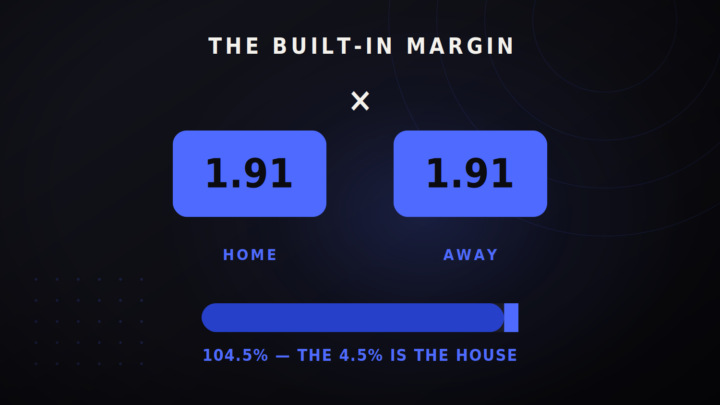
Mistake one: treating the implied probability as the true probability. It is not. It is the true probability plus the operator's margin, and as the previous article explains, the margin is not distributed evenly across a market. If a price implies 52%, the operator's honest estimate is lower than 52%.
Mistake two: comparing a boosted price without checking what it replaced. "Boosted from 2.00 to 2.20" is only meaningful if 2.00 was the genuine market price. Compare a boost against what several other operators are offering on the same selection at the same moment, not against the number in the marketing.
Where the format changes the feel
There is reasonable evidence from behavioural research that presentation affects choices — that is, after all, why marketing departments care about it. Fractional odds with large numerators make long shots look dramatic. American plus-prices do something similar. Decimal odds are the flattest of the three, which is part of why professional bettors prefer them.
Most operators let you switch the display format in your account settings. If you are comparing prices across several sites, set them all to decimal. It removes a whole class of error for the cost of about thirty seconds.
Sources and checking
Every conversion in this article is arithmetic and can be verified with a calculator. Nothing here depends on a claim about a particular operator.