Poker course review
The End Boss System review: is it worth $999?
The End Boss System is a remarkably complete heads-up course with a practical strategic framework, strong supporting sheets and almost 43 hours of training. Its depth is real, but so are its narrow focus and $999 price.
A complete heads-up system
The End Boss System is built for heads-up players. If you want a broad training membership, start with the Upswing Lab 2.0 review. For help organising solver study across formats, read the Simplifying Solvers review.
This course works through a full heads-up No Limit Hold’em strategy. Famous hands appear, but the teaching goes much further than adding solver screenshots to a few highlights.
The verdict: The End Boss System
A complete heads-up system for players who play heads-up regularly.
The good
Intermediate and advanced No Limit Hold’em players who play heads-up regularly or want a serious framework for wide-range situations
The bad
Heads-up is only an occasional endgame, solver language is still unfamiliar, or the $999 would be better kept in the bankroll
Doug Polk and Fabian “Frabb” Adler work through preflop ranges, single-raised pots from both seats, 3-bet pots from both seats, 4-bet pots and live play. The course contains 120 videos with a runtime just under 43 hours, plus preflop ranges and postflop strategy sheets.
It is one of the deepest courses Upswing sells, with a very specific player in mind. Play heads-up seriously and nearly all of it is relevant. Play six-max cash or tournaments and the wide-range thinking can still help, but you are paying for many hours devoted to a format you may rarely play.
The official price is $999 for lifetime access.
What is inside The End Boss System?
| Section | Videos | Runtime | What it covers |
|---|---|---|---|
| Introduction | 5 | 45 minutes | GTO versus exploitative play, simplification and the structure of the system |
| Preflop strategy | 11 | 1 hour 26 minutes | Opening, calling, 3-betting, 4-betting, 5-betting and opponent-specific adjustments |
| Small blind single-raised pots | 25 | 7 hours 40 minutes | C-betting, barreling, delayed lines and facing check-raises in position |
| Big blind single-raised pots | 22 | 8 hours 53 minutes | Defending, probing, check-raising, delayed lines and turn leads out of position |
| Big blind 3-bet pots | 20 | 6 hours 57 minutes | Flop sizing, multi-street aggression, float bets and delayed c-bets as the preflop aggressor |
| Small blind 3-bet pots | 12 | 5 hours 18 minutes | Playing in position against the 3-bettor, including barrels, checks and delayed lines |
| 4-bet pots | 16 | 6 hours 27 minutes | In-position and out-of-position play across all three streets |
| Play and explains | 9 | 5 hours 33 minutes | Live heads-up play, high-stakes sessions, member footage and course review |
The structure is one of the course’s strongest features. It does not stop after preflop charts and common flop lines. Delayed c-bets, probes, check-raises, river follow-through and rare 4-bet pot branches all receive dedicated attention.
That coverage also gives you a lot to work through. Going straight from lesson one to lesson 120 is a poor way to study it. Take one pot type at a time, then review database hands and try the ideas at the table.
The course makes the strategy simpler
Modern solver work can produce a forest of bet sizes and mixed actions. The End Boss System deliberately cuts that tree down.
Polk and Adler repeatedly choose one practical size for a board group when the expected-value loss is small. The other sizes may be sound too, but each adds turn and river branches you have to remember and balance. You still need enough attention left to watch the opponent.
This is the course’s most useful strategic choice. The resulting system gives you a realistic chance of remembering the strategy while playing.
The simplification is not absolute. Rivers still need multiple sizes when too much value would be lost, and some unusual textures justify more complexity. The course treats complexity as a cost that must earn its place.
A simpler range is easier to visualise. As the explanation shows, that leaves more attention for what the opponent is doing. The same principle runs through the course.
That approach is especially valuable in heads-up, where ranges are wide and the same opponent sees enough hands to notice repeated mistakes.
The postflop coverage is the real product
The sales page leads with Doug Polk’s reputation, but most of the value comes from Fabian Adler’s methodical postflop work.
Single-raised pots receive more than 16 hours. The small blind section begins with c-bet sizes and bluff-to-value ratios, then moves into double barrels, triple barrels, delayed c-bets and every major response to a check-raise. The big blind section answers from the other seat with probes, check-raises, delay lines and turn leads.
The same logic continues into 3-bet and 4-bet pots. Board groups are assigned a practical bet size and an average frequency. Individual hands are then organized around that starting point.
This is better than memorizing a long list of boards. The sheet gives the first answer to two questions: how large does this family of boards bet, and how often does it bet? Range construction becomes the next layer instead of a fresh puzzle every time.
The strategy sheets put those board groups in one place. You use that map throughout the postflop sections, so the files have a job beyond sitting beside the videos.
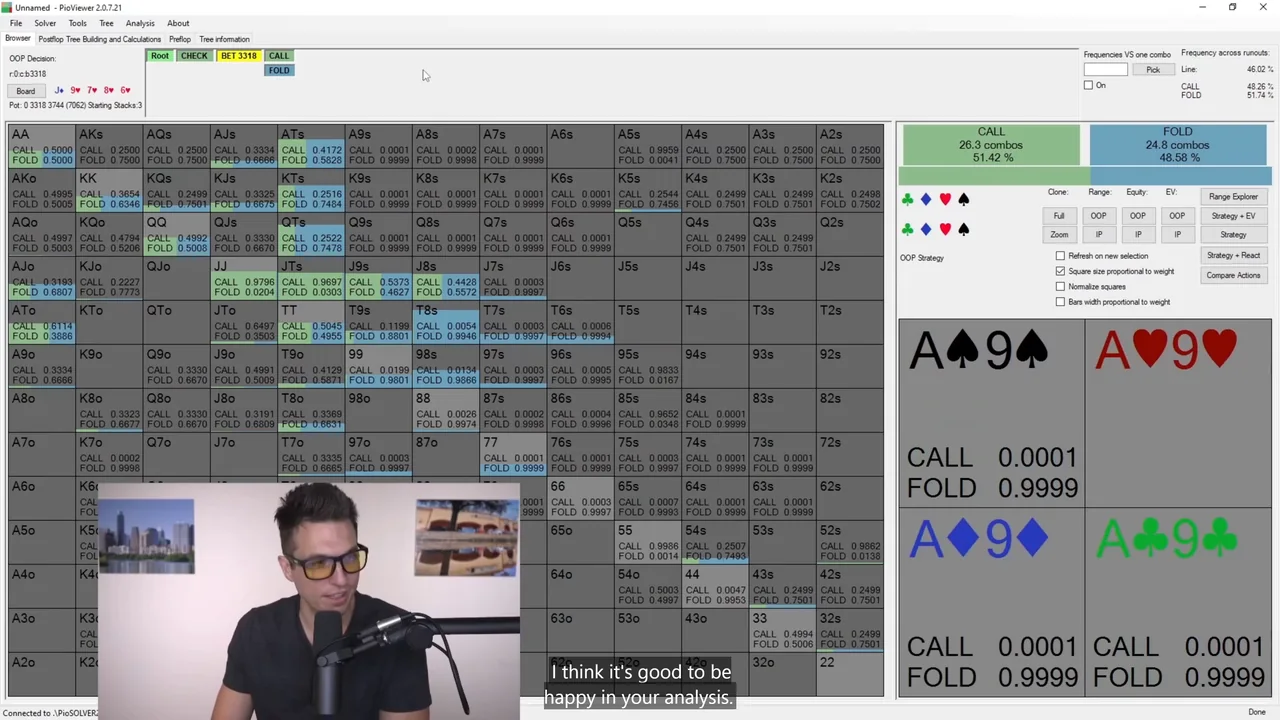
The downside is how much you have to take in. Many lessons move straight through solver outputs and hand classes, with frequencies along the way. There are no game-like drills to test recall. You need to pause, take notes and try the system in your own database or trainer.
The bluff framework is practical, but still advanced
One of the better early lessons turns exact bluff ratios into a street-by-street mental model.
The course provides frequencies for different bet sizes, then reduces the lesson to a usable principle: a range should release part of its bluffs on every street. That matters more in heads-up than it first appears. Extremely wide ranges create a large supply of hands that look tempting to keep firing.
The bluff frequencies become a rule you can remember. The explanation gives you a way to make the decision after closing the solver.
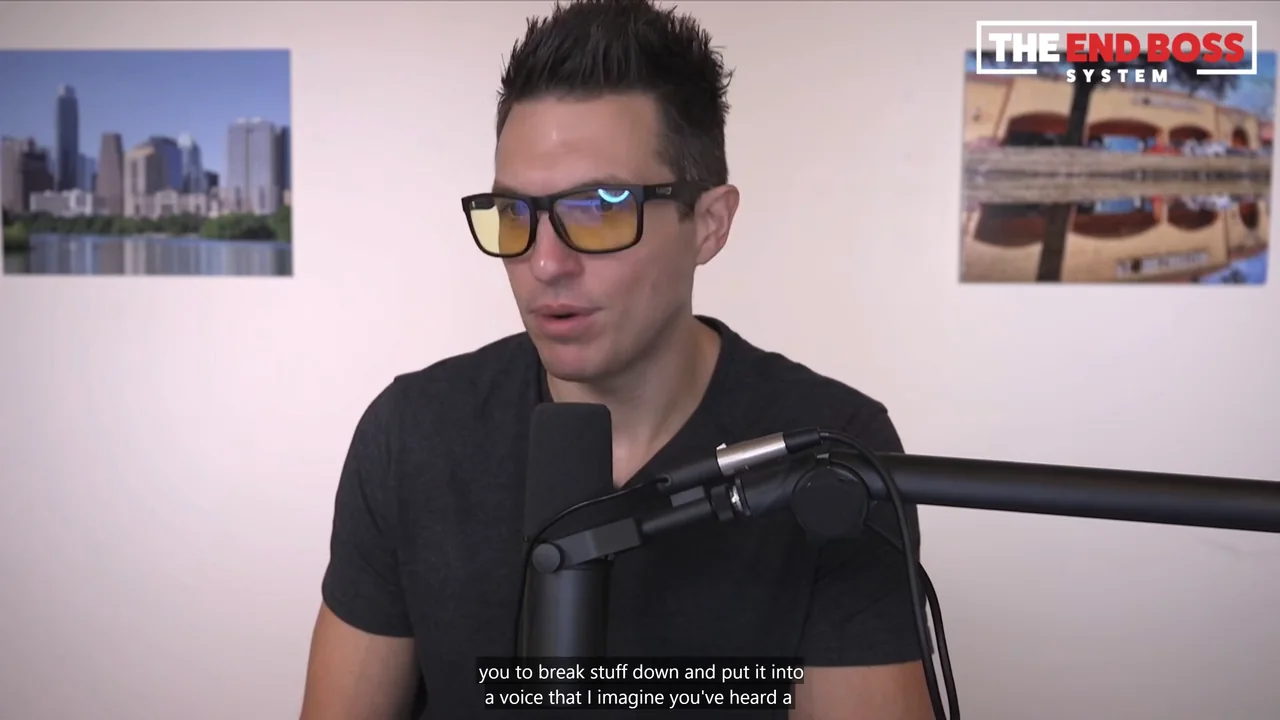
The better lessons keep doing this. They explain what a number changes at the table before moving on to the next one.
It is not beginner material. Terms such as range construction, blockers, node locking and expected value are used naturally. A player who still has to stop and define them will struggle to keep up with 43 hours of technical instruction.
Preflop is deeper than a chart viewer
The preflop section covers opens, calls, 3-bets, 4-bets and responses to 5-bet jams across different stack depths and sizes. It also includes ranges designed around the sizes Daniel Negreanu used in his heads-up challenge with Polk.
The useful part is the explanation of how ranges change. As stacks get deeper, offsuit hands lose some appeal while suited hands and pairs gain room to realize equity. Specific sizing changes also move hands between calls, bluffs and value raises.
The included range files cover several stack depths and common raise sizes. You get much more than one fixed 100-big-blind chart. Upswing also advertises a browser-based preflop chart app with the current course.

The opponent-specific material is interesting, but it should not be copied blindly. Its value lies in seeing how a baseline is adjusted when an opponent uses known sizes and tendencies.
The strategy sheets make the package more usable
The supporting files do useful work between lessons. They give you a place to find the strategy again when you are reviewing hands.
The package includes:
- Preflop ranges for opens, calls, 3-bets, 4-bets and 5-bet situations across several stack depths and sizings
- Single-raised pot c-bet and check-raise sheets
- 3-bet pot c-bet sheets
- 4-bet pot sheets
- Compact text versions of the main postflop strategies
The spreadsheets let you scan a large board group much faster than searching a video timeline. After a lesson, you can open the relevant sheet and compare your database hands with the same strategy.
They still take work to read. A beginner expecting a simple cheat sheet will find them dense. Alongside the lessons, though, they make it much easier to return to the strategy after the video ends.
The play and explains provide necessary reality
The final section moves away from clean solver nodes and into actual decisions.
Fabian plays $5/$10 Zoom and against a GTO trainer. Polk plays three parts at $100/$200, reviews member footage at $2.50/$5 and discusses elite high-stakes play. These sessions show where the simplified system holds and where opponent-specific information changes the decision.
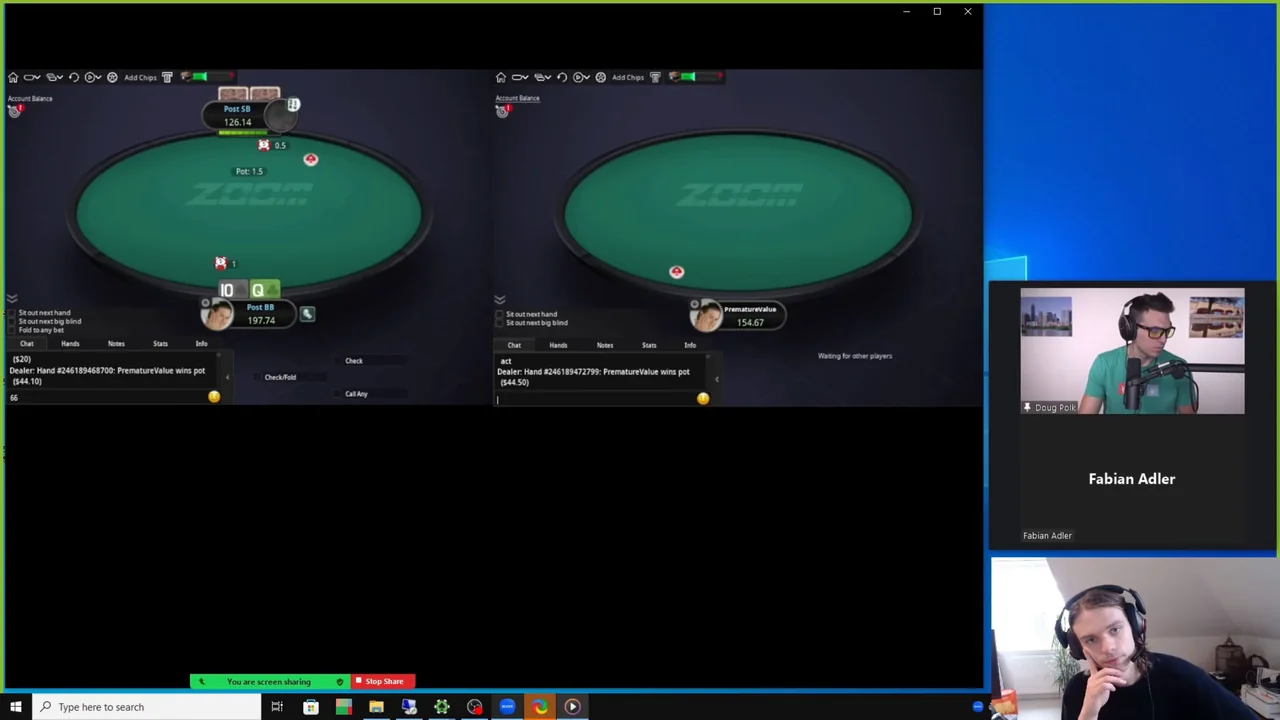
The discussions are strongest when Polk and Adler challenge each other. A sizing is questioned, a blocker is reconsidered, or a line is admitted to be a small mistake. That is more valuable than presenting every played hand as proof of expertise.
You will sit through resized tables and paused action while the coaches sometimes work their way towards an answer. The editing could be tighter, but those discussions are honest about the decisions being made.
Doug Polk and Fabian Adler have different jobs
The partnership works because the coaches do not fill the same role.
Polk is the clearer presenter and the more recognizable high-stakes player. He asks practical questions, tests whether a solver-approved strategy is realistic and connects ideas to matches against opponents such as Negreanu.
Adler supplies much of the systematic framework. He organizes board families, explains frequencies and turns large solver studies into a repeatable strategy. The course would be less useful if it relied on Polk’s hand histories alone.
That gives the discussions a useful feel. You see a top player and his coach work out the system together, including the questions that a finished script might have skipped.
Production is functional rather than premium
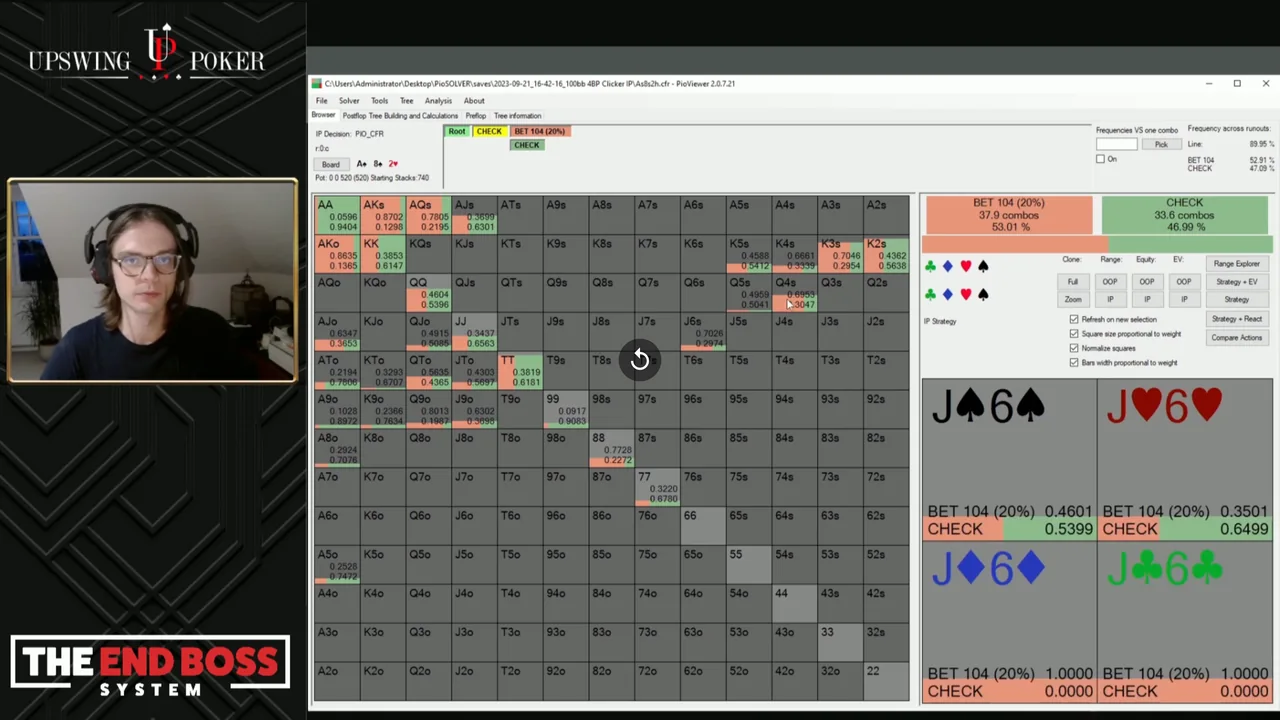
The lesson screens are clear enough to study. You can read the range grids, PioSolver outputs and spreadsheets, along with the poker tables. Most sections use the same branded layout.
For $999, the presentation can feel basic. Much of the course uses webcams, long screen recordings and video calls, and some lessons feel like recorded coaching sessions. The analysis and supporting files justify the attention. Cinematic editing and an interactive learning experience are not part of the appeal.
Most official course videos include English subtitles, according to Upswing. There is no free trial. Under the Fair Play policy, first-time course buyers can request a refund or exchange within 30 days, giving specific reasons. Watching too much can make you ineligible, and Upswing decides what counts as too much. A refund is discretionary.
Does it help players who do not specialize in heads-up?
There is useful material for other formats, but it is easy to overstate how much of this course those players need.
Wide-range reasoning transfers to blind-versus-blind tournament play, short-handed cash games, starting tables and heads-up tournament finishes. Bet sizing, bluff discipline and range construction also matter in every No Limit Hold’em format.
The ranges, stack depths and postflop trees are still built for two-player cash games. If you only play heads-up at the occasional tournament final table, you will use a small part of a very large course.
That also matters if you play heads-up sit-and-gos or hyper-turbos. The shared name can make this look like the obvious choice, but a cash-game course is not enough reason to buy it for short-stack tournament play. Start with the format and stack depths you need help with.
It makes more sense as extra work on a specific weakness once you already understand your main format. A developing player who needs a broad foundation should start elsewhere.
Is The End Boss System worth $999?
If you play heads-up seriously, the $999 price can make sense.
Nearly 43 hours of organised strategy and the supporting files give you a practical way through the major game tree. The course backs up its size with real work: single-raised pots, 3-bet pots and 4-bet pots each receive a full treatment from both seats.
Outside heads-up, ask how often you will get to use that work.
A strong six-max cash player who starts tables and often battles blind versus blind has good reasons to study these wide ranges. An MTT regular can use the late-stage and short-handed ideas, but a tournament course will apply to more hands. If you play heads-up only rarely for fun, it is hard to get enough value from $999.
The price also makes the study commitment matter. You need to use the sheets and filter your own hands, then return to the relevant lesson after playing. Paying for the information and leaving that work undone is an expensive way to collect videos.
A better way to study the course
The course order makes sense. Break it into smaller pieces as you work through it:
- Watch the introduction and strategic simplification lessons.
- Study the preflop section and keep the relevant range tool open during review.
- Choose one seat in single-raised pots and finish that block before switching seats.
- Use the strategy sheet to tag ten of your own hands from the same board families.
- Watch the matching play-and-explain section once you have studied the theory.
- Move to 3-bet pots only after the single-raised framework feels automatic.
- Leave 4-bet pots until last unless they already make up a major part of your games.
That gives each part of the 43-hour library a clear use before you move to the next.
Who should buy it?
- You regularly play heads-up No Limit Hold’em or start cash tables.
- You already understand ranges, blockers, equity and common solver output.
- You want a connected system that goes beyond isolated hand reviews.
- You will use the spreadsheets and review your own database hands alongside the videos.
- You play enough volume for a heads-up improvement to matter financially.
- You can spend $999 without putting pressure on your bankroll or normal finances.
Who should skip it?
- You only play heads-up occasionally at the end of tournaments.
- Poker fundamentals or solver language are still new to you.
- You need interactive drills to stay engaged.
- You are more likely to finish a short, tightly edited course.
- Your main game is live full-ring cash, PLO or ordinary multi-table tournaments.
- You would watch passively, without reviewing hands alongside the lessons.
Final verdict
The End Boss System earns the recommendation by following its heads-up strategy through the difficult parts of the game tree.
The simplification is the best reason to buy it. You get a strategy that a human can attempt to remember, with useful sheets to return to and detailed lessons on delayed lines, check-raises and 4-bet pots. The technical work continues well past the common flop spots.
You still have to be the right player for it. The $999 price buys long screen recordings and coaching discussions that assume strong fundamentals. If heads-up is a small part of your poker, much of that depth may sit unused.
For serious heads-up players who will work with the system, this is one of the most complete No Limit Hold’em courses available. The practical strategy and supporting material make its depth useful.
Official course page: The End Boss System at Upswing Poker (opens in a new tab)
Frequently asked questions
How much does The End Boss System cost?
Upswing Poker lists The End Boss System at $999 as a one-time purchase with lifetime access.
How long is The End Boss System?
The course contains 120 videos with a total runtime just under 43 hours. Upswing advertises it as more than 40 hours of training.
Who teaches The End Boss System?
The course is taught by Doug Polk and Fabian “Frabb” Adler. Polk brings elite heads-up experience and practical presentation. Adler provides much of the solver research and systematic framework.
Is it only for heads-up players?
The course is built around heads-up cash strategy. Its wide-range concepts can help cash and tournament players, especially in blind-versus-blind and short-handed situations, but it is not a general No Limit Hold’em curriculum.
Does it include preflop ranges?
Yes. The package includes extensive preflop ranges across multiple stack depths and raise sizes. Upswing also advertises access to its heads-up preflop chart app.
Does it include spreadsheets or strategy sheets?
Yes. It includes single-raised pot, 3-bet pot and 4-bet pot strategy sheets, plus compact text references for many postflop lines.
Is there a free trial?
No. The 30-day Fair Play policy has eligibility and viewing limits. It does not promise an automatic refund.
Sources
- The End Boss System official sales page
- Upswing Poker course catalog
- Official course sneak peek and curriculum