The short version
- Roulette takes its edge from a payout that is slightly short of the true odds.
- Baccarat takes it from a commission and from a small structural asymmetry.
- Blackjack's edge depends on the rules on the table and on how the hand is played.
"The house always wins" is true but uninformative. The interesting question is how, because the answer differs by game, and because within a single game the cost of one bet can be twenty times the cost of another.
Roulette: a shortfall in the payout
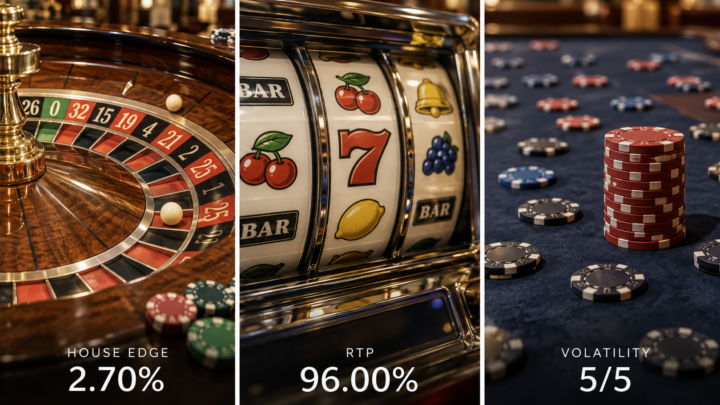
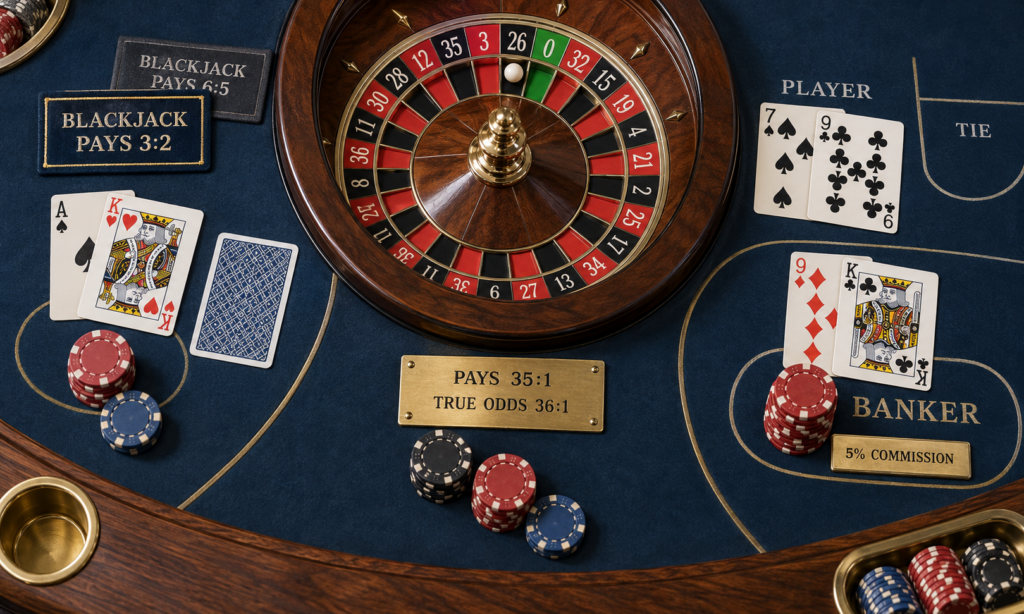
Roulette is the cleanest case. A European wheel has 37 pockets. A straight-up number wins once in 37 spins and pays 35 to 1. Fair odds would be 36 to 1. The missing unit spread over 37 spins gives a house edge of 1 ÷ 37 = 2.70%.
The elegant, and slightly ruthless, feature of European roulette is that almost every bet on the table carries the same 2.70%. Red or black, odd or even, a column, a split, a corner — the payouts are scaled so the shortfall is identical. There is no clever bet and no bad bet; there is one price.
The American wheel adds a double zero. Thirty-eight pockets, the same 35-to-1 payout, and the edge becomes 2 ÷ 38 = 5.26%. The one exception is the five-number bet available only on the American layout, which comes out at about 7.9% — the only genuinely worse bet on the table.
Some European tables offer la partage or en prison on even-money bets, returning half the stake, or holding it for one spin, when zero lands. That halves the edge on those bets to 1.35%. It is the single largest improvement available to a roulette player and it costs nothing to look for.
Baccarat: commission and a structural tilt
Baccarat has only three main bets, and they are priced very differently.
- Banker wins slightly more often than Player, because the Banker hand acts last and draws according to rules that use information about the Player's draw. To recover that advantage the casino charges a commission, conventionally 5% on winning Banker bets. After commission the house edge is a little over 1%.
- Player carries no commission and a house edge a little under 1.25%.
- Tie typically pays 8 to 1 against true odds nearer 9.5 to 1, producing a house edge in the region of 14%.
So the same table offers a bet costing around 1% and a bet costing around 14%, sitting next to each other with no warning on either. Side bets — pairs, dragon bonuses and similar — are generally in the same expensive territory as the tie.
Variants that remove the commission usually restore the margin another way, most often by paying less than even money on a Banker win with a particular total. That is not a free improvement; it is the same charge relocated.
Blackjack: the edge is in the rules and in your decisions
Blackjack is the only common casino game where the player's choices materially change the expected cost, which makes a single house-edge figure meaningless without qualification.
Two things determine it:
The rules of the table. Whether a natural blackjack pays 3 to 2 or 6 to 5; how many decks are used; whether the dealer stands or hits on soft 17; whether doubling after splitting is allowed; whether surrender is offered. The largest single item on that list is the blackjack payout. Moving from 3-to-2 to 6-to-5 on an otherwise identical game costs the player roughly 1.4 percentage points — which, on a game whose edge under good rules is a few tenths of a percent, can be several times the entire rest of the margin.
How the hand is played. Basic strategy is the mathematically optimal decision for every combination of player hand and dealer upcard, computed for a given rule set. Under favourable rules, a player following basic strategy perfectly faces a house edge of around half a percentage point. A player following instinct typically faces something closer to 2%.
Basic strategy is not a system for winning. It is the set of decisions that minimises the cost, and the cost remains positive.
Two additions are worth naming because they are so often misread. Insurance is a side bet on the dealer holding a ten-value card, and at its standard 2-to-1 payout it is a poor bet for anyone not tracking the composition of the shoe. The various side bets — perfect pairs, 21+3 and their relatives — carry house edges usually in the range of several percent, many times that of the main game.
What to take from this
Inside a single casino, on a single evening, the cost of an hour's play can vary by more than an order of magnitude depending on which table you sit at and which bets you make. Two rules of thumb do most of the work:
- Side bets are almost always the expensive part. If a bet is presented as an optional extra with a large payout, assume its edge is many times that of the main game.
- Read the table rules before the game, not during it. The 3-to-2 versus 6-to-5 question is settled by the felt and answers most of what you need to know.
None of this makes any of these games profitable. Every bet described above has a negative expected value. What varies is how quickly, and choosing to pay 1% instead of 14% is a real choice that the table itself will never draw to your attention.
Sources and checking
All figures here follow from the standard payout tables and drawing rules of each game and are reproducible by direct calculation or simulation. No claim is made about any particular venue's rules — those must be read on the table.