The short version
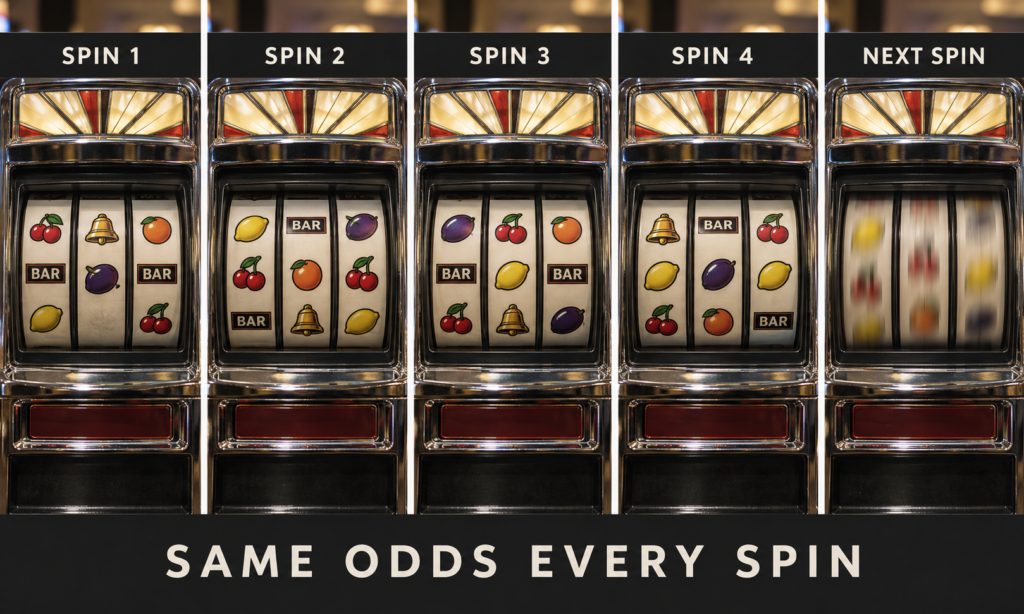
- Each spin, hand and roll is independent: earlier outcomes do not alter later probabilities.
- Averages are reached by dilution, not by correction — there is no balancing force.
- The same fallacy in reverse — the "hot streak" — is just as unfounded.
On 18 August 1913, at the Monte Carlo casino, a roulette wheel is said to have landed on black many times in succession, and a great deal of money was lost by players betting ever larger sums on red in the belief that it had become overdue. Whether every detail of the story is accurate, the reasoning it describes is real, it is extremely common, and it is wrong.
What independence means
Two events are independent if the outcome of one does not change the probability of the other. Almost everything in a casino is built this way:
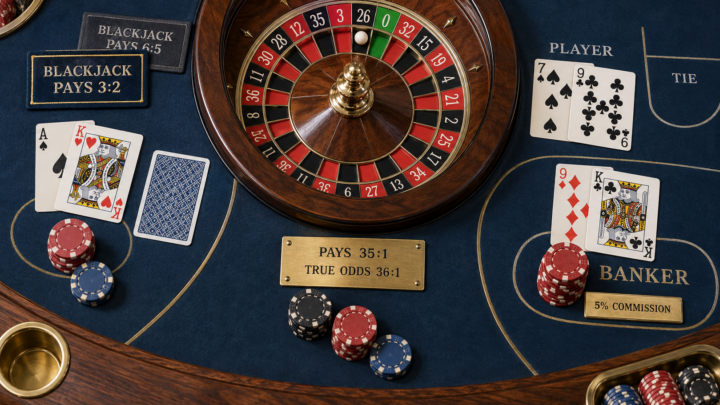
- A roulette wheel has no mechanism for recording what it just did. Pocket 17 is as likely on the next spin as it was on the last, whether or not 17 has appeared five times in a row.
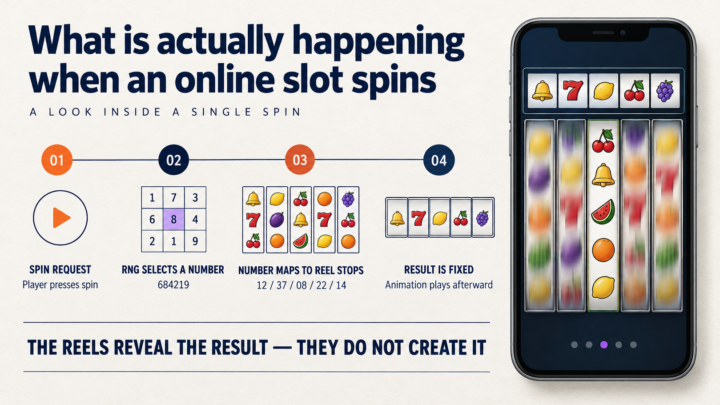
- A slot outcome is generated by a random number generator that samples afresh each spin. It does not track how much it has paid out recently.
- Dice have no memory. Neither do shuffled decks, once reshuffled.
The one meaningful exception in a casino is a card game dealt from a shoe that is not reshuffled between hands. There, removing cards genuinely does change the composition of what remains, which is the basis of card counting in blackjack — and precisely why operators use multiple decks, cut a portion of the shoe out of play, and reserve the right to refuse play to people who do it well. Everywhere else, independence holds.
Why the average still works out
If nothing corrects the imbalance, how does a fair coin end up near 50% heads?
Through dilution, not correction. Suppose the first 10 tosses give 8 heads — a surplus of 3 above the expected 5. Nothing pushes back against that surplus. But after 10,000 further tosses, that same surplus of 3 sits inside a much larger sample, and the proportion of heads is close to 50% even though the absolute difference has not been repaid and may well have grown.
The law of large numbers is a statement about proportions converging. It is not a promise that deficits are made good. A run of losses is not a credit balance the game owes you.
The same error in reverse
The mirror image is the belief in a hot streak: that a machine "paying well" will carry on, or that a run of wins means you are in a good patch.
This is the same mistake wearing different clothes. If outcomes are independent, a run of wins carries no information about the next result either. What makes the hot-hand version more dangerous is that it arrives while you are ahead, when stakes tend to rise and the decision to stop feels least urgent.
Why the illusion is so persistent
A few things conspire to make random sequences look patterned:
- Humans are pattern-finders. We are far better at detecting structure than at recognising its absence, and genuinely random sequences contain more clustering than intuition expects.
- Near misses feel like information. A slot reel stopping one position from a jackpot symbol registers as "close". Mathematically it is not close to anything; it is simply a losing outcome. Game design has historically leaned on this, and it is one reason regulators have taken an interest in how outcomes are displayed.
- Selective memory. The evening you recovered after a long losing run is a story. The evening you did not is not.
- Presentation. Boards displaying the last twenty roulette results serve no mathematical purpose. They exist because they encourage people to find trends in noise.
What follows in practice
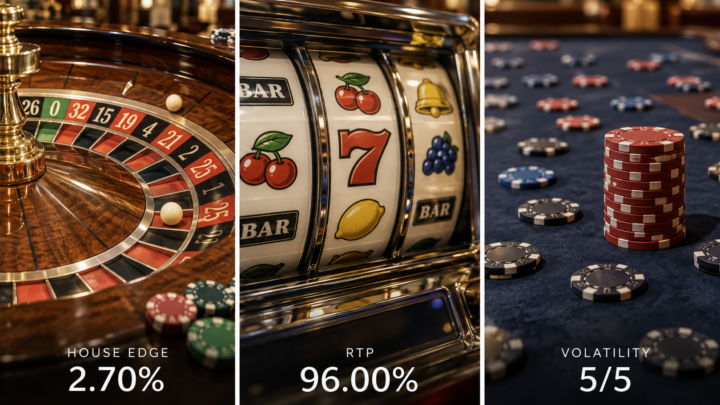
Chasing does not work. The reasoning behind a martingale — double after each loss, so one win recovers everything — fails for two reasons that have nothing to do with luck. Table limits cap the sequence, and bankrolls are finite; the strategy trades a high probability of a small win for a small probability of a catastrophic loss, and the house edge is untouched by the staking pattern. No staking system can convert a negative expectation into a positive one, because the edge applies to each stake independently of its size.
Stopping rules must be set in advance. Since the game provides no signal about when to stop, the signal has to come from you, before you start, in terms that do not depend on how things are going. A time limit and a loss limit set before the first spin are the only kind that survive contact with a bad run.
Deposit limits are the mechanism that works. Most licensed operators let you set a hard limit on deposits over a period, and in many jurisdictions they are required to offer them. A limit set while calm binds the version of you that is not, which is the whole point.
If a run of losses ever starts to feel like something the game owes you, that feeling is worth taking seriously — not because the machine is due, but because that is the thinking that turns an evening out into a problem. Free, confidential help exists in most countries, and our responsible gambling page lists the organisations we have checked.
Sources and checking
The probability results described here — independence, the law of large numbers, and the failure of progressive staking systems under a fixed house edge — are standard and can be verified in any introductory probability text.