The short version
- A blackjack paying 6:5 instead of 3:2 adds about 1.4% to the house edge on its own.
- That is more than the entire edge of a good blackjack game, and more than every strategy mistake combined.
- It is printed on the felt, and it is the single most valuable thing to check before sitting down.
Every table game has a paytable. Blackjack's is short enough to print on the felt in one line: Blackjack pays 3 to 2.
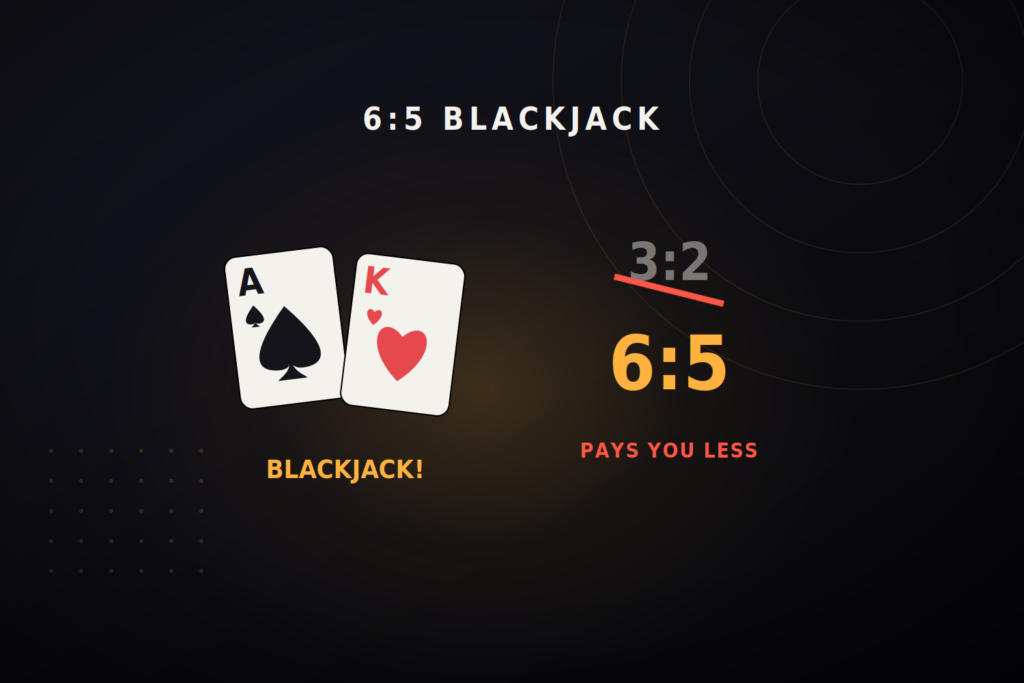
On some tables that line reads Blackjack pays 6 to 5. Everything else about the game looks identical — same cards, same dealer, same strategy chart, same chips. The difference is worth more than anything else you will decide at that table.
The arithmetic
On a 3:2 table, a €10 bet that makes blackjack pays €15.
On a 6:5 table, the same bet pays €12.
Blackjack comes up roughly once every 21 hands. Shaving €3 off every one of those, across a session, adds about 1.4% to the house edge.
A good blackjack game played with basic strategy runs at about 0.5%. Add 1.4% and you are at roughly 1.9% — nearly four times the price, for a game that plays and feels exactly the same.
What that does to a session
At €1 a hand and 120 hands an hour, a 0.5% game costs about €0.60 an hour. The same game at 6:5 costs about €2.28.
Put differently: a €50 bankroll lasts around 83 hours at 3:2, and around 22 hours at 6:5. You are buying a quarter of the session for the same money.
No playing decision available to you comes anywhere close to that. You could misplay every sixteen you are dealt and still cost yourself less than sitting at the wrong table.
Why it exists
Because it works. The change is small, it is disclosed, it is printed openly on the felt, and most players do not know what it means. Tables that pay 6:5 are frequently the ones with the lowest minimum bet, which makes them the ones a casual player is most likely to choose.
That is not a trick. It is a price, stated plainly, in a place most people do not look.
The other rules worth reading
While you are checking the payout, three more lines matter:
- Dealer stands on soft 17 is better for you than dealer hits soft 17, by about 0.2%.
- Double after split allowed is worth roughly 0.15%.
- Fewer decks is better, though the effect is smaller than most people assume.
None of these is close to the 3:2 line in importance. If you only check one thing, check that.
What to do
Look at the felt before you sit. If it says 6 to 5, walk to another table. If every table in the room says 6 to 5, the game on offer is no longer one of the better-value games in the building, and something else on the floor will treat your bankroll better.
Online, the payout is in the game's rules panel, usually one click away, and there is no social cost whatsoever to closing the tab.