The short version
- Pass line costs 1.41%. Don't pass costs 1.36%. Both are excellent.
- The odds bet behind a point is paid at true odds — a house edge of exactly zero.
- The centre of the table, where the loud bets live, runs from 9% to nearly 17%.
Craps looks like the most complicated game in the casino. The layout is covered in numbers, the crew has its own vocabulary, and the table is the loudest place on the floor.
Underneath that, the good version of the game is simple: there are two bets worth making, one add-on that is the best deal in gambling, and a large decorative area you can ignore entirely.
The pass line
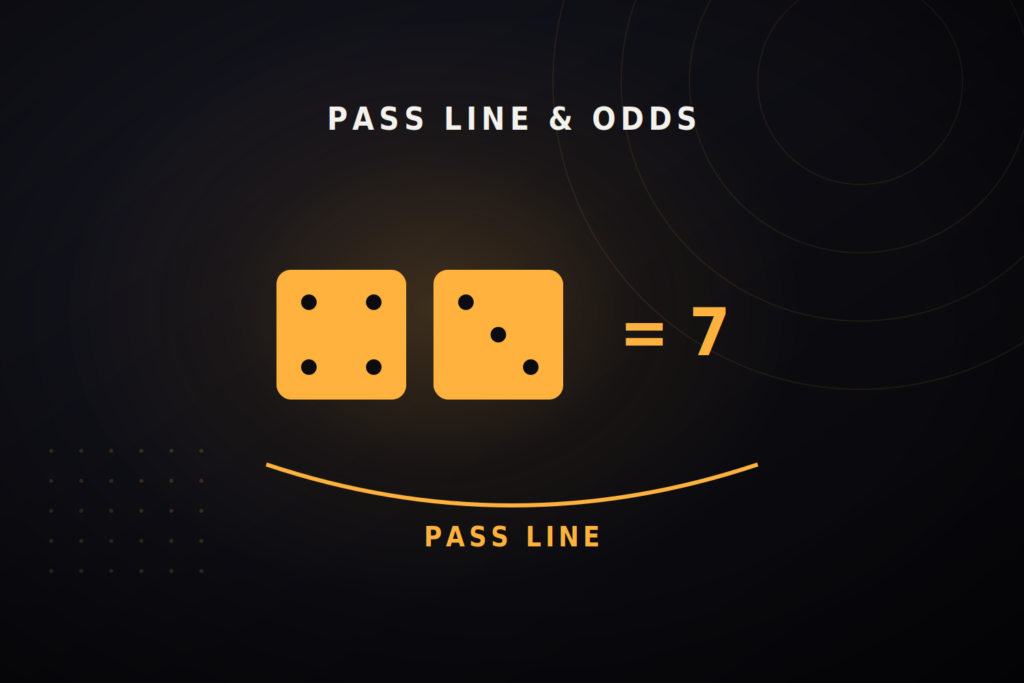
You bet before the come-out roll. Seven or eleven wins immediately, two, three or twelve loses, anything else becomes the point — and now you need that number again before a seven arrives.
House edge: 1.41%. That is better than every roulette wheel and every slot in the building.
Don't pass
The mirror image: you win when the pass line loses, with a push on twelve.
House edge: 1.36% — very slightly better, because of that push.
It is marginally the better bet and almost nobody makes it, because you are betting against everyone else at the table and the atmosphere makes that uncomfortable. The five basis points are real but small; play whichever side you prefer standing on.
The odds bet: zero house edge
Once a point is established, you can back your pass line bet with an additional wager called odds, placed behind your original chips.
The odds bet is paid at true mathematical odds — 2:1 on a four or ten, 3:2 on five or nine, 6:5 on six or eight. No margin is taken.
The house edge on that portion of your money is exactly zero. It is the only bet in a casino that can say so.
What it does in practice is dilute your overall cost. A €10 pass line bet carries a 1.41% edge. Add €20 of odds behind it and the same 1.41% is now spread across €30, which drops the blended edge to around 0.47%. Tables advertising "3x 4x 5x odds" or better are advertising how much of your money they will take no margin on.
The catch is variance: you are putting more money at risk per roll. The edge per euro falls; the swing per hand rises. That trade is worth making deliberately rather than by accident.
Come and don't come
Functionally identical to pass and don't pass, but established on any roll rather than only the come-out. Same edges, same odds backing available. They let you have several points working at once.
What to skip
The centre of the table — the proposition bets — is where the edge lives:
- Any seven: 16.67%
- Big 6 / Big 8: 9.09% (the identical bet exists as a place bet at 1.52%)
- Hardways: 9.09% to 11.11%
- Field: 2.78% or 5.56% depending on whether the twelve pays double or triple
These are the bets the table shouts about, and they cost between six and twelve times what the pass line does.
Place bets on six and eight are the reasonable middle ground at 1.52% — not as good as pass with odds, but nowhere near the centre of the table.
The whole strategy, in one line
Pass line or don't pass, maximum odds behind the point, place the six and eight if you want more action, ignore everything in the middle.
That is a game with a blended cost of well under one percent, which makes craps one of the cheapest hours in any casino — and the most entertaining of the cheap ones.