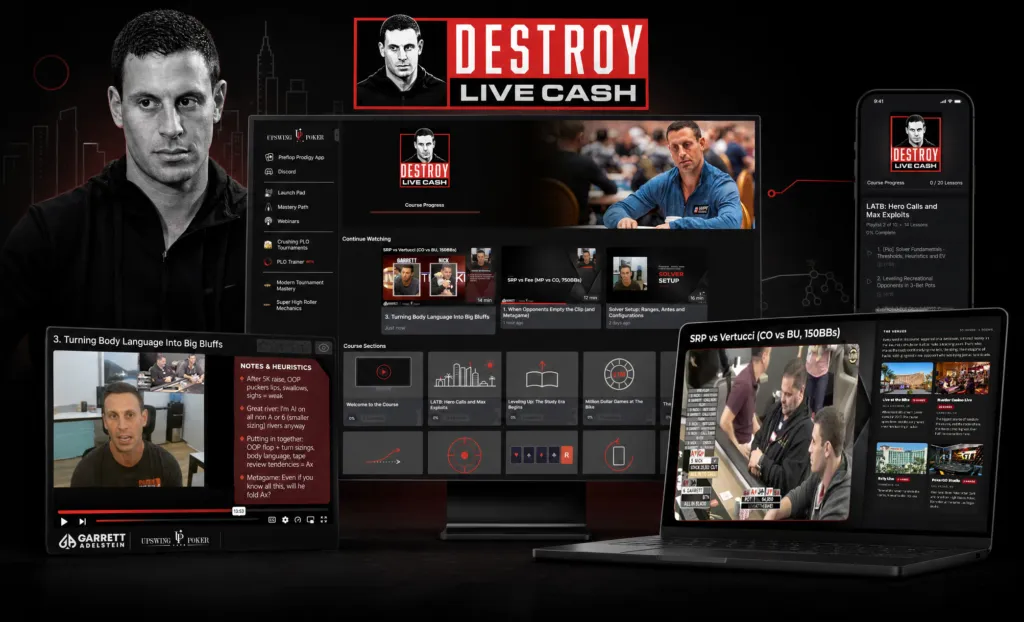
Garrett Adelstein, creator and coach of Destroy Live Cash.
Destroy Live Cash is probably the best course Garrett Adelstein could have made. It is also a very easy course to buy for the wrong reason.
If you want 35 hours of Garrett explaining how fearless he is, save your money. That is not what you get here. The strongest moments come when he looks back at a famous call or bluff, admits that the play was poor, and shows how his thinking changed over the next six years.
That honesty is what makes the course worth the time. The $999 price still needs to make sense for your game. A serious live cash regular can get real value from this. A casual player may simply buy an expensive seat beside Garrett while he talks through games that look nothing like theirs.
Quick verdict
- Best for: experienced live cash players who regularly play deep, know basic theory and face the same opponents often
- Skip it if: you are a beginner, mainly play 100 big blind online games, or would be taking the money from your bankroll
- Current price: $999 for lifetime access on the official Upswing page
- Best part: seeing a strong live player put a price on his own reads instead of pretending every hero play was genius
- Biggest weakness: a lot of the material comes from very deep, ante-heavy games and will not transfer cleanly to every table
ChipVerdict rating: 8.7/10
If you want a broader learning path instead of one specialist course, compare our Upswing Lab 2.0 review. Online cash players should also read our Mechanics of Poker review.
What is inside Destroy Live Cash?
The main course contains 50 hands from Garrett’s livestream career, starting in 2017 and ending in December 2023. Every hand gets a practical breakdown. Thirty five also get a separate PioSOLVER lesson. Add the introduction and you get 87 lessons and more than 35 hours of video.
| Part | What you get | My view |
|---|---|---|
| 50 live hand reviews | Real hands from Live at the Bike, Hustler Casino Live and other streamed games | The heart of the course |
| 35 solver follow-ups | Pio baselines, thresholds, sizing choices and a review of Garrett’s line | Dense, but much more practical than a normal solver recital |
| Deep stack ranges | More than 200 official charts built for 300 big blinds, a straddle and antes | Strong bonus for the right game, far less useful outside it |
| Other bonuses | Garrett’s book and 50 ClubWPT Gold chips where eligible | Nice extras, not a reason to spend $999 |
The course is meant to be watched in order. That matters more than it usually does. Early lessons introduce ideas that Garrett later refers to in a sentence or two. The chronological setup also lets you watch him become less eager to force a read and more willing to use theory as a guardrail.
The first hand tells you what kind of course this is
The first reviewed hand comes from a 2017 Live at the Bike game against Ryan Fee. Garrett makes a thin hero call, gets shown a bluff and wins the pot. That would be an easy clip to present as proof that his instincts were already on another level.
He does the opposite. He calls it a poor play that happened to work.
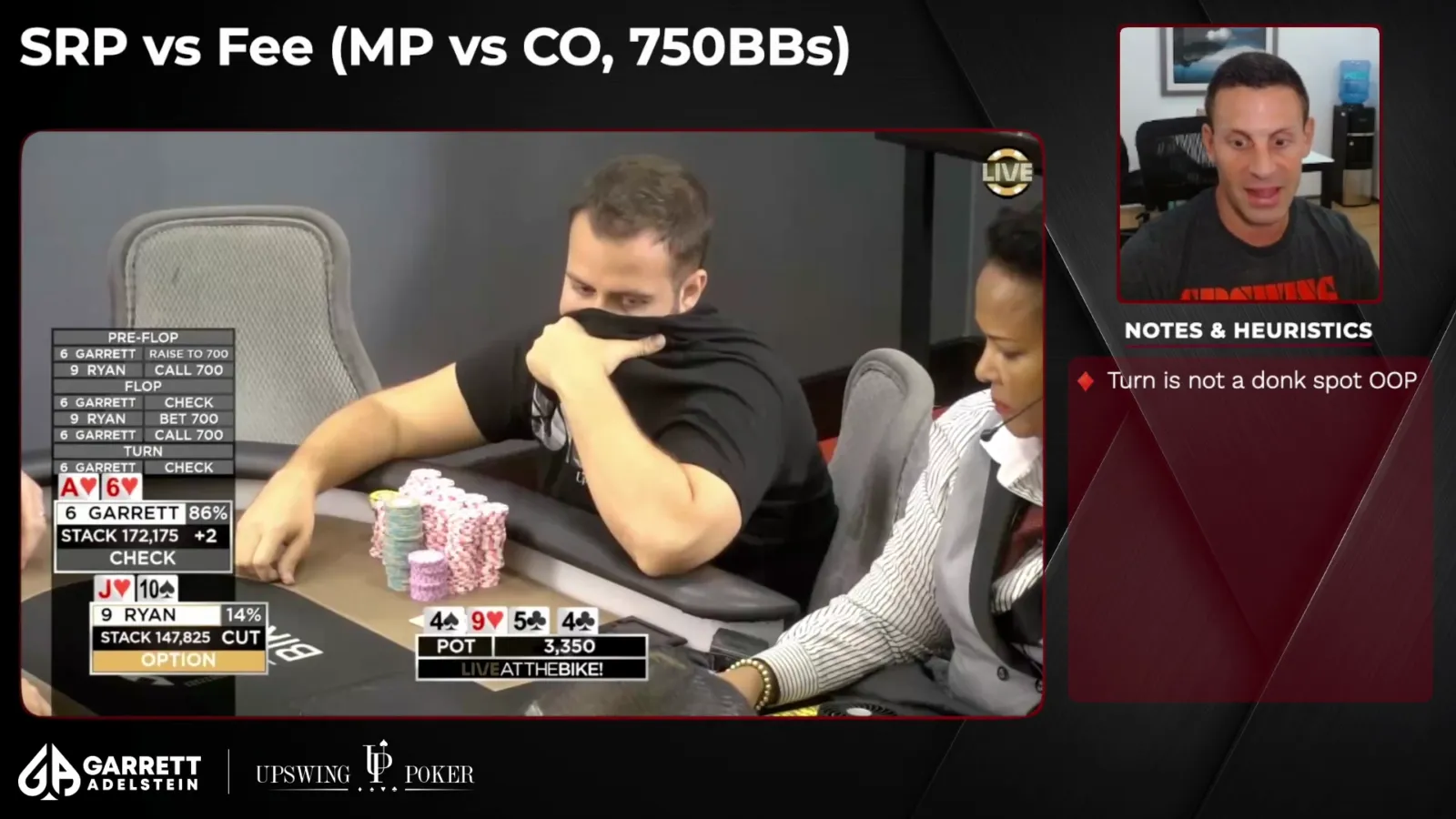
His read was not imaginary. He had hundreds of hours with Fee, knew the metagame and noticed how the chips went in. The problem was the weight he gave that information. The hand was too weak, the price was poor and the read was not strong enough to rescue the call.
This becomes the theme of the course. Garrett is not telling you to trust your gut. He is trying to show how much trust a read deserves. A sizing tell seen once may move a close decision. A pattern seen fifty times can justify a larger break from theory. That is a far more useful lesson than another list of fake live tells.
The best material is about being wrong
An early hand against Andy Stacks makes the point even better. Garrett believes Andy never checks back an overpair in a four bet pot. He has seen the pattern repeatedly and builds a huge bluff around it. Andy checks back aces and wins.
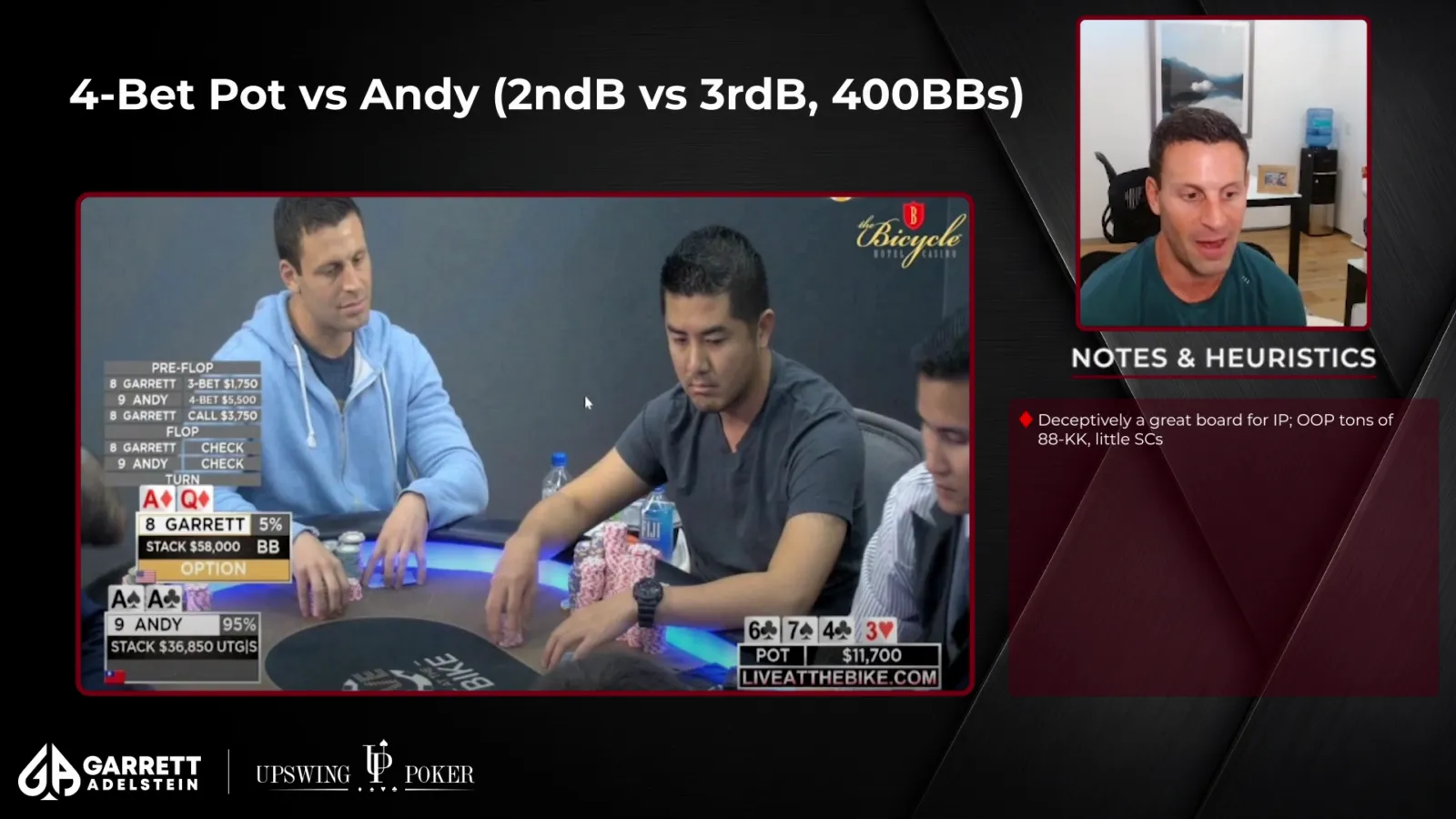
Garrett does not pretend the earlier read had no value. If a pattern holds for a long time, acting on it can still be reasonable. The mistake was turning a strong tendency into a law. His conclusion is simple: eighty or ninety percent is not one hundred percent.
That sounds obvious after the cards are exposed. It is much harder when a six figure pot is moving toward the middle. Watching the same player update his beliefs across several years is the most original part of Destroy Live Cash. Most courses show polished answers. This one often shows the scar tissue that produced them.
The Pio videos are useful without becoming worship
The solver lessons are not exact recreations of every live hand. Sometimes the available setup uses a nearby position or a heads-up tree for a hand that began multiway. Garrett says this openly and treats the output as a map, not a court ruling.
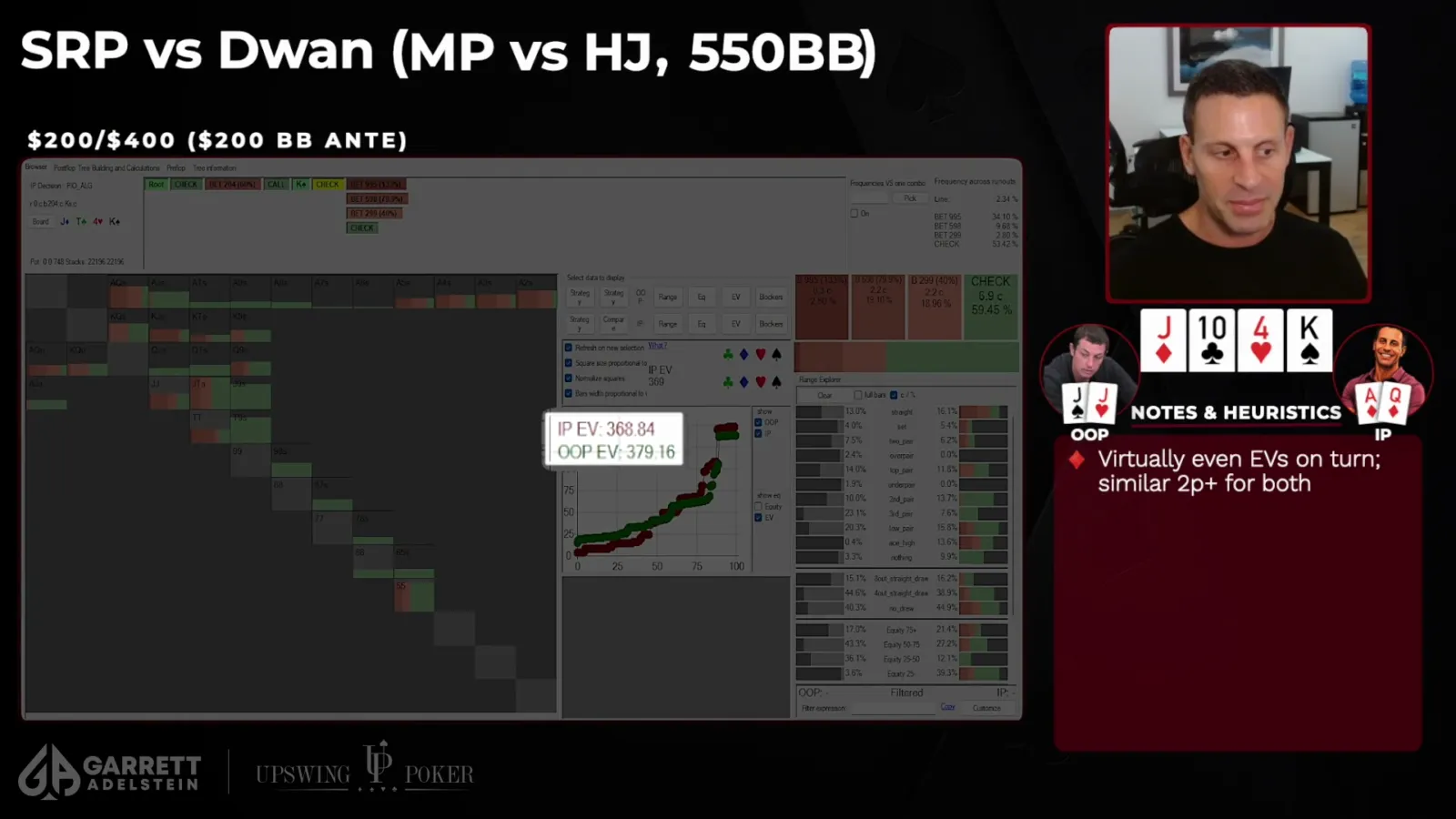
He usually looks for three things. Which player owns the equity advantage, which hands sit near the continue or fold threshold, and whether a complicated mixed strategy can be reduced to one sensible size. That is much easier to carry into a casino than memorising a forest of coloured squares.
I also liked how often he rejects fake precision. If two actions differ by one or two percent of the pot, he treats the decision as close and looks for a real opponent tendency. If the solver hates a call by forty percent of the pot, a vague feeling is not enough to override it.
The weakness is repetition. By the middle of the course, you will have seen many range graphs, threshold hands and simplified sizes. Serious students need that repetition. A player watching for entertainment may start skipping. The practical videos can stand alone, but skipping every Pio follow-up removes much of what makes the course better than a collection of televised hand histories.
These are not normal poker games
Many pots are played hundreds of big blinds deep with a big blind ante, several blinds or a straddle. One solver lesson examines a 1,700 big blind spot. The opponents include Tom Dwan, Patrik Antonius, Andy Stacks, Art Papazyan, Matt Berkey and strong regulars who have years of history with Garrett.
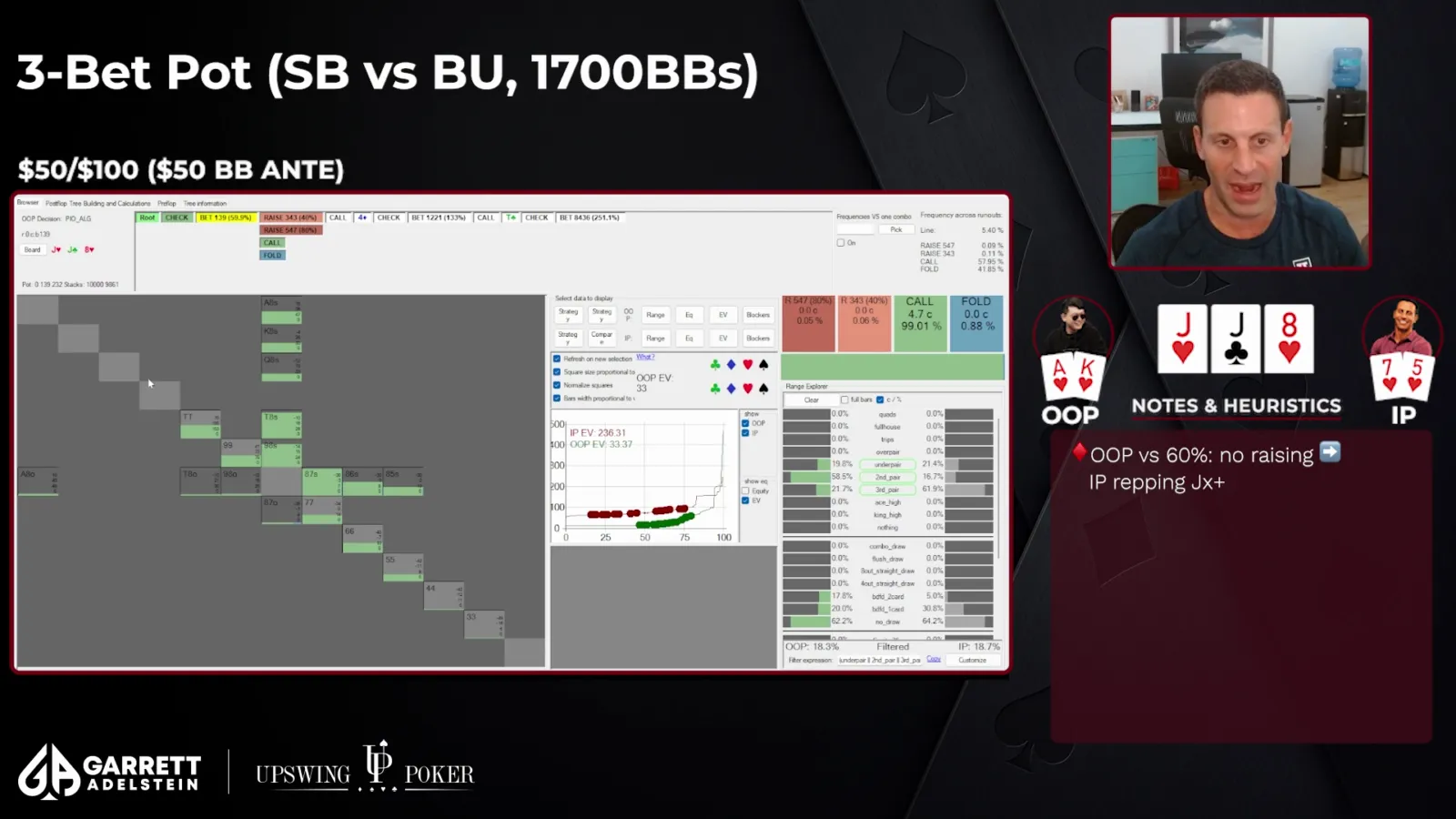
Upswing says the course is suitable for serious players at $2/$5 and above. I think that is fair, with one warning. The exact ranges and sizes are often not the part you should copy. The value comes from how Garrett asks whether a player is too wide, whether the evidence is reliable and how much money the exploit is worth.
If your game is shallow $1/$2 with unknown opponents, the deep preflop charts will be overkill and many history-based reads will not exist. If you play the same $2/$5 or $5/$10 pool every week, the material becomes much more relevant. You actually have enough repeated contact to build the kind of evidence Garrett uses.
The deep stack preflop ranges
The range pack is built around an eight handed game with 300 big blind stacks, a straddle, antes and no rake. It covers opening, facing opens, three bets, four bets, squeezes and many of the awkward branches created by callers in between.
It is very detailed. It is also specialised. These are not universal charts for live poker. Change the rake, remove the ante, shorten the stacks or use smaller opens and the ranges move. Treat them as a starting point for the type of game in the course, not as a laminated answer sheet for every casino.
The teaching style
Garrett talks quickly and packs a lot into each lesson. He is direct, occasionally blunt and not afraid to say that a play was bad. The videos look professional without feeling like a television advert. Hand footage, the coach camera and short notes stay visible together, so it is usually easy to follow the action.
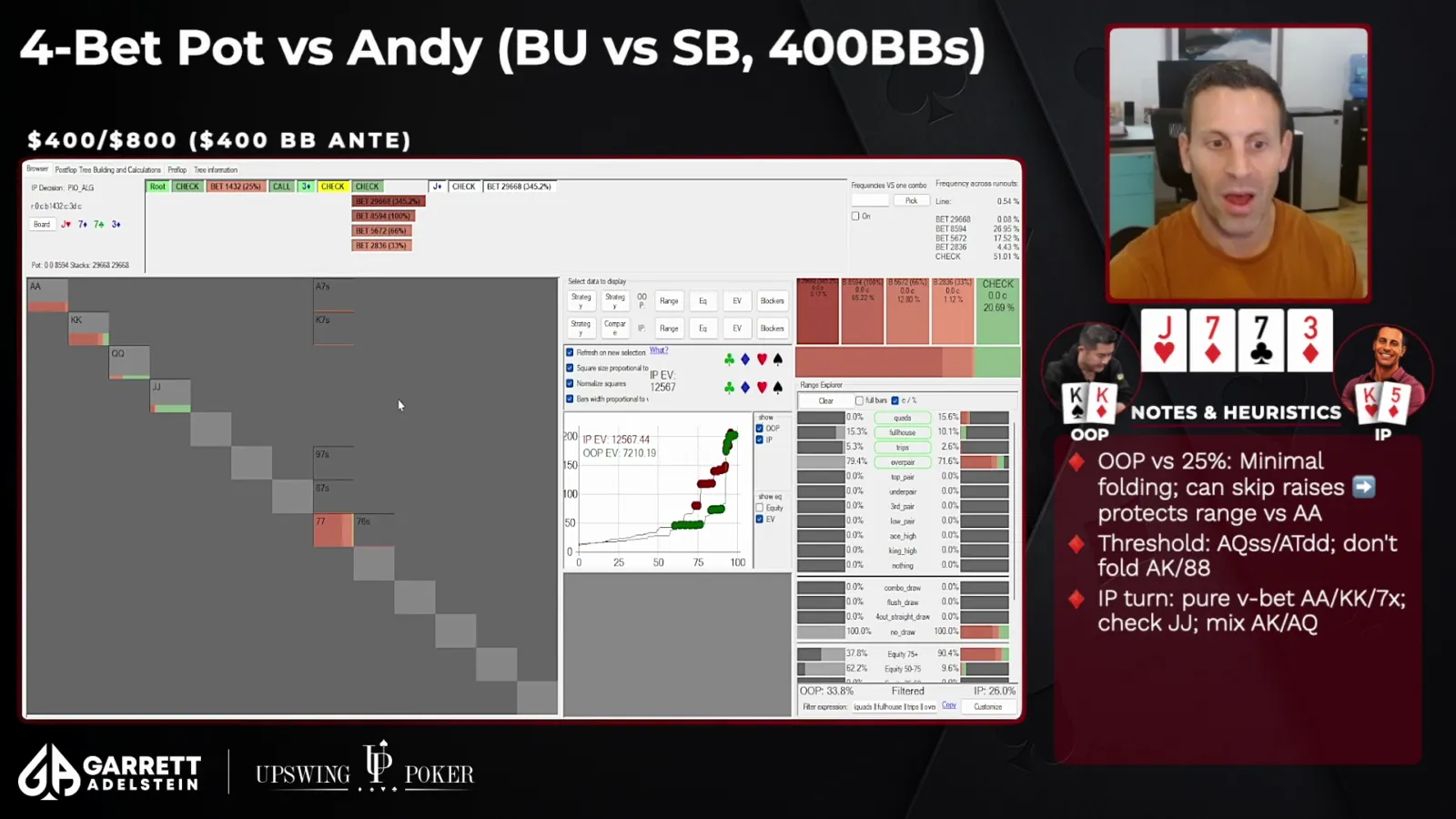
This is still a video course. It does not do the work for you. There are no structured tests forcing you to recall a threshold, rebuild a range or explain a hand before Garrett gives the answer. You will get much more from it if you pause before each street, write down your decision and then compare the reasoning.
A free lesson gives you a fair taste
Upswing has published the final hand as a public preview. Garrett runs a three street bluff against Patrik Antonius in a multiway pot and explains the blockers, the players left behind and why the river has to be an all-in.
Watch the full free lesson
See the complete hand against Patrik Antonius and hear Garrett explain the bluff street by street.
If this pace and level of detail annoy you, do not spend $999 hoping the rest will feel different.
What do other players say?
There is not enough independent buyer feedback yet to build a serious consensus. The course launched on September 8, 2026, less than a month before this review was written.
Upswing publishes very positive comments from Garrett’s private students and early access testers. Those comments may be genuine, but they are still selected by the company selling the course. I found plenty of announcements and recycled summaries, but very little detailed discussion from verified buyers outside the sales page.
That does not make the course weak. It means you should judge the public testimonials as marketing, watch the free lesson and use the 30 day guarantee carefully. Upswing says the guarantee is for first-time members and may not apply after a significant portion of the course has been consumed.
Destroy Live Cash or Smash Live Cash?
Smash Live Cash is the more conventional system. Nick Petrangelo builds strategy by spot, stack depth and game type. Destroy Live Cash starts with Garrett’s real hands and works backwards from the mess.
Choose Smash Live Cash if you want a broader foundation and a more organised path through common live cash situations. Choose Destroy Live Cash if your fundamentals are already solid and you want to study how a top player weighs theory, history and imperfect information in very deep games.
Who should buy it?
- You play live cash seriously, usually $2/$5 or higher, and the games often run deep.
- You understand ranges and pot odds, but struggle to decide when a read is strong enough to change the theoretical play.
- You face the same regulars often enough to collect useful information.
- You are willing to pause, take notes and study the Pio follow-ups instead of treating the course like Netflix.
- The $999 price is a sensible study expense for your stakes and bankroll.
Who should skip it?
- You are still learning basic preflop play or common postflop terms.
- You mainly play 100 big blind online cash and want precise population work for that format.
- Your live games are shallow and full of unknown players you rarely see again.
- You want quick tells, simple rules or a chart that removes difficult decisions.
- You already own several unfinished courses.
My final verdict
Destroy Live Cash is excellent at the thing most live poker courses avoid. It shows how uncertain an exploit really is.
Garrett has strong opinions, but he keeps returning to evidence. What does theory say? What is this player doing differently? How sure are we? Is the edge large enough to justify leaving the baseline? That process is useful long after the exact cards are forgotten.
The course is not perfect. The price is high. The games are unusually deep. Some Pio sections repeat ideas that strong players already know, and the range bonus is built for a narrow structure. There is also no meaningful body of independent buyer feedback yet.
For a committed live cash regular, I think it is one of the strongest courses Upswing has made. For a beginner or a casual player, it is too much course at too much money.
The right buyer is not someone who wants to play like Garrett. It is someone who wants to understand why a smart player can make a reasonable read, pull the trigger and still be wrong.
Destroy Live Cash FAQ
Is Destroy Live Cash worth $999?
It can be for serious live cash regulars who play deep and study actively. It is poor value for beginners, casual players and anyone who would weaken their bankroll to buy it.
Do I need PioSOLVER?
No. Garrett operates the solver and explains the useful parts. You can also watch the 50 practical hand reviews without the Pio lessons, although you would miss a large part of the course’s value.
Is the course good for beginners?
No. A newer player may follow the stories, but the course assumes comfort with ranges, stack depth, equity, blockers and betting across several streets.
Will it help online cash players?
Some concepts transfer, especially the work on thresholds and exploit confidence. A player focused on 100 big blind online pools would be better served by a course built around that format.
What bonuses are included?
The official offer currently includes more than 200 deep stack preflop charts, Garrett’s book Beneath the Cards and 50 ClubWPT Gold chips in eligible locations.