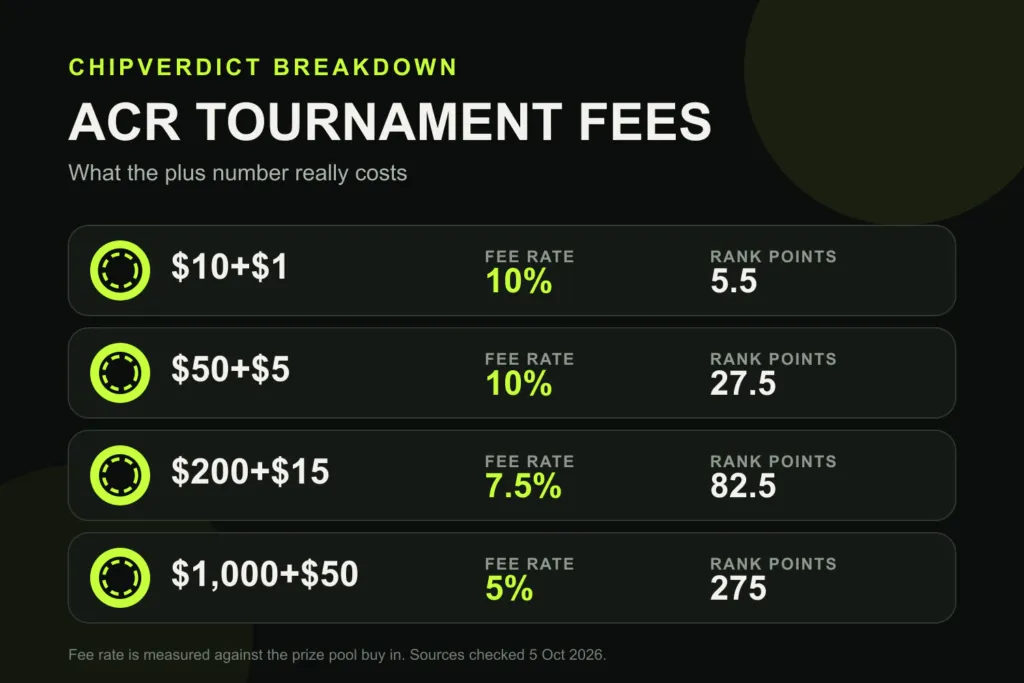
Quick answer: ACR says its tournament fees are usually around 10% of the amount going into the prize pool. A $10+$1 event has a 10% fee. A $200+$15 event works out at 7.5%, while a $1,000+$50 event is 5%. Bigger tournaments can therefore be cheaper as a percentage, even though the dollar fee is higher.
The bit that catches people is the plus sign. If the lobby shows $50+$5, the first number goes into the prize pool and the second number is ACR’s fee. You pay $55 in total. The room calls that a 10% fee because $5 is 10% of the $50 buy in.
That also means it is not an 11% fee and it is not 10% of the full amount leaving your balance. Measured against the $55 total, the $5 fee is 9.09%. Poker rooms normally quote it against the prize pool portion, so that is the convention used throughout this guide.
ACR tournament fee examples
| Lobby price | Total paid | Fee rate | Fee as part of total | Elite Rank Points |
|---|---|---|---|---|
| $10+$1 | $11 | 10% | 9.09% | 5.5 |
| $50+$5 | $55 | 10% | 9.09% | 27.5 |
| $200+$15 | $215 | 7.5% | 6.98% | 82.5 |
| $1,000+$50 | $1,050 | 5% | 4.76% | 275 |
The useful column is the fee rate, not the dollar fee on its own. Paying $50 to enter a $1,000 event sounds painful, but it is half the percentage charged by a $10+$1 tournament.
Why the lobby price matters more than the headline buy in
Tournament pages often lead with a neat number such as $11, $55 or $215. That is convenient for browsing, but it can hide the split between prize money and the house fee. Open the tournament lobby before registering and look for the full breakdown.
- Buy in: the part used to build the prize pool.
- Fee: the part kept by the poker room.
- Bounty: in a knockout event, a separate part of the entry attached to knocking players out.
- Total cost: everything deducted from your balance when you register.
A knockout event needs an extra second of attention. ACR’s rules use an example where a $10 tournament has $8 going to the ordinary prize pool, $2 attached to the player’s bounty and a further $1 fee. The bounty is still part of the competition. It is not extra rake.
Reentries are where the fee starts to bite
One bullet in a $50+$5 tournament costs $55. Four bullets cost $220, of which $20 is fees. Nothing complicated is happening, but it is easy to mentally track the $200 in buy ins and forget the extra $20.
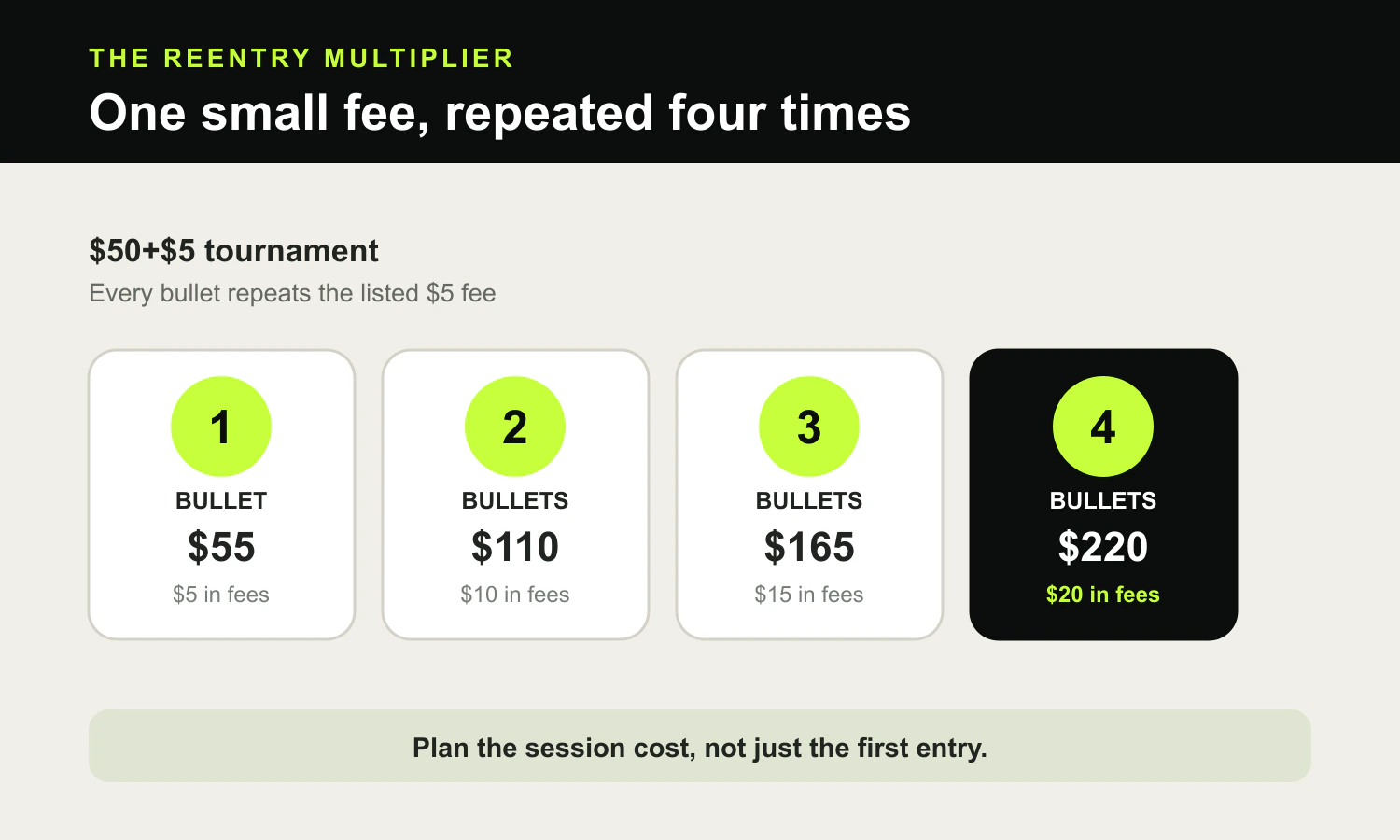
ACR’s tournament rules treat buy ins, reentries and fees as separate items when explaining refunds. The practical move is simple: check the price shown for each reentry and budget the full amount before you start. Do not build a session plan around one bullet if you know you normally fire three.
| Entries at $50+$5 | Total spent | Prize pool contribution | Total fees |
|---|---|---|---|
| 1 | $55 | $50 | $5 |
| 2 | $110 | $100 | $10 |
| 3 | $165 | $150 | $15 |
| 4 | $220 | $200 | $20 |
What do you get back through Elite Benefits?
ACR currently awards 5.5 Rank Points for every $1 spent in poker rake or tournament entry fees. That makes the points easy to work out:
- A $1 tournament fee earns 5.5 Rank Points.
- A $5 fee earns 27.5 Rank Points.
- A $15 fee earns 82.5 Rank Points.
- A $50 fee earns 275 Rank Points.
At the starting Lieutenant level, one Rank Point also earns one Combat Point and 100 Combat Points can be exchanged for $1. On that basic conversion, the reward value is roughly 5.5% of the fee. Higher ranks improve the return, but they require much more volume.
So the rewards soften the cost, but they do not make tournament fees disappear. A casual player paying $100 in fees should not think of that as free play because a few points came back. Our ACR rewards guide breaks down what each rank is actually worth.
Sit & Crush is not automatic cashback
ACR also runs the Sit & Crush leaderboard for Sit & Go, Jackpot Poker and On Demand games. Its published example takes $2.50 from a $10 tournament fee and puts that amount into the promotion’s prize pool. There is no extra charge, but that money funds a leaderboard. It is not a guaranteed personal refund.
Regular multitable tournaments do not qualify for Sit & Crush. A player grinding ordinary MTTs should judge the fee without counting on that race. If you mainly play Sit & Go or On Demand events, the leaderboard can add value, but only if your volume is high enough to place.
The real cost over a month
A single $1 or $5 fee barely registers. The monthly total is what matters.
| Schedule | Buy ins paid | Fees paid | Total spent |
|---|---|---|---|
| 20 events at $10+$1 | $200 | $20 | $220 |
| 20 events at $50+$5 | $1,000 | $100 | $1,100 |
| One $50+$5 event with four bullets | $200 | $20 | $220 |
| One $200+$15 event | $200 | $15 | $215 |
The last two rows are the interesting comparison. Four attempts in a smaller tournament put the same $200 into prize pools as one $200+$15 entry, but the repeated 10% fee costs $5 more. That does not automatically make the bigger event the better game. Field strength, bankroll risk, structure and expected value still matter. It does show why players should compare a full session rather than one lobby price.
How I compare two ACR tournaments
- Calculate the fee rate. Divide the fee by the amount entering the prize pool.
- Set a bullet limit. Multiply the full entry price by the number of attempts you are honestly prepared to make.
- Check the structure. A cheaper fee does not rescue a bad structure or a field that is far too tough.
- Separate bounties from fees. Bounty money remains playable prize value.
- Treat rewards as a rebate. Count only the Elite level or promotion you can realistically reach.
This is also the right way to compare ACR with another room. Looking at one flagship event tells you very little. Use the tournaments you would actually play, add the likely reentries, then compare total fees and rewards across a normal month.
My take
ACR’s basic tournament pricing is not hard to understand once you stop looking at the rounded headline and read the plus number. Around 10% is normal at the lower prices. The better news is that ACR’s own examples show the percentage dropping on larger buy ins.
The real leak is not the first $1 fee. It is firing extra bullets without counting them. If you like ACR because the schedule is huge, decide your total spend before registering and judge the fee across the whole session. That gives you a much more honest number than saying a tournament is only eleven bucks.
If the tournament selection is the reason you are considering the room, read our full ACR Poker review. The bonus clearing guide and withdrawal rake rule guide cover two other costs that are easy to misunderstand.
ACR tournament fee questions
Does ACR charge rake on poker tournaments?
Yes. ACR calls it a tournament fee. Its FAQ says fees are usually around 10% of the prize pool buy in, although the percentage can be lower in larger events.
Is a $10+$1 tournament an 11% fee?
No. The $1 fee is 10% of the $10 entering the prize pool. It is 9.09% of the full $11 payment.
Do reentries mean paying another fee?
Budget each reentry at the full price displayed in the lobby. If the reentry is shown at the same $50+$5 price, another bullet adds another $5 fee.
Are tournament fees added to the prize pool?
No. The fee is the room’s charge. The buy in portion, plus any separate bounty contribution, is the part connected to player prizes.
Do ACR tournament fees earn Rank Points?
Yes. ACR currently publishes a rate of 5.5 Rank Points for every $1 spent in rake or tournament entry fees.
Sources
- ACR explanation of tournament fees
- ACR tournament rules and refund examples
- ACR Elite Benefits earning rates
- ACR Sit & Crush rules and fee examples
Fees and rewards checked October 5, 2026. Tournament prices and promotions can change, so confirm the split shown in the lobby before registering.