Upswing Lab 2.0 is easy to recommend to one type of player: someone who knows they need to study but keeps bouncing between random videos, charts and solver outputs without a plan.
The $99 monthly price buys structure more than secrets. There is a large course library, separate paths for live cash, online cash and tournaments, preflop charts, weekly coaching and a private Discord. The material ranges from poker basics to detailed work on bet sizing, river play, database analysis and exploitative adjustments.
Our short verdict: it is strong value for beginner and intermediate no-limit hold’em players who will follow a path and study consistently. Advanced regulars with a narrow technical leak may get more from a database review, private coaching or a specialist course.
Quick verdict
- Best for: beginner to intermediate cash and tournament players who want one organized study system
- Less useful for: experienced regulars looking for deep work on one specific format or leak
- Price: $99 monthly, $399 for six months, or $699 annually
- What stands out: clear learning paths, broad coverage, practical play reviews and an active coaching community
- Main concern: the library can feel overwhelming, and some retained lessons look older than the new Lab 2.0 material
ChipVerdict rating: 8.3/10
If you would rather buy one specialist course, our Destroy Live Cash review covers deep live cash, while Crushing PLO Tournaments is built for PLO MTTs. For high-level online cash, see our Mechanics of Poker review.
What does an Upswing Lab 2.0 membership include?
The subscription is broader than the main course map. Every plan currently includes the complete Lab library, the archived premium training library, a placement quiz, lesson quizzes, the Preflop Prodigy charts app, weekly Strategy Specials, the private Discord and the Fair Play guarantee. Members also receive the Max Exploit Academy and the newer Crushing Low Stakes series.
| Included feature | What it is | Who benefits most |
|---|---|---|
| Launch Pad and Mastery Path | The main structured curriculum, from fundamentals to advanced theory and exploits | Players who need a study order |
| Placement quiz | A short assessment that recommends where to enter the Launch Pad | Experienced players who do not want to repeat basic lessons |
| Preflop Prodigy | A browser-based range app with six extra sets of Lab member ranges | Cash, tournament and live players checking common preflop spots |
| Strategy Specials | Weekly coaching, Q&A sessions and a growing archive of recorded webinars | Members who want current material and coach interaction |
| Private Discord | Course-specific forums, hand feedback, content requests and direct coach discussion | Players who will actively post hands and questions |
| Max Exploit Academy | Avery Nitkin’s work on population tendencies and counter-strategies | Intermediate and advanced players trying to move beyond standard lines |
| Crushing Low Stakes | Uri Peleg’s practical rule-based approach to the games most members actually play | Micro and low-stakes players |
The difference between “included” and “valuable” depends on how you study. The charts app is useful immediately. Discord and weekly coaching can be worth more than another fifty videos, but only if you participate. A member who ignores the community is paying for part of the package without using it.
What is actually inside Lab 2.0?
The course is split into two broad stages. The Launch Pads build a base for live cash, online cash or tournaments. The Mastery Path then moves into theory, exploitation and Play & Explain sessions.

The introductory path covers terminology, quick wins, preflop play, postflop play, solver basics and softer-game adjustments. From there, players can choose the track that matches the games they actually play.
The cash-game theory path alone contains levels on 3-bet and 4-bet pots, playing against bets, bet sizing, turn strategy, river strategy, early position against late position, database analysis, unusual flop textures, understudied spots, check-raised pots and donk betting. That is a sensible progression. It starts with common decisions and gradually moves into spots that are harder to study on your own.
A closer look at the bet-sizing module
One representative module contains 20 lessons. It begins with overbets, geometric sizing and hand examples, then moves through single-raised pots, toy-game simulations, polarity and specific board textures. The final lessons compare sizes across positions and finish with homework using Lucid.
This matters because it shows the difference between a real curriculum and a folder full of poker videos. The lessons are arranged around a decision that appears at the table, with examples and homework following the theory.
The bonuses and extra tools, explained
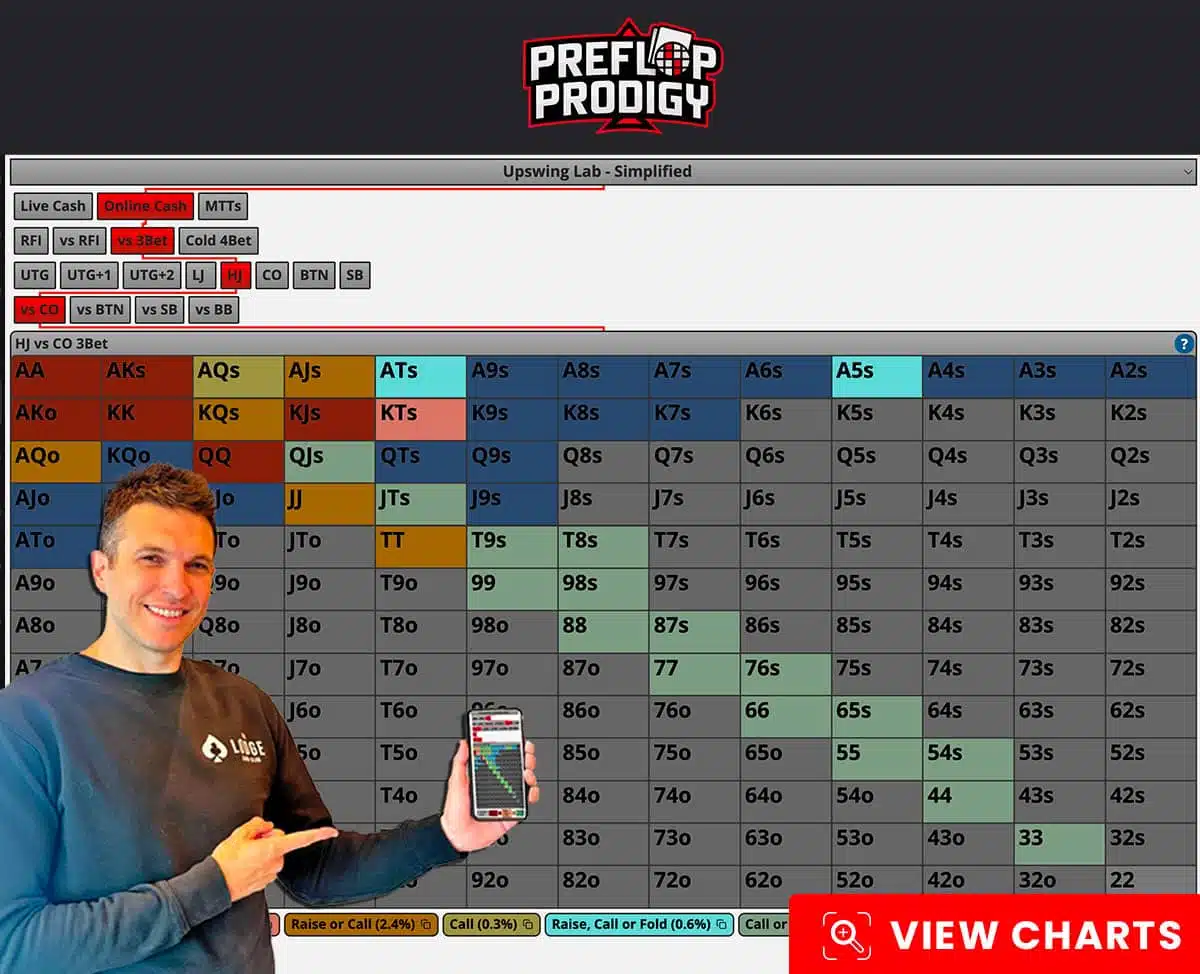
Preflop Prodigy charts
Preflop Prodigy runs in a browser and works on any device with an internet connection. Lab members receive six additional sets of ranges covering online cash, live cash and tournaments. Upswing also advertises ClubWPT Gold straddle ranges. This is a reference tool, not a substitute for understanding why a range changes with stack depth, position or rake.
Weekly Strategy Specials and Q&As
Upswing says a new Strategy Special is published each week. These sessions combine a current strategy topic with questions from members, and the existing archive contains roughly 20 hours of recorded webinars and live training. This is one reason a continuing subscription can make sense after the core lessons are complete.
Max Exploit Academy
Max Exploit Academy is not a small add-on. It focuses on identifying common player tendencies, deciding where a theoretically imperfect adjustment is justified and reviewing the resulting hands. That gives stronger players a reason to look beyond the beginner path. It is also the part most likely to be misused by someone who copies an exploit without understanding the population read behind it.
Crushing Low Stakes
Released in March 2026, this series follows Uri from the lowest stakes upward. The approach is deliberately practical: connect pot size to hand strength, recognize which hands can be pushed for value, choose simpler bluffs and avoid forcing thin plays during losing stretches. That is more relevant to a $10NL or $1/$2 player than watching another nosebleed cash-game battle.
Private Discord access
The Discord has forums linked to individual sections of the course, general hand-review channels and places to request future content. Upswing says six coaches are active in the community. Access lasts while the membership is active, so useful discussions should be treated as part of the subscription rather than permanent course material.
ClubWPT Gold chip bonus
Eligible US members currently receive ClubWPT Gold Chips with each purchase and renewal. The monthly plan gives 10 Chips, the six-month plan gives 40, and the annual plan gives 70. Chips are credited by the end of Sunday in the purchase or renewal week rather than instantly at checkout.
This promotion is limited to US residents in states where ClubWPT Gold is available. Upswing currently excludes Idaho, Michigan, Montana, New Jersey and Washington. Treat the Chips as an extra, not as cash deducted from the membership price. Availability and promotional amounts can change.
The teaching style
Lab 2.0 is not built around one personality. Uri Peleg, Doug Polk, Gary Blackwood, Qing Yang, Tim Jenkins and other coaches appear across the library. The style changes with the coach, but the stronger previews share one useful habit: they explain the decision before revealing the result.
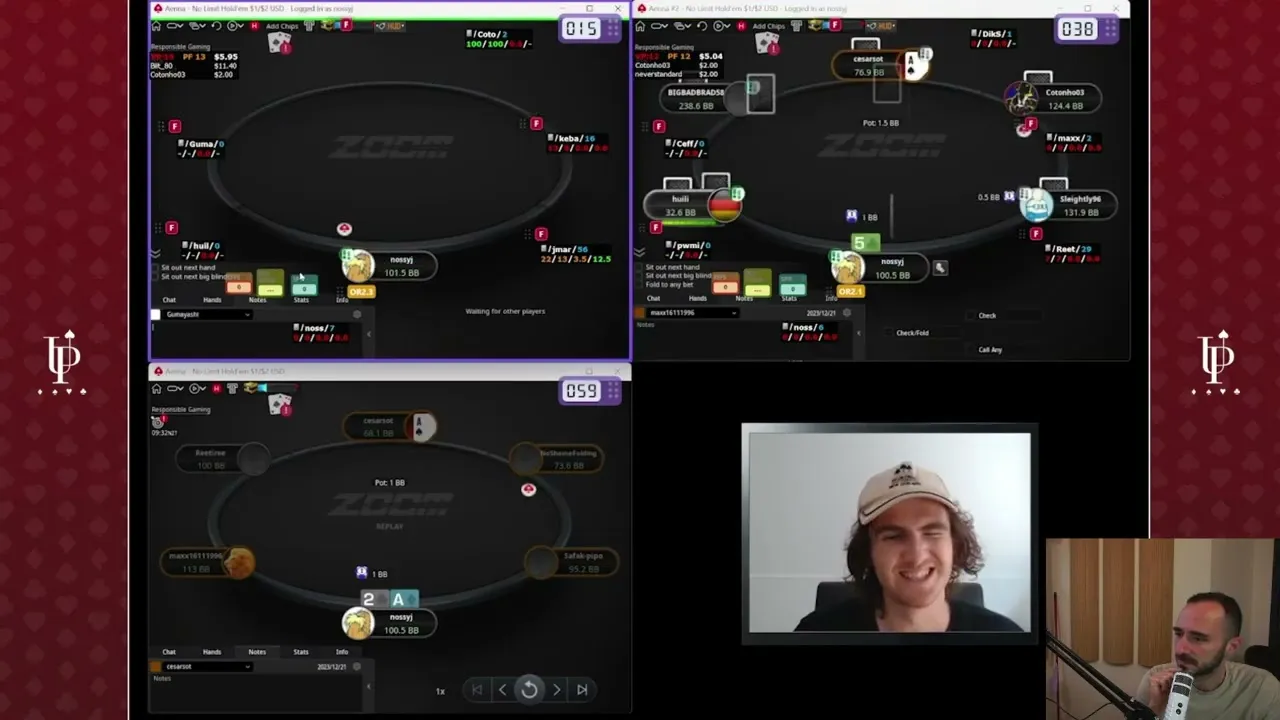
In Tim Jenkins’ 200NL session, the useful part is not a spectacular hero call. It is the steady accumulation of small edges. He tags opponents, notices slight range changes and explains why an apparently automatic spot deserves another look. That is relevant to players who already know standard ranges but still click too quickly in familiar situations.
Uri Peleg’s live-play preview is faster and more demanding. He talks through sizing, range interaction, check-raises and bluff candidates while playing several tables. Experienced players will get plenty from it. A newer player may need to pause and replay sections.
An older Doug Polk tournament lesson takes a different approach. Uri adds a simple hand-category framework over legacy footage. The new explanation makes the old hands easier to study, but it also confirms that part of the library has been retained rather than rebuilt from scratch.
What we liked
1. It gives scattered players a route
The internet already has more poker advice than anyone can watch. The advantage here is the sequence. A live $1/$2 player can start with the live cash path instead of wondering whether a high-stakes solver video applies to the game in front of them.
2. The library covers both theory and exploitation
Pure theory can turn into memorization. Pure exploit content can become guesswork. Lab 2.0 makes room for both. The Max Exploit Academy is designed around population tendencies, while the theory track develops the baseline needed to recognize when an adjustment makes sense.
3. The course is still being updated
Upswing’s public update log shows new material continuing through 2026, including database reviews, hand-history sessions and deeper strategy lessons. That makes the subscription easier to justify than a static library that has not changed in years.
4. The community adds practical value
Recent members repeatedly mention the Discord and weekly coaching as important parts of the package. A course becomes more useful when a player can ask about a hand, compare notes and get pulled back into studying after a bad week.
Where it falls short
The amount of content can become its own problem
A large library sounds valuable, but watching videos is not the same as improving. Players who jump between tracks may finish the month with a notebook full of ideas and no measurable change at the table. Pick one path, take notes and review hands connected to each lesson.
Not every lesson feels equally current
Upswing says the strongest material from the original Lab was retained, and some older videos now have new introductions. The strategy may still be useful, but the presentation is less consistent than a course recorded as one project.
The platform has drawn complaints
Member feedback is mostly positive about the strategy material, but there are recurring complaints about the mobile experience, bugs and parts of the quiz system. One recent Reddit poster also reported losing access immediately after cancelling and having trouble with a charge and Discord invitation. That is one player’s account, not proof of a general billing issue, but it is a reason to read the cancellation terms and keep confirmation emails.
There is no free trial
Upswing offers a 30-day Fair Play guarantee to eligible first-time members, subject to its fair-use rules and approval. That is not the same as a free trial. Check the current terms before treating it as a risk-free month.
Is Upswing Lab 2.0 worth the price?
| Plan | Total price | Effective monthly price | Eligible ClubWPT bonus | Our take |
|---|---|---|---|---|
| Monthly | $99 | $99 | 10 Chips each month | Best first step for most players |
| Six months | $399 | $66.50 | 40 Chips every six months | Reasonable if you follow a longer study plan |
| Annual | $699 | $58.25 | 70 Chips each year | Best price only if you use coaching and updates regularly |
For most people, one focused month is the sensible test. Choose one track in advance and make time for two or three study sessions each week. If the format works and you are using the community, the six-month plan becomes more attractive.
The annual plan saves $489 compared with paying monthly for a full year. It also creates a bigger risk that the course becomes another subscription you mean to use later. Do not buy twelve months just because the monthly equivalent looks cheaper.
Upswing estimates that someone studying five hours per week could complete the Launch Pad in about three weeks and the Mastery Path in roughly two further months. That is the seller’s estimate, not a deadline. Watching the material faster is not useful if the ideas never reach your hand reviews or playing decisions.
Who should join?
- Newer players: Yes, especially if free content has left gaps in your fundamentals.
- Low-stakes live players: Yes. The live cash route and exploit material are a better fit than solver-heavy content alone.
- Micro and low-stakes online players: Usually yes, provided you review your own hands alongside the lessons.
- Tournament players: Yes if you want a broad structured base. Compare it with a tournament-only course if MTTs are your sole focus.
- Established mid-stakes regulars: Maybe. The advanced modules and community can help, but a targeted database review may expose leaks faster.
- Players who rarely study: No. The membership only has value if you use it.
A practical one-month plan
- Choose live cash, online cash or tournaments before paying.
- Work through one connected group of lessons rather than sampling everything.
- Mark three hands after every playing session that relate to the current topic.
- Use the community or coaching session to resolve one question each week.
- At the end of the month, decide whether the next module and the community justify renewing.
Upswing Lab 2.0 alternatives
Players who want tournament-only training should compare a dedicated MTT course before subscribing. Cash players with a mature strategy may get a quicker return from a database review or one-on-one coaching. If the price is the main concern, start with a reputable free fundamentals series and spend money only when you can name the leak you are trying to fix.
Final verdict
Upswing Lab 2.0 is one of the more complete general poker training memberships available. Its real strength is not that every lesson is revolutionary. It is that a player can enter at the right level, follow a coherent route and combine theory with practical hand reviews and community feedback.
Start monthly. Give one track a serious four-week attempt. If you are studying, posting hands and attending coaching, the longer plans can make financial sense. If you are only watching the occasional video, keep the $99 for your bankroll.
Frequently asked questions
How much does Upswing Lab 2.0 cost?
At the time of this review, it costs $99 monthly, $399 for six months or $699 for one year. Prices and bonuses can change, so check the official page before paying.
Is there a free trial?
No. Upswing advertises a 30-day Fair Play guarantee for qualifying first-time members, but conditions apply and refunds are not automatic.
Is the Lab suitable for complete beginners?
Yes. Its opening levels cover terminology, preflop fundamentals and basic postflop decisions. Beginners should stay on the Launch Pad before moving into the denser Mastery Path material.
Does it cover tournaments and cash games?
Yes. There are separate Launch Pads for live cash, online cash and tournaments, followed by broader theory, exploit and Play & Explain material.
Can you cancel at any time?
Upswing says members can cancel online. Confirm when access ends and save the cancellation confirmation, particularly if you are cancelling close to a renewal date.
What is the ClubWPT Gold bonus?
It is a recurring allocation of ClubWPT Gold Chips for eligible US members. The amount depends on the Lab plan. It is not available in every state, is not credited instantly and should not be treated as a cash discount on the course.
Does membership include new content?
Yes. Upswing currently advertises weekly Strategy Specials, regular library updates and continued expansion based on member questions. Access to new material, the charts and the private community lasts only while the subscription remains active.
Sources
- Upswing Poker: Lab 2.0 curriculum, pricing and membership terms
- Upswing Poker: Lab 2.0 sneak peek
- Upswing Poker: Lab 2.0 content update log
- Upswing Poker: Tim Jenkins 200NL lesson preview
- Upswing Poker: Uri Peleg live-play lesson preview
- Upswing Poker: Uri Peleg reviews legacy Doug Polk footage
- r/poker discussion: early Lab 2.0 member feedback
- r/poker discussion: platform and cancellation complaint