The short version
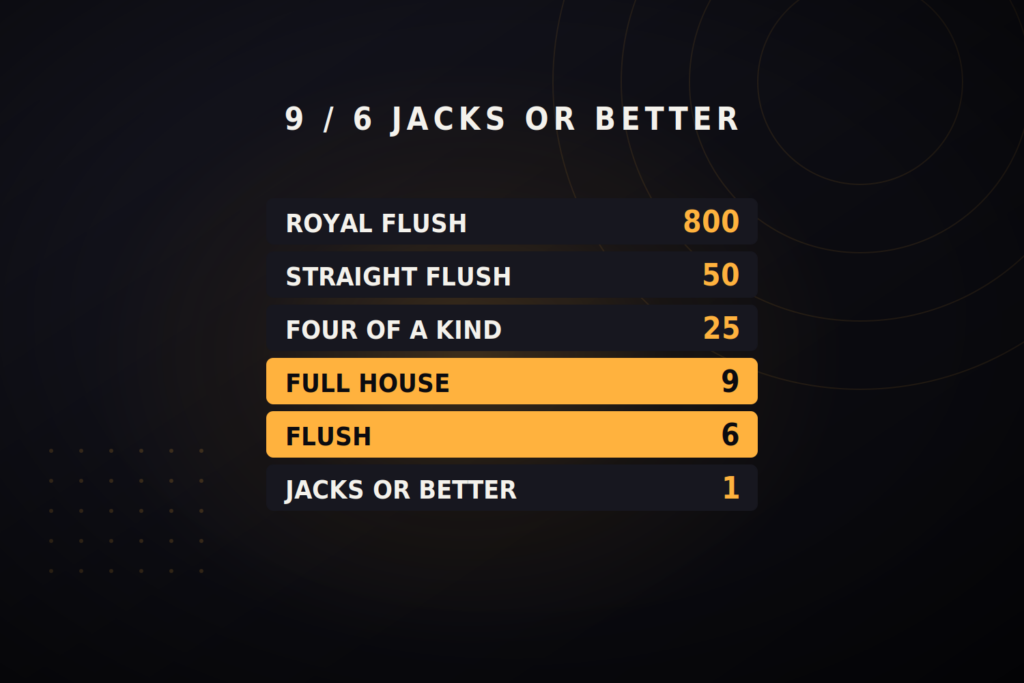
- Jacks or Better paytables are named after the full house and flush payouts: 9/6 is full pay, at 99.54% RTP.
- Drop to 8/5 and the return falls to 97.3%. At 6/5 it is 95% — five times the cost of the full-pay game.
- Everything else on the paytable is usually identical. The two numbers are the whole story.
Video poker is one of the few casino games where the exact price is printed on the screen before you play, in numbers anyone can read.
Almost nobody reads them.
The naming convention
Jacks or Better paytables are described by two numbers: what a full house pays and what a flush pays, per coin bet.
9/6 means a full house pays 9 and a flush pays 6. This is the full-pay game, and played with correct strategy it returns 99.54% — a house edge of under half a percent, which is better than almost anything else in the building.
8/5 means a full house pays 8 and a flush pays 5. Return: 97.30%.
6/5 means exactly what it sounds like. Return: 95.00%.
Everything else on those three paytables — the pair, two pair, three of a kind, straight, four of a kind, straight flush and royal — is typically identical. Two lines change, and the price of the game multiplies by five.
What the difference costs
Video poker is fast. Even at a deliberate pace, 500 hands an hour is realistic, and experienced players go well past that.
At €0.25 a hand and 500 hands an hour, you are putting €125 an hour through the machine.
- 9/6: about €0.58 an hour
- 8/5: about €3.38 an hour
- 6/5: about €6.25 an hour
A €50 bankroll lasts about 86 hours on the full-pay game and about 8 hours on the 6/5 version. Identical screen, identical cards, identical decisions.
Where to look
The paytable is displayed permanently on the main game screen in most video poker interfaces, as a grid at the top. Find the FULL HOUSE row and the FLUSH row, read the numbers in the 1-coin column, and you have your answer before your first hand.
If the paytable only shows the 5-coin column, divide by five: a full house at 45 for five coins is a 9. A flush at 25 is a 5.
Two things that change the answer
Play max coins. The royal flush pays disproportionately more on the fifth coin — typically 4,000 rather than the 1,250 that straight scaling would give. That single jump is worth around 1.4% of the total return. Playing fewer than five coins on a video poker machine throws away more than the difference between paytables. If five coins is more than you want to risk, drop to a lower denomination rather than fewer coins.
Play correct strategy. The 99.54% figure assumes the mathematically best hold on every hand. Playing by feel typically costs one to two percentage points, which is to say playing 9/6 badly is worse than playing 8/5 well. The strategy is learnable — there are perhaps twenty rules that cover almost every hand — and it is the only casino game where getting it exactly right is genuinely achievable.
Other variants, same principle
Bonus Poker, Double Bonus, Deuces Wild and the rest all have full-pay versions and degraded ones, all distinguished by a couple of paytable lines.
The habit generalises: before the first hand, read the paytable. It is the only casino game that tells you the price up front, and it is a shame to waste that.