The short version
- Insurance is a separate bet on the dealer's hole card. It has nothing to do with the hand you are holding.
- It pays 2:1 when the true odds are about 2.25:1, which makes it roughly a 7% bet.
- For anyone not counting cards, the answer is no. Every time. Including on a blackjack.
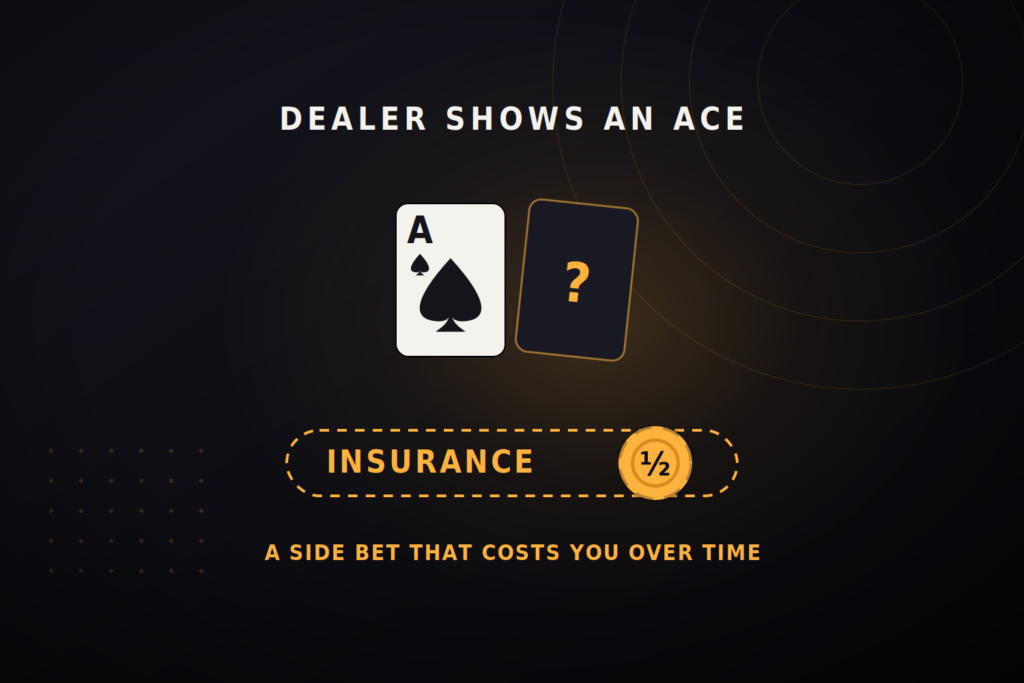
The dealer turns an ace and asks whether you want insurance. Half the table takes it, usually the half holding good hands.
It is worth understanding exactly what is being offered, because it is not what it sounds like.
What insurance actually is
Insurance is a side bet, up to half your original stake, that the dealer's face-down card is a ten-value card — giving them blackjack.
If you are right, it pays 2:1. If you are wrong, you lose it, and then you play your hand normally.
Note what is missing from that description: your cards. Insurance does not protect your hand, does not interact with it, and does not care what you are holding. It is a separate wager on one specific card, offered at a moment when the casino knows you feel exposed.
The price
A 52-card deck holds sixteen ten-value cards — the tens, jacks, queens and kings — and thirty-six cards that are not. Ignoring the cards already visible, the dealer's hole card is a ten about 30.8% of the time.
A fair payout for a 30.8% chance would be about 2.25:1. You are offered 2:1.
That gap is the house edge, and it works out to roughly 7% of the insurance stake. For comparison, the blackjack hand you are sitting there playing runs at about 0.5%. Insurance is fourteen times more expensive than the game it is attached to.
"Even money" is the same bet
If you have a blackjack and the dealer shows an ace, you will often be offered even money instead: a guaranteed 1:1 payout rather than risking a push against a dealer blackjack.
That is insurance with the arithmetic pre-applied. Taking it means accepting a certain 1 unit instead of a 3:2 payout that lands about 69% of the time — which averages out to roughly 1.04 units.
Declining is worth about 4% more. It also means occasionally watching your blackjack push against a dealer blackjack, which stings considerably more than 4% feels like it should.
The exception
There is one circumstance where insurance is a good bet: when you know the remaining shoe is unusually rich in ten-value cards.
That is what card counters are tracking. When the count is high enough, the real probability of a ten climbs past the break-even point, the 2:1 price becomes generous, and insurance flips from a bad bet to a good one. It is one of the most valuable plays available to a counter.
If you are not counting, this does not apply to you, and no amount of watching the previous few hands substitutes for it.
The short version
Decline. Every time, on every hand, including blackjacks. The bet is priced against you by a wide margin, it has nothing to do with the cards you are holding, and the feeling that you are protecting something is exactly what the offer is designed to produce.