The short version
- RTP tells you what a slot returns over millions of spins. Volatility tells you what your afternoon looks like.
- Low volatility means frequent small wins and a bankroll that drifts slowly. High volatility means long dry runs punctuated by big hits.
- Same RTP, same long-run cost — completely different session. Choose by the session you want.
Two slots both advertise 96% RTP. One pays something back on nearly half your spins. The other goes forty spins without a flicker and then hands you 200x your stake.
Over ten million spins those two games cost exactly the same. Over the ninety minutes you are actually going to play, they are not remotely the same game.
That difference is volatility, and it matters far more to how a session feels than the RTP figure everyone quotes.
What volatility measures
Volatility (sometimes called variance) describes how the wins are distributed rather than how much they add up to.
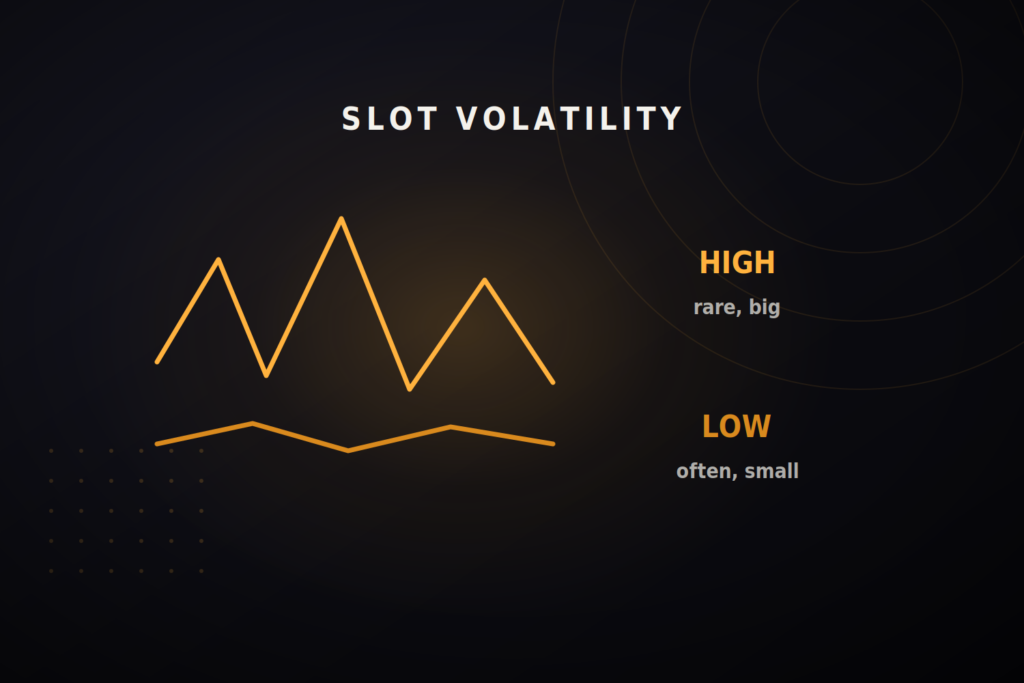
A low volatility slot spreads its return thinly and often. Lots of small wins, many of them below your stake. The balance moves in small steps and rarely collapses.
A high volatility slot hoards the same return and delivers it in rare, large lumps. Most spins return nothing. The wins, when they land, are the ones people post screenshots of.
Both games hand back the same 96% in the limit. They simply choose different shapes to do it in.
What each one does to a bankroll
Here is the practical translation.
Low volatility gives you more spins per euro. A €50 bankroll survives long sessions because the small returns keep topping it up. What you will not get is a screenshot moment — the top prize on a low-volatility game is typically a few hundred times stake, not a few thousand.
High volatility gives you a shot at something genuinely large and a much rougher ride getting there. The same €50 can be gone in twenty minutes, or it can turn into something you remember. The distribution is wide enough that neither outcome is unusual.
Neither is a better bet. They are the same bet, packaged for different appetites.
How to tell which is which
Most slot providers now publish a volatility rating in the game info panel — usually low, medium, high, or a five-point scale. That is the fastest answer and it is generally honest.
Where it is missing, three things give it away:
The paytable spread. If the top symbol pays 50x for five in a row, that is a low-volatility game. If it pays 5,000x, it is not.
The hit frequency, where it is published. Above roughly 30% is low volatility territory; below 20% is high.
The free spins round. Games that trigger bonuses often and pay modestly are low volatility. Games where the bonus is rare and enormous are high.
Matching the game to the session
If you are playing for an evening and want the stake to last, low volatility is doing what you want. The money moves slowly, the game stays live, and the cost per hour is what it says on the tin.
If you are putting a specific amount in specifically to chase something big — and you are comfortable with that amount being gone quickly — high volatility is the honest tool for that job. It is what those games are built for.
The mistake is using the wrong one for the job: sitting down with a high-volatility game and a small bankroll expecting a long session, or playing low volatility and wondering why the big win never comes.
Bet sizing changes the equation
Volatility interacts with stake in a way worth noticing.
On a high-volatility game, cutting your stake in half roughly doubles the number of spins you get — and the number of spins is what buys you a chance at the rare big hit. Betting small on a volatile game is a genuinely sensible way to play it.
The reverse is also true: betting big on a volatile game compresses the whole distribution into very few spins, which mostly means finding out fast.