The short version
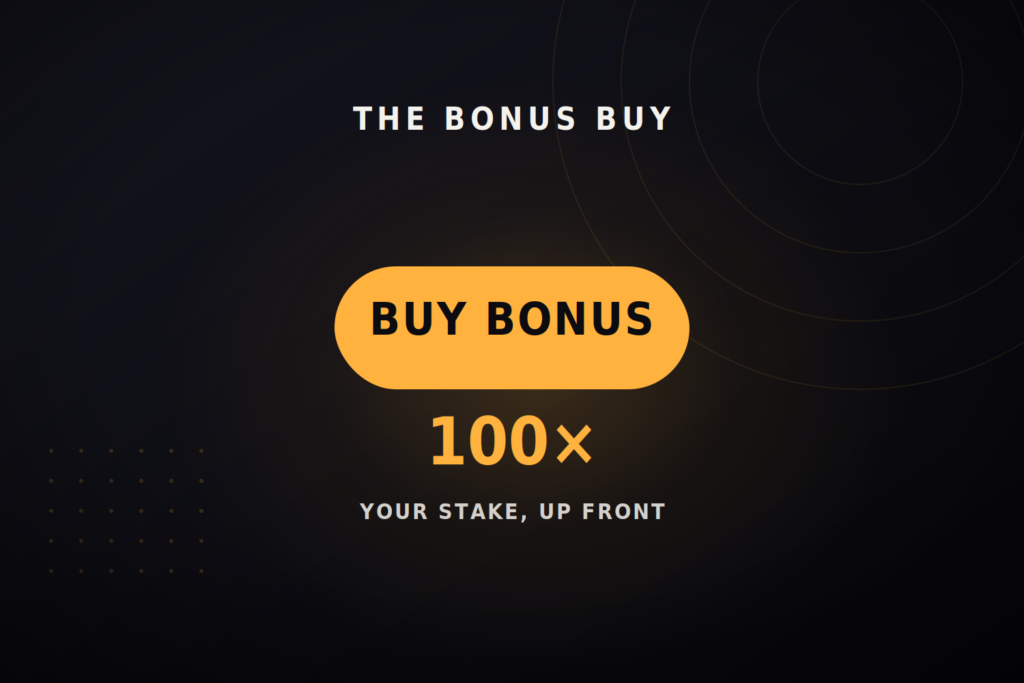
- A bonus buy compresses hours of base-game spins into one purchase, at typically 50x to 100x your stake.
- The buy has its own RTP, printed in the game info, and it is often different from the base game's.
- The real effect is on variance: you are paying a large sum for a single, wide outcome.
Feature buy, bonus buy, buy free spins — whatever a given studio calls it, the button does the same thing. Pay a fixed multiple of your stake, typically 50x to 100x, and the game drops you straight into the bonus round.
It is one of the most misunderstood features in online slots, mostly because people argue about whether it is good value when the interesting question is a different one.
What you are actually buying
The bonus round in a modern slot is where most of the return lives. On a high-volatility title, the base game might return 30% of the total RTP and the feature the other 66%, with the buy sitting on top of that structure.
Triggering it naturally takes, on average, a few hundred spins. Those spins cost money — that is the "hours" you are skipping.
So the buy price is roughly what those spins would have cost you, give or take the operator's margin on the transaction. A 100x buy on a €0.20 spin is €20, which is roughly 100 spins at that stake. The arithmetic is not outrageous.
The RTP is often different
This is the part worth checking.
Many games publish a separate RTP for the bonus buy, and it is not always the same as the base game's. Some titles set the buy slightly higher — 96.5% against 96.0% — as an incentive. Others set it noticeably lower, on the reasoning that people who want the feature will pay for it regardless.
Both figures are in the game info panel. Open it, find the RTP section, and look for a second line covering the feature purchase. If the buy figure is lower than the base figure, you are paying a premium for the convenience, and now you know by how much.
What it really changes: variance
Here is the thing the RTP debate misses.
Playing 100 base-game spins at €0.20 gives you a hundred separate outcomes. Most are small. The distribution is comparatively narrow and the session takes twenty minutes.
Spending the same €20 on one bonus buy gives you one outcome. It might return nothing. It might return 300x. The expected value is similar; the shape is nothing alike.
A bonus buy is a variance instrument. It takes a long, gentle distribution and compresses it into a single wide one. That is why it feels dramatic, and it is the honest reason to press it or not.
The practical consequences
Your bankroll disappears faster in wall-clock terms. A €50 balance is two and a half buys at €20. Whatever the RTP says, two and a half outcomes is not a session.
Loss limits matter more, not less. The pace at which money leaves your account during bonus buys is an order of magnitude above base play. Any deposit or loss limit you use should be set with that in mind, not with base-game pacing in mind.
Some markets ban them outright. The UK prohibits feature buys, and several other jurisdictions have followed. If the button is missing from a game you have seen it in elsewhere, that is why — not a fault.
How to use it sensibly, if you want to
Check the buy RTP against the base RTP in the game info and skip the buy if the gap is meaningfully negative.
Decide the number of buys before you start, and treat that as the session rather than treating the balance as the session.
And understand that you are not buying better odds. You are buying the interesting part of the game, compressed, at approximately its market price. That is a legitimate thing to want. It is just worth knowing that is what is being sold.