The short version
- Martingale wins small amounts very often and loses a very large amount rarely. The averages come out unchanged.
- A seven-loss streak on red/black arrives roughly once every 106 sequences, and it costs 127 units.
- Table limits guarantee the streak that breaks you will arrive before the recovery does.
The Martingale is the most famous betting system there is, and the reasoning behind it is genuinely appealing.
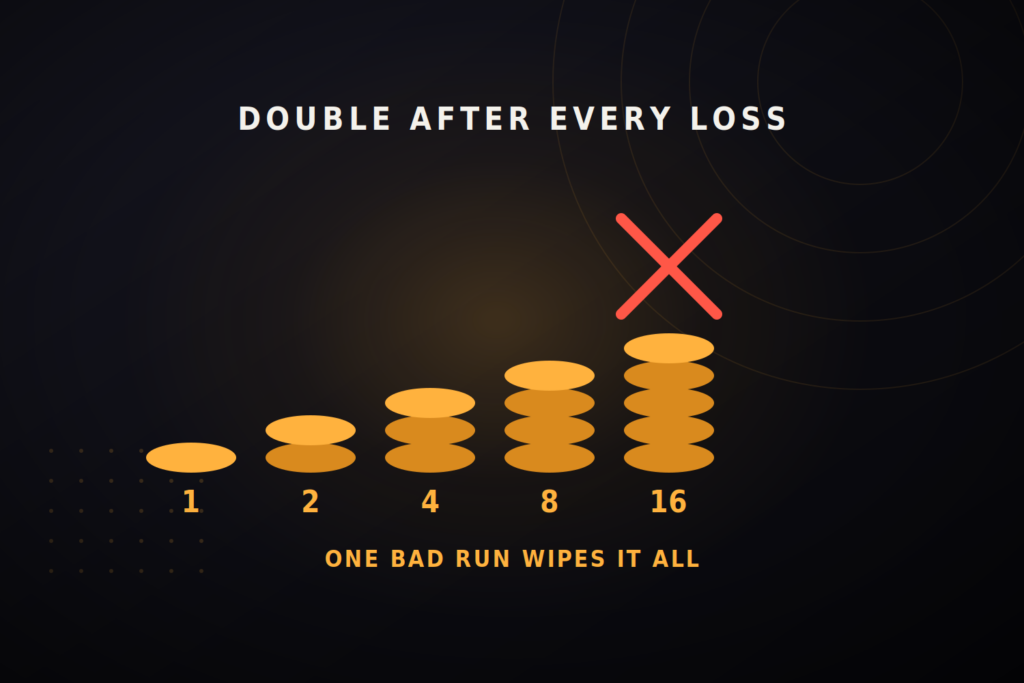
Bet one unit on red. If it loses, bet two. If that loses, bet four, then eight, then sixteen. Whenever red eventually lands, you recover everything you have lost plus one unit of profit. Red must come up eventually. Therefore you always win.
Every step of that is true except the conclusion.
Where it actually goes wrong
The system does what it claims. Most sessions do end in a small profit. That part is not a trick.
The problem is what happens in the sessions that do not.
On a European wheel, red comes up 18 times in 37 — about 48.6%. Red fails to come up 19 times in 37, or 51.4% of spins. The chance of that happening seven times running is 0.514 to the seventh power, or roughly 0.94%: once every 106 sequences or so.
When it happens, you have bet 1 + 2 + 4 + 8 + 16 + 32 + 64 = 127 units and lost all of them.
So the ledger reads: about 106 sequences that win one unit each, against one that loses 127. That is 106 won and 127 lost — and the gap between them is not bad luck, it is precisely the 2.70% house edge, showing up on schedule and in full.
The Martingale does not reduce the edge. It reshapes the distribution: many small wins, one catastrophic loss. The average is untouched, because no sequence of bets on a negative-expectation game can change the average. That is not an opinion about systems; it is arithmetic.
Table limits close the exit
The system requires that you can always double. Real tables do not allow that.
A table running from €1 to €500 lets you double nine times: 1, 2, 4, 8, 16, 32, 64, 128, 256. The tenth step would be €512 and the table will not take it.
So the strategy is not "double until you win". It is "double until you win or until you hit the ceiling, whichever comes first" — and the ceiling converts the rare enormous loss from theoretical to guaranteed-eventually.
A nine-loss streak arrives roughly once every 400 sequences. Play long enough and you will meet it. The 511 units you lose when you do are not recoverable by the system that lost it, because the system's only move is to bet more and it is no longer allowed to.
Bankroll makes it worse, not better
The obvious response is to start smaller relative to your bankroll. It does not help in the way it feels like it should.
Starting at €0.50 instead of €1 halves the size of the disaster and halves the size of every win that precedes it. The ratio is fixed. You are buying a longer wait for the same outcome.
What it is good for
There is one honest use. If you specifically want a high probability of a small win and you are genuinely willing to accept a small probability of a large loss, the Martingale delivers exactly that shape. Some people prefer it to the flat-betting distribution, and that is a legitimate preference about variance rather than a mistake about maths.
What it cannot do is beat the house edge. Nothing can, on a game where every individual bet carries one. The wheel has no memory of the six spins that just landed black, and the seventh spin is priced identically to the first.
The systems that are the same idea
D'Alembert, Fibonacci, Labouchère, reverse Martingale — all of them redistribute where the wins and losses sit within a session. None of them changes the expected value, because the expected value of a series of negative-expectation bets is the sum of those negatives regardless of what order you place them in.
If you want to lower the cost of an hour of roulette, the lever is the table, not the pattern: a single-zero wheel instead of a double, and la partage on the even-money bets instead of not.